The Comment Section Is the Content: How Gen Alpha Took Over the Bottom of the Post
The Comment Section Is the Content: How Gen Alpha Took Over the Bottom of the Post


The Comment Section Is the Content: How Gen Alpha Took Over the Bottom of the Post
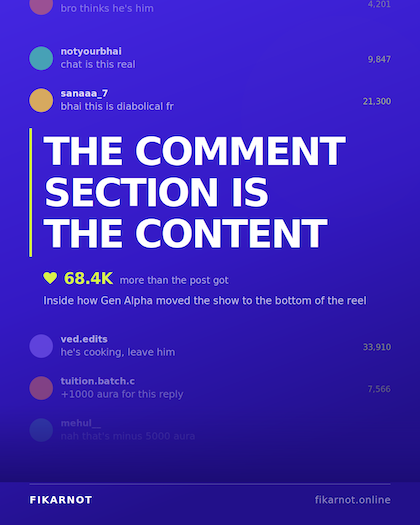
Watch a 13 year old use Instagram sometime. Not from over their shoulder in a judgy way, just observe the sequence. Reel starts. Two seconds in, before the audio has even resolved into a joke, thumb goes up and swipes the comment opens. The reel keeps playing behind a wall of text they are no longer watching.
That's not a shortened attention span. That's a reader skipping the headline to get to the letters page, because the letters page is where the good stuff is.
The post is a prompt, not a product
Millennials treated the caption as the statement and comments as feedback. Gen Z treated the comment section as a place to add a good line. Gen Alpha has gone one further: the post exists to generate a comment section, the way a topic exists to generate a debate.
You can see it in what gets posted. A blurry photo of a classroom fan captioned "he's cooking" is not content in any conventional sense. It's a serve. The value is entirely in what comes back. Meme pages have figured this out and started posting deliberately weak bait, because a great post gets 800 likes and a mediocre post that makes 400 people want to correct it gets 40,000.
The most telling detail is the like counts. Go to a reel with 90k likes and check the top comment. Very often it has 60k, 70k, sometimes more than the post it's attached to. The audience has voted on where the actual content is.
It has grammar, and it's stricter than yours
The standard adult reaction is that this is gibberish. Skibidi, rizz, aura, sigma, Ohio, mewing, chat is this real, bro thinks he's him. It reads like a stroke.
But sit with it for a week and the structure shows up. This is a dialect with real rules, and the rules are enforced brutally.
Everything is scored. Aura is a points system for social competence. You lose 5,000 aura for tripping in the corridor, you gain aura for saying nothing when someone tries to embarrass you. It's a running ledger of composure. That's not nonsense, that's a value system, and it's arguably a more sophisticated one than "cool."
The templates are fixed. "Bro thinks he's X" requires a specific kind of target: someone overreaching. "Chat is this real" is imported from Twitch and marks disbelief performed for an audience that isn't there. "It's giving X" needs X to be a vibe, not a thing. Use a template slightly wrong and you get corrected faster than a grammar teacher would manage.
Sincerity is the one banned move. A straight compliment gets a reply calling it yapping. Anything earnest has to be wrapped in at least two layers of irony to survive. Gen Z invented ironic distance. Gen Alpha inherited it as the default setting and has to work to switch it off.
Words die on contact with adults. The moment a brand account or a teacher or a news anchor uses a term, it becomes evidence of being old. This is why the vocabulary rotates every few months. It isn't fashion. It's a password system that changes whenever it leaks.
The Indian version has its own accent
Under a Mumbai meme page reel, the comment section runs in three languages at once and switches mid sentence. English structure, Hindi verbs, Marathi or Tamil punchline. "Bhai this is diabolical fr."
There's a whole subgenre of cricket edits where the comments are more choreographed than the edit: a call and response the whole section knows, one line each, in order, like a crowd doing a chant. And there's the tuition batch phenomenon, where a comment section under a random reel becomes a group chat for 40 kids from the same coaching class, none of whom know the poster, all of whom are talking about a chemistry test.
The comment section is doing what the maidan and the building compound used to do. It's the unsupervised place where you find out who's funny.
What it's actually teaching
Here's the part worth taking seriously, and it cuts both ways.
Positively: this is a comedy workshop with instant feedback and an enormous audience. Kids are learning timing, register, callback structure, how to read a room, and how to write tight. A good comment is nine words. That's real skill and most adults writing captions can't do it.
Negatively: they are learning it in public, in front of strangers, with a permanent record and a visible score.
A joke that lands gets 12,000 likes and a rush that nothing at school can match. A joke that misses gets ratioed, which means a reply pile of people dunking on you, and there is no version of that which a 12 year old is emotionally equipped for. The same mechanism that teaches timing also teaches that being wrong in public is a survivable disaster. Some kids get the first lesson. Some get the second one first.
And pile ons scale in a way playground mockery never did. Being laughed at by your class is 30 people. Being ratioed is 4,000, from countries you'll never visit, and it sits there under your name for as long as the post exists.
Not brainrot
Calling it brainrot is the lazy read, and it's mostly a way of saying you don't have the password.
What's actually happening is that a generation is doing its social development in a venue that is public by default, scored by default, and permanent by default. The language is inventive. The community is real. The comedy is often genuinely good.
The thing nobody has solved is that the room where they're learning to be funny is the same room where they learn what a few thousand strangers think of them, and they get both lessons on the same afternoon, in the same thread, usually somewhere around midnight.
The comments are the content. That was always going to be true eventually. It just arrived a bit early for the people it happened to.
If you're a parent reading this and reaching for a ban, that isn't the move either. The comment section is where the friendships are. Ask what got the most likes this week instead. You will not understand the answer, and that's fine, and asking is the entire point.