Why Gen Z Is Quiet Quitting Friendships Too
Why Gen Z Is Quiet Quitting Friendships Too
|


We've all heard of quiet quitting at work, doing the bare minimum and checking out mentally without ever officially quitting. Turns out there's a quieter version happening in friendships too, and barely anyone talks about it. Gen Z is quiet quitting friendships. No big fallout, no fight, just a slow fade. A text that gets read but never answered. A birthday that passes without a call. A group chat that goes silent for months before someone quietly leaves.Why Gen Z Is Quiet Quitting Friendships Too
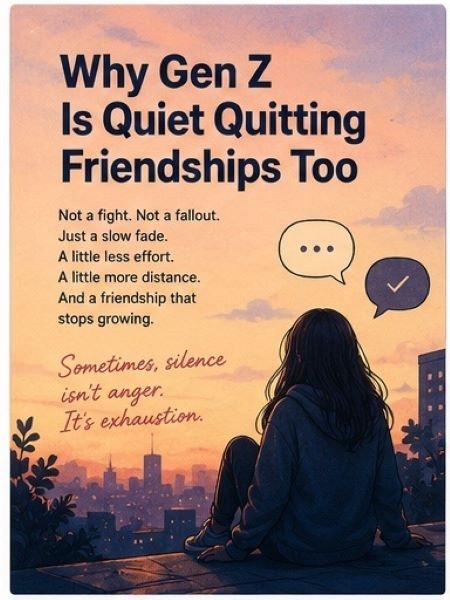
It's not the same as ghosting, which usually happens fast, often after conflict. This is slower. It happens between people who still genuinely like each other but stop putting in effort. The friendships don't end, it just stops growing, kept alive by nostalgia instead of actual care.
Makes sense when you think about what we're dealing with. We're burnt out in ways our parents weren't at our age, between school, job insecurity, and constant social comparison online. There's just not much emotional energy left, and somewhere along the way, keeping up a friendship started feeling like effort instead of relief.
Then there's choice overload. We've got hundreds of loose connections thanks to social media, more people to talk to than ever, but less energy to talk to any of them properly. When you can message fifty people a day, it's weirdly easy to deprioritize the five who actually matter.
Attachment stuff plays into it too. A lot of us grew up watching relationships fall apart around us, parents divorcing, friends drifting after school ends. So some people protect themselves by staying just distant enough that it won't hurt as much if it ends anyway.
And validation has changed. It used to come from consistency, showing up, remembering things, being present during boring ordinary weeks. Now it comes from an audience. Fifty likes on a post can feel more immediate and less risky than a real conversation with a friend who might actually ask how you're doing.
The tricky part is quiet quitting a friendship rarely feels like a decision. Nobody wakes up and decides to stop caring. It's a thousand tiny choices, not replying right away, skipping a call, letting plans get cancelled one time too many. And since nothing dramatic ever happens, there's no clear moment to fix it either.
If there's a way out, it probably starts with naming it. Once you realize you're drifting rather than actually falling out with someone, it gets easier to make one small effort to turn it around. Something as simple as "I miss talking to you" does more than we give it credit for. Most of the time it's not that people stopped caring, they just forgot how much a small effort still means to the person on the other end of the silence.
-MAITRAYEE REPAL