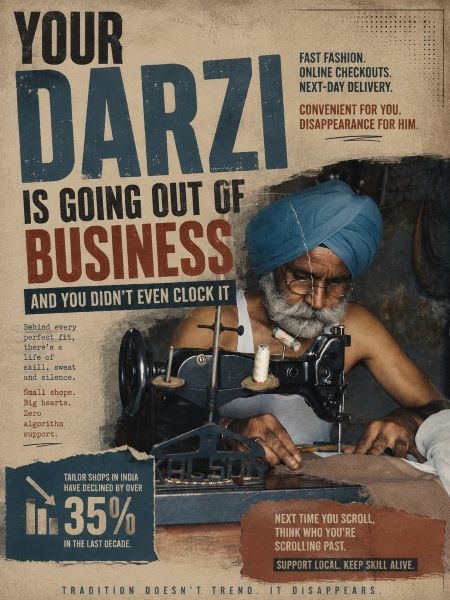
Your Darzi Is Going Out Of Business And You Didn't Even Clock It
Your Darzi Is Going Out Of Business And You Didn"t Even Clock It Somewhere in your neighbourhood a man who can build a shirt from scratch is sitting behind a Usha machine with no work. Meanwhile you"re waiting eleven days for a Myntra order that won"t fit either.
|


Your Darzi Is Going Out Of Business And You Didn't Even Clock It
Somewhere in your neighbourhood a man who can build a shirt from scratch is sitting behind a Usha machine with no work. Meanwhile you're waiting eleven days for a Myntra order that won't fit either.
Try to remember the last time you got something stitched. Not altered. Not "bhaiya thoda le lo." Actually stitched. Fabric bought, measurements taken, a paper chit with numbers on it that only he understood, a delivery date that was a suggestion at best.For a lot of people reading this, the answer is a school uniform. Which means the answer is basically never. That is the whole story. There is no villain, no scandal, no boycott. An entire skilled trade is just quietly evaporating while everyone's attention is on the drop calendar.
A shirt at your neighbourhood tailor costs somewhere around 400 to 700 rupees in stitching alone. Then you buy the fabric, which is another 500 to 900 for anything you would actually want to wear. So you are at 1,200 rupees minimum, plus a trip to the cloth shop, plus a fitting, plus waiting a week. A shirt at Zudio costs 599. It is on the hanger. You can wear it tonight. That is not a close call and nobody should pretend it is. The tailor did not lose because of aesthetics or laziness or Gen Z having no taste. He lost an arithmetic problem to a supply chain that is genuinely, ruthlessly better at getting a shirt onto a body fast.
The catch is what you gave up in the trade. You gave up fit. Every single one of us walks around in clothes cut for an averaged out statistical body that does not exist, and we have collectively decided this is normal. Sleeves slightly too long. Shoulders slightly too wide. Trousers that sit wrong and we blame our bodies instead of the pattern.
Your grandfather never had that problem in his life. Not once. Here is the part that should bother you more than it does. Tailoring in India is not a job, it is an oral tradition. Nobody learned it from a book. It moved from a father to a son, from an ustad to an apprentice who swept the floor for two years before he was allowed near the cutting table. Drafting a pattern from eleven measurements without a template. Knowing that this fabric will shrink and that one will not. Setting a sleeve so the arm actually moves. Building a blouse for a body that will change three times before the wedding. This knowledge lives in hands. It is not written down anywhere. And the transmission chain is snapping. Talk to any tailor over fifty and ask whether his son is learning the trade, and watch the answer. It is almost always no, and almost always said with relief. He has pushed the kid into a diploma, a delivery job, a call centre, anything with a fixed salary and a chair that does not destroy your spine by forty five. You cannot really blame him. He is not protecting a heritage craft. He is running a small business with collapsing margins and no pension. So when this generation of darzis retires, that is it. The skill does not get archived. It just stops.
Meanwhile the exact thing you cannot get cheaply anymore has become the most expensive word in global fashion. Bespoke. Made to measure. Custom fit. Every luxury brand on earth is selling the idea that a garment should be made for one specific person, at prices that would make your tailor faint. The waiting list at a Savile Row house is measured in months and the suit costs more than a used car. India had that on every second street corner. We had a nationwide network of made to order clothing accessible to the middle class, functioning as basic infrastructure, so ordinary that nobody thought it was remarkable. We are now losing it right as the rest of the world decides it is the height of luxury.
Add the sustainability angle if you like, and it holds up. A made to measure garment gets worn because it fits. It gets repaired because you know where to take it. It does not end up in the pile at Panipat that we all know about and never think about. Your tailor was running a circular economy before anyone had the vocabulary for it, and he was doing it out of a ten by ten shop with a calendar from 2011 on the wall.
Nobody is asking you to stop buying fast fashion. That is not a realistic ask and pretending otherwise is how these conversations become useless. But there is a middle path and it is stupidly cheap.
Take the stuff you already own to a tailor. That is it, that is the ask. The 599 rupee shirt that fits everywhere except the shoulders becomes a genuinely good shirt for another 150. Your jeans get hemmed properly instead of rolled. That kurta gets taken in at the sides and suddenly looks intentional instead of borrowed. Alterations are where the thrift flippers already are, by the way. Everyone posting hauls from Sarojini and Fashion Street and pretending it is pure luck... a lot of them have a tailor. That is the actual secret. The clothes did not fit when they bought them either.And if you ever have the money for one custom piece, make it the thing you will keep. A jacket. A good black kurta. A blazer for interviews. One garment that fits you exactly will do more for how you look than six that almost do.
Go past his shop this week. Notice whether it is still there. A lot of them have already become a mobile accessory counter or a juice place or that specific type of shop that sells both Xerox and Maggi. The machine got sold. The paper chits with your family's measurements on them got thrown away, along with the only record of what your father's shoulders were in 1998.Nobody protested. Nobody made a documentary. It just closed on a Tuesday.That is how a skill dies in this country. Not loudly. Just gradually, one retirement at a time, while we all wait for a package that is out for delivery.
Fikarnot. Go get something hemmed.
-Devvangshu Purohit