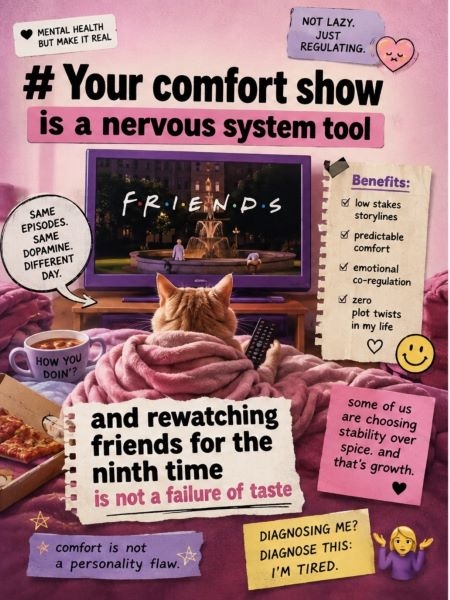
Your comfort show is a nervous system tool and rewatching Friends for the ninth time is not a failure of taste
Your comfort show is a nervous system tool and rewatching Friends for the ninth time is not a failure of taste
|


Your comfort show is a nervous system tool and rewatching Friends for the ninth time is not a failure of taste
You are not watching it. You are dosing it.
Here is what the ninth rewatch actually looks like, and it is nothing like watching. It is 11:40pm, the laptop is at the foot of the bed, the episode is the one with the turkey on the head, and you are on your phone. You are not looking at the screen. You could not tell a court of law what happened in the last four minutes and you do not need to, because you already know, you have always known, you knew before you pressed play. That is the entire point and it is the part that gets misread as laziness. Novelty is work. A new show is a job application. You have to learn eleven names, work out who is lying, hold the timeline, tolerate not knowing whether the dog dies, and your brain has to keep a prediction engine running the whole time on the off chance something matters. The rewatch removes all of that. Zero surprise, zero threat, zero requirement to track anything, and into that gap your nervous system finally gets to stand down.
It is not television. It is a weighted blanket that talks.
And there is real research under this, not just vibes. Psychologists have a thing called the social surrogacy hypothesis, from work by Jaye Derrick and colleagues around 2009, which found that thinking about a favourite show buffered people against loneliness and against the drop in self
esteem that usually follows rejection, in a way that thinking about a show they merely liked did not. The characters function, at the level of the brain doing the processing, a little like people you know. Derrick's later work found something even more specific, that reengaging with familiar fictional worlds seemed to restore depleted self control, meaning the rewatch was not just pleasant but actually replenishing after a day that had taken something out of you. Layer on the ordinary psychology of familiarity, the mere exposure effect, the way fluent easy to process input registers as safe and even mildly pleasurable, and the ninth rewatch stops looking like a hole in your personality. It looks like the single most efficient self regulation tool available to a broke twenty three year old at midnight, costing nothing, requiring no one else to be free, and working within about ninety seconds.
Which is why the taste shaming around this is so tedious and so misdirected. There is an entire genre of person online whose only stated hobby is being annoyed that you have not seen a better show, and the letterboxd four and a half star crowd will tell you that rewatching sitcoms is intellectual bedrotting, and none of it engages with what the thing is being used for. Nobody says this about music. Nobody has ever been mocked for replaying a song they have heard four hundred times, we understand instinctively that repetition is the medium there, not a failure inside it. The show is doing the same job. And you can hold that alongside the honest bit, which is that friends has aged badly in specific places, the fat suit stuff is genuinely rough, the running gag about Chandler's parent is a period piece, and pretending otherwise makes you sound like you have never watched it with your eyes open. Both things sit together fine. You are allowed to know a show is flawed and still use it as a regulation device, in the same way people eat maggi at 1am without submitting a defence of its nutritional profile. Also, the indian version of this exists and gets even less respect, the Sarabhai rewatch, the Hera Pheri scenes you can recite, Taarak Mehta running in the background of an entire household for a decade, and that is the same mechanism with a different accent.
The only place this genuinely turns is when it stops being one tool and becomes the only one, and the tell is not how many times you have rewatched it, it is what it is standing in for. There is a difference between putting it on to come down after a bad shift and putting it on so that you are never once alone in a quiet room with your own head. A surrogate works because it is a surrogate. The moment the show is doing the job of every friend you have not texted back, the loop closes in the same way avoidance always does, comfortably and invisibly. The other small thing worth noticing is the second screen habit, where it plays while you scroll, because that is the one version where you get neither rest nor engagement, just two streams of low grade input competing, and you end up finishing the night vaguely tired and unrefreshed and blaming the show. Put the phone down and it works better, which is a strange sentence to write about something you have already seen nine times, and is also true. Beyond that, there is no problem here to solve. Somebody who watches the same twenty two minutes of nonsense every night to make their heart rate go down has not failed at culture. They have found something that works, for free, in a decade that charges for everything else.
-Maitrayee Repal