₹150 Or ₹800, It's The Same Fade The haircut is identical. You're paying for the mirror, the music, and permission to sitthere.
₹150 Or ₹800, It"s The Same Fade The haircut is identical. You"re paying for the mirror, the music, and permission to sit there.
|


₹150 Or ₹800, It's The Same Fade
The haircut is identical. You're paying for the mirror, the music, and permission to sit
there.
Two chairs, two kilometres apart.
In the first one there's a man who has cut hair for twenty-two years, a tube light, a mirror with a crack in the top corner, a Sunday crowd, a picture of a deity above the shelf, and a comb-and-scissors set that has outlasted three governments. He charges a hundred and fifty. He'll do a skin fade if you ask, and he'll do it well, because a fade is a technique and he learned techniques a long time before Instagram decided to name them.
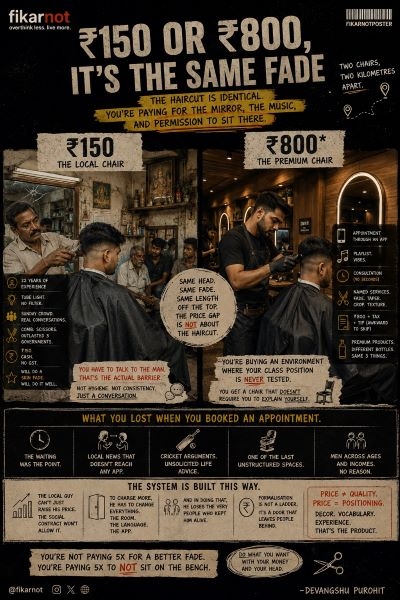
In the second one there's a man of about twenty-six in a black apron, a playlist, wooden panelling, a bottle of something in a matte black container, an appointment booked through an app, and a "consultation" that lasts ninety seconds. Eight hundred, plus tax, plus a tip that the interface makes awkward to skip. Same head. Same fade. Same length off the top. And nobody in this country will say out loud what everyone in this country knows, which is that the price gap is not about the haircut.
It's about the room. That's the whole product. In the eight-hundred chair you are buying an environment in which nothing about your class position is being tested. You get an appointment, which means no waiting on a bench next to strangers. You get English, or the specific register of Hindi that signals you're the kind of person who books appointments. You get a menu with names on it, fade, taper, crop, texture, because naming the thing is what allows it to be priced.
You get a chair that doesn't require you to explain yourself. And in the hundred-and-fifty chair you have to be able to talk to the man. That's the actual barrier, and it's the one nobody admits. You have to know how to say what you want to somebody who isn't performing service at you, in a language you might have let go a bit, in a room where you might be the only person of your background, sitting between an uncle and a kid who's been coming here since he was four. A lot of people who could easily afford either option choose the expensive one specifically to avoid that conversation, and would describe the reason as hygiene, or consistency, or the products.
The products, incidentally, are the same three things in different bottles. What makes this the sharpest class line in Indian daily life is that it's completely invisible in the output. Your shoes announce their price. Your phone announces its price. Your clothes announce whatever they announce. A haircut announces nothing. Nobody can look at the back of your head and tell you what you paid, which means this is one of the rare expenditures that buys you no visible status whatsoever. You are paying purely for the experience of getting it, which is the most honest form of luxury spending there is and also the most quietly revealing. The people who work in these
two rooms are not two different professions, either. Very often they are literally the same profession one generation apart. There are men in premium salons in this city whose fathers cut hair in a lane for a fraction of the price, doing largely the same work with better lighting and a booking system, and the fee difference is not skill. It's positioning. Somebody, somewhere, correctly identified that the barrier to charging more was never the quality of the cut. It was the decor and the vocabulary.
Which is why the local guy usually can't just raise his price. He's tried. The regulars react as though he's insulted them, because the price is part of the social contract at that chair, and moving from one-fifty to two-fifty is treated as a betrayal in a way that eight hundred at the salon never is. He can only raise his price by changing his entire room, buying the panelling, learning the vocabulary, installing the app, and losing every customer who has been coming for eleven years. Formalisation is not a ladder for him. It's a door he can only walk through by leaving people behind. And the version of this you should notice most is the ritual you lost. The old chair was a social institution. You waited. That waiting was the point. You heard the local news that doesn't reach any app, you sat through an argument about a cricket match, somebody's uncle offered an opinion on your future that you didn't ask for, and you left knowing four things about the neighbourhood you didn't know when you walked in. It was one of the last unstructured spaces where men in this country talked to each other across ages and incomes without a reason. The appointment killed the waiting, and the waiting was where all the value was hiding.
None of this is an instruction to go get a cheaper haircut to prove something. Do what you want with your money and your head. The barber near you is good and so is the salon, and both of them are working. Just be precise about the transaction.
You're not paying five times more for a better fade. You're paying five times more to not sit on the bench.
-Devangshu Purohit