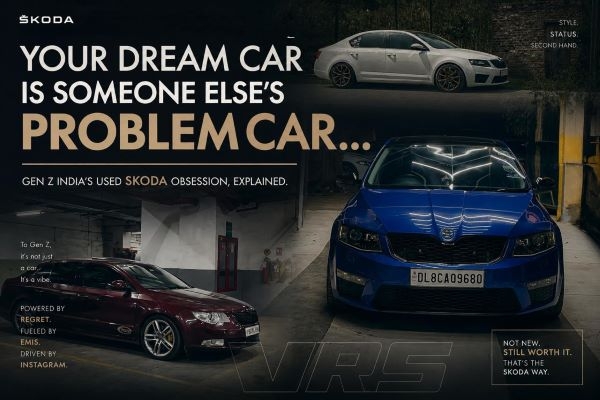
Your Dream Car Is Someone Else's Problem Car...Gen Z India's Used Skoda Obsession, Explained.
Your Dream Car Is Someone Else"s Problem Car... Gen Z India"s Used Skoda Obsession, Explained.
|


Your Dream Car Is Someone Else's Problem Car...
Gen Z India's Used Skoda Obsession, Explained.
Every Gen Z car story in India follows the same arc. Boy or girl get their first real salary, they get tempted by a badge that used to belong to their dad's boss, boy or girl can't afford it new so goes second hand instead, feels like a smart move, signs the papers at 23 feeling like they've made it. Eighteen months later they're doing DSG service math in a WhatsApp group at 1am wondering where the money went, and also wondering what exactly the last owner did to this car before it became theirs.
MONEY-WISE, WHAT YOU'RE ACTUALLY SIGNING UP FOR
The upfront number is never the real number
The EMI calculator shows you one figure. Nobody's calculator shows you the second, third, and fourth numbers... insurance for a driver under 25 priced as pure risk, a service network that's thinner outside metro cities so every visit becomes a whole day off work, parts that cost mass market money's cousin who moved abroad and got expensive, and on a used car specifically, the invisible bill for whatever the previous owner skipped, delayed, or half-fixed before flipping it to you.
Depreciation doesn't care about your feelings
A car you stretched your entire savings for loses a third of its value in the first few years, no matter how many detailing sessions it gets. Buying second hand feels like you're dodging that depreciation curve, someone else already ate the worst of it, except the used price often hides how much of the car's remaining life it already burned through. You're not avoiding the depreciation trap, you're just inheriting it one owner late.
"Affordable maintenance" is a moving target, and a used car makes it worse
The Octavia has a reputation for being the sensible European choice... reasonably good after-sales, decent reliability on the petrol variants, a badge that reads smart rather than showy. But that reputation was built on full service history and consistent upkeep. A used Octavia bought off a listing with a patchy or missing service record is a completely different bet, and at 23, on one salary, with no backup, you rarely have the budget to absorb what a stranger's neglect left behind.
THE OCTAVIA AND THE SUPERB: TWO VERSIONS OF THE SAME TRAP
The Octavia is the one everyone recommends as the smart Gen Z German car, and almost always the smart version of that advice is "buy it used, it's cheaper that way." Which is true on the sticker price, until the DSG gearbox needs attention or the electricals throw a tantrum that the local mechanic can diagnose but not actually fix, sending you straight to a dealership service centre with dealership pricing. Every used-buying guide for the Octavia says the same thing in different words, this car is only as good as its service history, and a nervous 23 year old buying their first import badge rarely has the experience to actually verify that history properly before signing.
Now take the Superb, the one-rung-up dream car, almost never bought new by anyone under 25 because the on-road price simply doesn't match a first or second salary. It shows up second hand
instead, 4-5 years old, priced like it's a steal because it rides like something a class above its price. That's exactly the problem. It's priced like an executive sedan but budgeted for like a slightly nicer hatchback, and now it's also someone else's several-year-old car with several years of wear you didn't witness. The maintenance cost studies on the Superb consistently put it as the costliest in its segment to keep running even when it's new and well cared for. Add unknown history on top and the bills stop being predictable at all.
Then there's the Octavia vRS, the version people buy with their heart instead of their spreadsheet, and almost exclusively second hand because new vRS pricing puts it out of reach for most young buyers entirely. It's genuinely thrilling, and also explicitly flagged by every used-buying guide as the variant with the highest running costs and the highest risk of a previous owner who drove it hard, because that's the whole point of the car, someone bought it to be driven hard. A used vRS is a used performance car, which means you're not just buying an engine, you're buying somebody else's track day decisions.
THE POLO MOD CULTURE PIPELINE
Before any of this, there was the Polo. Cheapest entry into the VAG badge, and almost always the used entry point too, a 6-8 year old Polo bought cheap specifically because it's cheap enough to leave room in the budget for mods. For a decade it's been the unofficial canvas of young car culture in India, the remap, the coilovers, the exhaust note, the alloy upgrade, the whole modding subculture that treats a used hatchback like a personality project. And here's the part that never makes it into the reel... you often don't even know what the car's original owner did to it before you got it, let alone what you're about to do to it yourself. Every modification voids or
complicates your warranty, if any warranty was even left on a car that old. Every remap that adds power also adds wear nobody's tracking, on an engine that's already done a decade of somebody else's driving.
The Polo mod scene is genuinely fun, genuinely a real community, and genuinely a financial blind spot layered on top of another financial blind spot. The used car that cost 4-5 lakh quietly becomes a 8-9 lakh project car through a dozen small upgrades that each felt reasonable in the moment, on a base that was already halfway through its useful life when you bought it. None of it comes back to you at resale. You're not building equity, you're building a hobby that happens to have wheels, on a foundation someone else already used up half of.
THE ACTUAL DISASTER, SPELLED OUT
It's never one big moment. Nobody wakes up and realises the dream car ruined them. It's a slow leak. It's the EMI that was comfortable on the old salary and tight on the current one. It's the service bill that was "not that bad" three times in a row until it wasn't. It's the used car listing that said "single owner, full service history" and turned out to mean neither. It's the resale value check you do eighteen months in, purely out of curiosity, that ruins your whole week. It's explaining to yourself why the car that was supposed to represent arrival is the reason you can't save for
anything else.
The badge still works, to be clear. People still look. The Superb still rides like a small 5 Series, the vRS still pulls like it means it, the modded Polo still sounds incredible outside a café at 8pm. None of that is fake. What's fake is the idea that buying it second hand made the flex free. It's financed, it's serviced, it's insured, and it's carrying somebody else's history, and at 23, on one salary, with no safety net, it's usually financed by a version of you that hasn't met the version of you paying for it in year three.
-Devangshu Purohit