New Sansad Bhavan: Soul of Bharat
Why India’s New Parliament is Total Main-Character Energy ✨


Hey guys, welcome back to the feed! ✨ Today we are diving deep into some major main-character energy for our nation. 🇮🇳
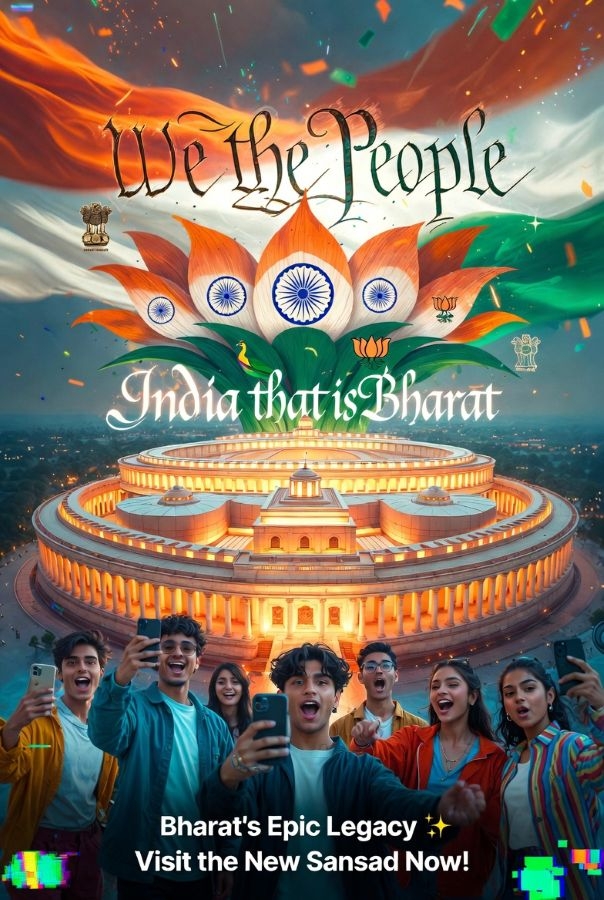
So, pop quiz: Did you actually know that the Constitution of India—aka our Samvidhan—isn’t printed or typed at all? No copy-paste here! It is 100% handwritten and calligraphed in both Hindi and English. It was penned by the legendary Sh. Prem Behari Narain Raizada and published by him straight out of Dehradun. And the aesthetics? Totally immaculate. Every single page was decorated by Shantiniketan artists, including Beohar Rammanohar Sinha and Nandalal Bose. It literally took 2 years, 11 months, and 18 days of pure dedication to finish the final draft. 🤯
Our Samvidhan is officially the largest in the world, serving as the supreme law and foundational document that governs India, establishing a sovereign, socialist, secular, and democratic republic. It was adopted on November 26, 1949, and went live on January 26, 1950. It outlines the entire structure, powers, and duties of the government, alongside our fundamental rights and duties as citizens. As of 2019, it includes over 470 Articles and 12 Schedules! 📜
Also, let’s talk about the opening phrase of Article 1: "India, that is Bharat". This officially establishes both names for the Union of States. While "India" is the internationally recognized name, "Bharat" is deeply rooted in Puranic literature. Both names are legally and commonly used, especially with government institutions using Hindi variants like "Bharatiya". Honestly, it really highlights the importance of reclaiming our indigenous name, "Bharat," over the colonial-era name "India." 🙌
Now, quick civics check: Parliament is the supreme legislative body in a democracy, functioning primarily to create laws, control government finances, and oversee the executive branch. So, needless to say, I was so keen to see the new building. I finally visited the new Sansad Bhavan last year!
The Old Parliament was constructed way back in 1927 and was starting to incur super high maintenance costs. So, in 2019, the government launched the Central Vista Redevelopment Project. It was designed by the brilliant architect Bimal Patel for the firm HCP Design, Planning and Management, and the construction contract was awarded by the Central Public Works Department to Tata Projects. 🏗️
Let me tell you, everything about the new premises is fiercely Bharatiya. It features three main gates named Gyan Dwar, Shakti Dwar, and Karma Dwar. Plus, the building has six grand entrances guarded by statues on both sides: Gaja, Ashva, Garuda, Makara, Shardula, and Hamsa. 🦁🦅
The design is a total vibe—the three sections of the building are based on India's national symbols: the banyan tree, the peacock, and the lotus. The beautiful play of colors in these rooms and the craft gallery are absolutely amazing. If a foreigner wants a quick, breathtaking feel of what Bharat has to offer in terms of culture and heritage, this is it. 🎨✨
But what moved me the most? Seeing the Sengol. It was installed following Tamil Hindu traditions, after being handed over by the Adheenams (Shaivite priests) to Modi ji. (Note: The mural of Akhand Bharat showing Nepal and Afghanistan as part of India did gather a lot of criticism online, but I will not tell you more about that here! 😉)
You seriously need to plan a visit ASAP! Here is the blueprint to get your pass:
💻 Apply via the Darshan Public Portal or Digital Sansad website.
👔 Pro-tip: A recommendation from a Member of Parliament (MP) or a gazetted officer can totally facilitate the process.
🪪 A valid photo ID is mandatory.
🚫 Strict rule: Electronic gadgets (phones, cameras), bags, and pens are not allowed inside, so prepare to disconnect and just soak in the history!
Who's adding this to their travel bucket list? Let me know in the comments! 👇