How Gen Z Uses Dating Apps Differently
How Gen Z Uses Dating Apps Differently


How Gen Z Uses Dating Apps Differently
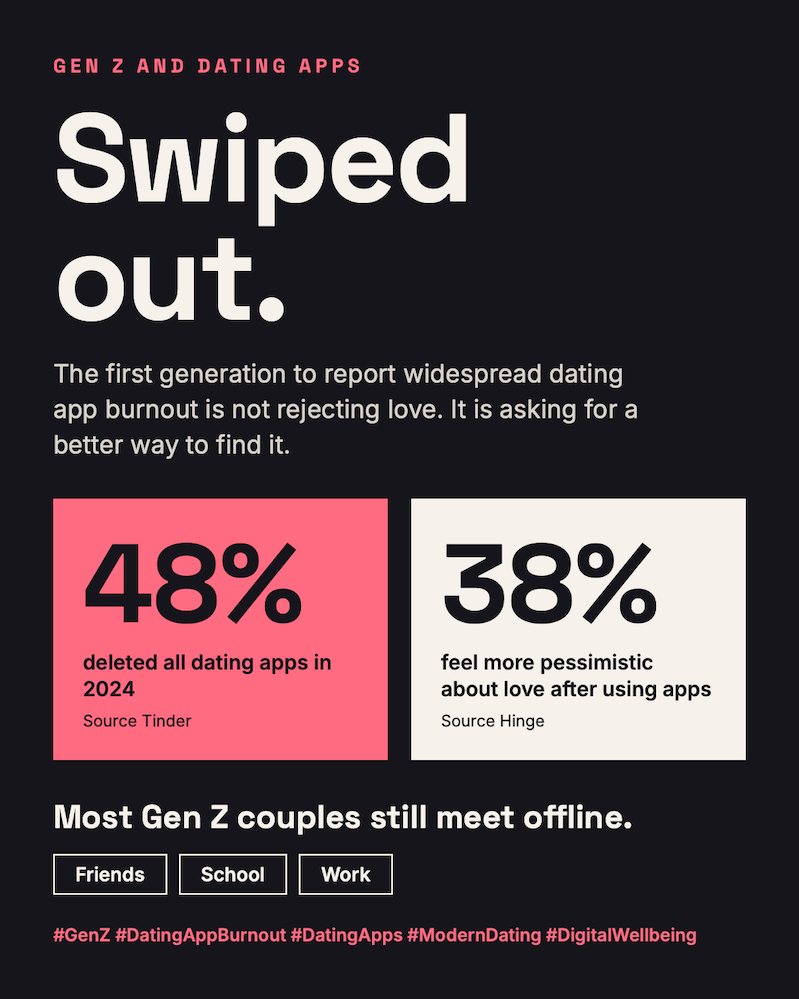
Gen Z grew up with a phone in hand and a screen between them and almost everything else. So it would be natural to assume this generation would take to dating apps more eagerly than any before it. The reality looks very different. Gen Z is the first generation to report widespread dating app burnout and the numbers tell a story that few app makers wanted to hear.
According to Tinder 48 percent of Gen Z users deleted all their dating apps in 2024. Hinge data shows that 38 percent of its Gen Z users feel more pessimistic about love after using the platform. These are not small signals. They suggest that the very tools built to help young people find connection are leaving many of them feeling worse than when they started.
Using apps with caution rather than hope
Older generations tended to treat dating apps as a thrilling new door to open. Gen Z treats them more like a tool that needs careful handling. Many young users open an app for a short stretch then close it again and take long breaks. Deleting and reinstalling has become a routine rather than a dramatic act. People step away when the experience starts to feel heavy and return only when they have the energy.
This pattern points to something deeper. Endless swiping can feel like a job. Every profile asks for a decision and every match asks for a message and every conversation can fade without warning. Over time that constant evaluation wears people down. Psychologists often describe this as choice overload where too many options make each option feel less valuable and the whole process feel less satisfying.
Pessimism is part of the story
The Hinge finding about pessimism deserves attention. Feeling more doubtful about love after using an app is a sign that the experience shapes how people see relationships themselves. Ghosting and mismatched intentions and low effort chats can build a quiet belief that people are disposable. When a young person meets that belief again and again it can seep into how they view real romance.
Gen Z is also very open about this. They talk about burnout online and with friends. They share screenshots and laugh about awkward matches and warn each other about red flags. This openness is a healthy shift. Speaking honestly about how apps feel helps people avoid blaming themselves when things go wrong.
Apps as a social space
Many Gen Z users do not treat an app as a place where a relationship must begin. Some use it to meet new people in a new city. Others use it to explore their identity or to find friendship. Swiping has even turned into a group activity where friends gather around one phone or share profiles in a group chat. This turns a lonely task into a shared one and softens the sting of rejection.
Offline still wins
Perhaps the most striking fact is that most Gen Z couples still meet offline. They meet through friends or at school or at work. Apps may grab the headlines but real life still does the heavy lifting. Shared spaces give people context. A friend can vouch for someone. A classroom or office gives two people repeated chances to see each other in natural settings. Trust builds slowly and without the pressure of a profile.
This matters because it shows what young people actually value. They want ease and familiarity and a sense of safety. They want to know who someone is beyond a few photos and a short bio. Apps struggle to offer that depth while social circles offer it by default.
Intentional use and new expectations
When Gen Z does use apps they often bring clear expectations. Many state what they want right in their profile. Some want something serious and others want friendship or something casual. This honesty cuts down on wasted time. Authenticity matters too. Polished photos and clever lines matter less than a profile that feels real and relaxed.
Safety also plays a larger role. Young users tend to move conversations to video calls before meeting in person. They tell friends where they are going. They pay attention to mental health and step back when an app begins to harm their mood.
What this means for the future
The message for app makers is plain. Design that rewards endless scrolling will keep losing trust. Features that encourage meaningful conversation and slower pacing and real world connection will fit better with what this generation wants. Some platforms have already begun to move in that direction with group events and friend recommendations and verification tools.
For young people the lesson is balanced. Apps can still be useful but they work best as one option among many. Friends and hobbies and campus life and work all remain strong paths to love.
Gen Z is not rejecting connection. It is asking for a better way to find it. The burnout is a form of feedback and the preference for offline meeting is a reminder that people still want to be known in person.
Maitrayee repal