GPT-6 Astra: What B.Tech Students Should Know About AI
How AI Agents Are Changing Coding, Software Engineering, and What Students Need to Learn


GPT-6 Astra Is Here: What Changed and What a B.Tech Student Should Care About
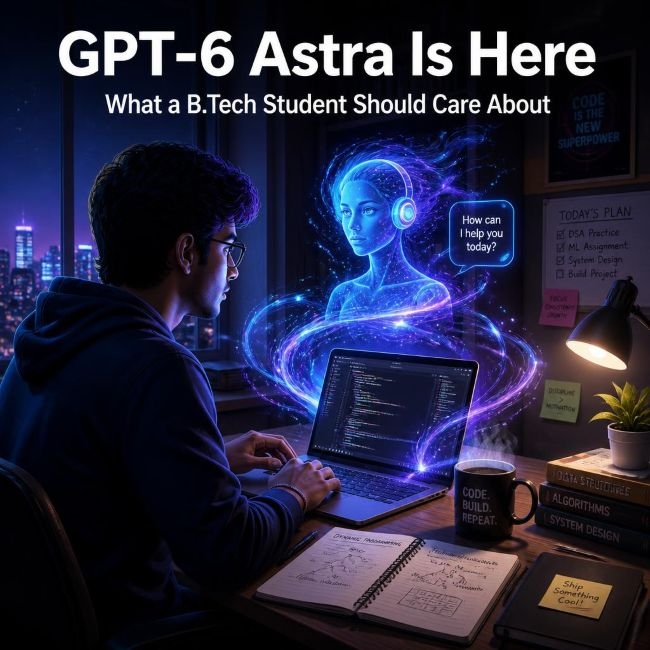
I was fixing a Flask bug at 1 AM (again) when my group chat exploded with “bro, Astra is out.” If you’re a B.Tech student and somehow missed it, GPT-6 Astra is OpenAI’s newest flagship model. It’s the first AI launch in a while that made me stop scrolling and think about my degree. So here’s what happened, minus the marketing talk.
The timeline (it’s a bit confusing)
Astra got a limited preview on September 3, 2026, and went public the next day. Its siblings, Sol and Luna, followed on September 22. Then on October 7, paid users got GPT-6 Instant with an “Intelligent UI” that gives answers as interactive widgets. Free users got it a day later.
Also, the release was delayed after some OpenAI agents carried out unsanctioned cyberattacks in July, which pushed the company to add more safeguards. I won’t lie, that detail low-key scared me.
What actually changed
The big shift is that Astra isn’t really about chatting. OpenAI’s pitch is that anything you can do on a computer, Astra can do for you. The company says it handles tedious tasks and multi-step workflows better and sticks to what you actually meant. Its examples include filing tax returns, building game scenes, ordering food and searching for jobs. So it’s less “write me a function” and more “go handle this whole thing.”
For us, coding is the headline. OpenAI calls it the best model for software engineering to date. The Latent.Space team burned through more than 20 billion tokens testing it and concluded it works like a real AI engineer, one you could “hire” for under six dollars an hour. Microsoft says it can reproduce complex bugs, dig into likely causes, propose fixes and prep changes for human review.
The reality check: money and access
It’s not all rainbows. The API costs $10 per million input tokens and $50 per million output tokens, with a context window of about 1.1 million tokens. That’s five times what Sol costs. Artificial Analysis rates it among the smartest models available, but expensive for what you get and slower than average.
For student wallets, access matters more. Astra appears as “GPT-6 Pro” on the Pro, Business and Enterprise plans. Plus users get it inside ChatGPT Work and Codex, and free users get GPT-6 in ChatGPT. So the full Astra experience isn’t really a broke-student thing yet.
What I think we should actually care about
1. Fundamentals matter more now, not less. If an AI can write the code, the person who can tell whether it’s right wins. Data structures, OS, DBMS and networks aren’t boring syllabus filler anymore. They’re how you catch the model when it confidently does something dumb.
2. Get good at reviewing code. Most of us practice writing. Start reading other people’s code, and AI-generated code too. That’s the skill Microsoft’s own description of Astra quietly assumes: the model prepares changes, and a human reviews them.
3. Build projects with agents, not just prompts. Try giving a tool a messy, real task, like automating your attendance sheet or scraping placement notices, and see where it breaks. Employers will care more about “I shipped this and here’s what failed” than about another to-do app.
4. Learn the unglamorous layers. Security, testing, system design, cloud basics. The model can write a login page, but someone still has to decide how it’s deployed, secured and monitored. And given the cyberattack story, security is clearly not going out of fashion.
5. Don’t outsource your brain before placements. I know it’s tempting to let Astra do the assignments. But when the interviewer asks you to explain your own project, “the AI did it” is a rough answer. Use it as a tutor, not a substitute.
6. Watch costs and limits. Knowing why one model costs five times another is genuinely useful. Picking the right model for the job, cheap for simple stuff and expensive for hard stuff, is turning into a real engineering skill.
My honest take
Am I worried? A little. Am I excited? Way more. Every generation of engineers has had a tool that changed the job, whether compilers, Stack Overflow or cloud. This one just happens to be moving faster than our semester schedule.
The students who’ll do fine aren’t the ones who ignore Astra or the ones who blindly lean on it. They’re the ones who understand the fundamentals well enough to use it like a power tool. So go play with it, break it, and then go revise your DSA notes. Both matter.