Paying for a Date Is Not Consent, and More Men Need to Hear This
Paying for a Date Is Not Consent, and More Men Need to Hear This


Paying for a Date Is Not Consent, and More Men Need to Hear This
There is a very specific kind of tension that shows up at the end of a first date, when a guy pays for two coffees worth maybe four hundred rupees total, and somehow acts like that transaction came with terms and conditions attached. A hand that lingers too long. A disappointed tone when plans end at the door. A comment dressed up as a joke about "at least a hug." It is such a small amount of money to suddenly carry so much unspoken expectation.
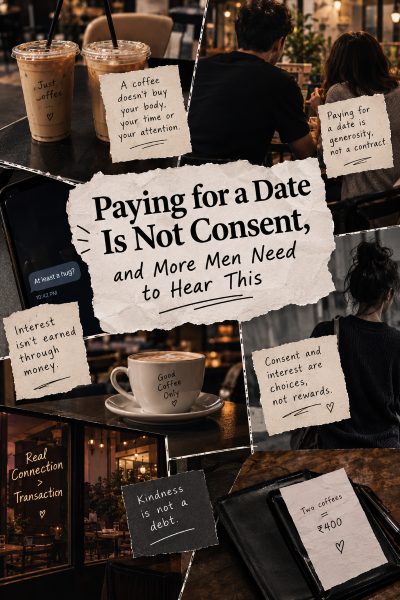
This entitlement is not really about the coffee at all, it is about a quietly outdated idea that paying for a date is some kind of investment that is supposed to produce a return. Somewhere along the way, generosity got confused with a transaction, as if spending money automatically earns access to someone else's body, attention, or time beyond what was actually agreed to walking in. A date is two people spending time together to see if there is a connection, not a purchase with expected delivery.
The uncomfortable part is how normalized this entitlement still is in a lot of dating culture, even among people who would never openly admit to thinking this way. It shows up subtly, in a sudden change of mood when a date does not go where someone hoped, in comments like "I came all this way" or "I spent money on you" said half jokingly but clearly meant to apply pressure, in the quiet assumption that kindness or interest shown during a date is owed back in a specific physical form. None of that is romance, that is a man keeping score and feeling entitled to collect.
Here is something worth sitting with. If affection, attention or intimacy only happens because someone feels obligated after being paid for, that is not actually connection, it is compliance dressed up as chemistry. And if a man's interest or mood visibly shifts the moment he realizes a date will not end with physical intimacy, that was never really about the coffee, it reveals exactly how conditional his interest actually was the whole time.
This also puts an unfair pressure on women specifically, who often end up managing a man's ego on top of everything else a first date already requires navigating. Being polite enough not to "lead someone on," while also being firm enough to protect personal boundaries, all while worrying that saying no clearly might trigger an entitled reaction instead of simple acceptance. That mental load is exhausting, and it is a direct result of an expectation that should have never existed in the first place.
Paying for a date is not a bad thing by any means, generosity and kindness on a date can be lovely when it comes with zero strings attached. The actual problem starts the moment money becomes a silent IOU instead of just a nice gesture. Real respect looks like being genuinely fine with however the night ends, without guilt tripping, sulking, or quietly treating someone colder because they did not give back what was never promised to begin with.
At the end of the day, consent and interest are not things that get earned through spending money, they are things that are freely given or they are not given at all. A coffee buys exactly one thing, a cup of coffee. Anything beyond that was always supposed to be a choice, not a transaction, and anyone who cannot accept that was never really paying for a date, he was paying for an outcome, and that is exactly the kind of entitlement worth calling out instead of quietly tolerating.