Mental Health Deserves Attention Every Day, Not Just on October 10
Mental Health Deserves Attention Every Day, Not Just on October 10


Mental Health Deserves Attention Every Day, Not Just on October 10
Every year, around the second week of October, your feed turns green. Ribbons, quotes, soft pastel graphics, captions about how it is okay not to be okay. Friends who never mention their feelings suddenly post a long paragraph about self care. And then, a day later, everything goes back to normal. Deadlines, doomscrolling, "I'm fine" on repeat. If you have noticed that pattern, you are not being cynical. You are being observant.
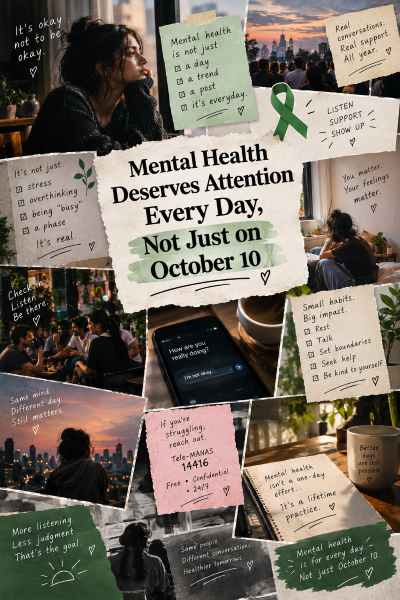
World Mental Health Day has been marked every 10 October since 1992, and this year's theme is about listening to people with lived experience, letting the ones who have actually been through it shape the conversation instead of being talked about from the outside. That idea is worth keeping long after the day is over, because lived experience does not have a calendar. Someone is having a hard week on 11 October too, and on a random Tuesday in March.
Be honest, how many times have you said "I'm just tired" when what you really meant was "I'm not okay." Most of us have a whole vocabulary of excuses we use to avoid saying the real thing. Busy. Stressed. Overthinking. Just a phase. These small, harmless words become a wall, and the wall gets thicker the longer we keep adding bricks. The scary part is that nobody sees it from the outside, because the person behind it is usually the one who keeps showing up, replying to texts and meeting deadlines.
That is why mental health cannot be treated like a once a year event. It is closer to sleep or hydration. You do not get to fix it in a single day of attention and then forget about it. It is built through ordinary, boring habits. Telling one friend the real answer when they ask how you are. Taking a proper break before you hit burnout instead of after. Noticing when scrolling stops being rest and starts being numbing. Asking for help with the thing you are struggling with, even when it feels small.
It also means making space for other people. A lot of us, especially in Indian households, grew up in homes where feelings were not really discussed. Not because anyone did not care, but because nobody had the words, or the time, or the permission. Gen Z and Gen Alpha are the first generations to openly name anxiety, burnout and overwhelm, and that matters. But naming it is only the first step. The real shift happens when we listen without rushing to fix, judge or compare. Sometimes the most useful thing you can say to someone is simply that you believe them.
Here is a small question to sit with today. If your best friend said they were struggling, you would drop everything to listen. Would you give yourself the same treatment. For many of us, the honest answer is no, and that gap is where a lot of quiet suffering lives.
Awareness days are good for starting conversations, but they were never meant to be the whole effort. What matters is the unglamorous part that happens the rest of the year, the check in texts, the longer pauses, the decision to not call someone dramatic when they finally open up. If this day gave you the push to start one of those conversations, keep going tomorrow, and the day after that.
If things feel heavy for you right now, talking to someone you trust or a trained professional can really help. In India, Tele-MANAS offers free, confidential mental health support on 14416. You do not need to wait for a special day to reach out.