The chocolate, Belgium Couldn’t Deliver - and the War India Never Chose
The chocolate, Belgium Couldn’t Deliver - and the War India Never Chose
|


The chocolate, Belgium Couldn’t Deliver — and the War India Never Chose
-Pulse Desk
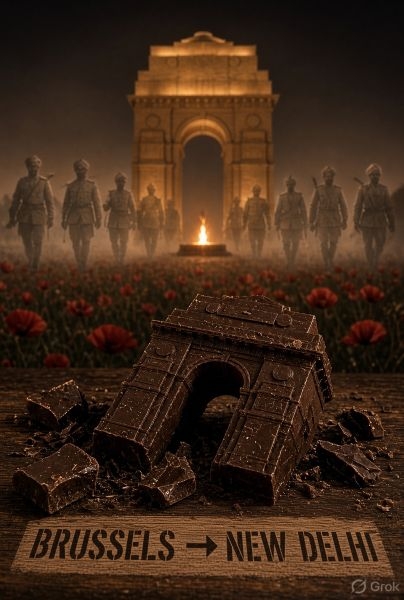
The chocolate 'India Gate' never made it to Delhi. Belgium’s Prime Minister had planned to hand Narendra Modi a sculpture of the monument — carved entirely from Belgian chocolate — as a quiet nod to the Indian soldiers who once froze, drowned, and died in the mud of Flanders Fields. The gift melted somewhere in transit. The history didn’t.Here’s the part your school curriculum chose not to teach you.
One of them was Sepoy Khudadad Khan of the 129th Baluchis. When his machine-gun team was wiped out, he kept firing until he was wounded and the position overrun. He became the first Indian soldier to win the Victoria Cross. Others weren’t so lucky. The 47th Sikhs landed with 764 men. A few weeks later they had 385 fit for duty. At the Second Battle of Ypres in April 1915 they met something new: chlorine gas. Green-yellow clouds that burned lungs and eyes. Indian units still counter-attacked. Jemadar Mir Dast dragged eight wounded men to safety while half-blind himself. Another VC.
Roughly 130,000 Indian soldiers served on the Western Front. Around 9,000 never came home from France and Belgium. Their names sit on the Menin Gate in Ypres and on India Gate in Delhi. The monument the chocolate was trying to copy lists more than 13,000 names and stands in for the 70,000-plus from undivided India who died in the First World War.
Now the part that doesn’t fit the parade-ground version.
The Indian Army was officially a volunteer force. There was no legal conscription. That is true. It is also incomplete. Early on, many signed up for pay, land grants, or because the village headman said so. By 1917–18 the quotas got brutal. District officers and local elites were given targets. Irrigation water was cut to villages that didn’t deliver sons. Recruits were bought and sold. Men were “chalaned” (charged with petty offences) and the charges dropped if they enlisted. Some families paid others to go in their place. In Punjab — which supplied more than half the overseas troops — the pressure was systematic. Historians now describe the later phase as coercion dressed up as volunteering.
India also paid. The colonial government sent cash, grain, jute, animals, and the entire cost of keeping its own troops abroad. After the war the promised political rewards arrived as the Rowlatt Act and Jallianwala Bagh.
Twenty years later it happened again. In 1939 the Viceroy declared war on Germany without asking a single Indian political leader. This time 2.5 million men served — the largest volunteer army in history on paper. Same colony, same distance, same lack of consent.
So when Belgium tried to send a chocolate India Gate in 2026, it wasn’t just a cute diplomatic flex. It was a small European country acknowledging that Indian peasants once held a stretch of their soil when the German army was trying to break through to the Channel. The sculpture didn’t survive the journey. The names on the real India Gate did.
Next time someone posts a “forgotten history” reel, remember the men who went from dusty villages to Flanders poppy fields because an empire needed bodies and a chocolate gift, a century later, tried to say thank you. The thank-you still arrived. The chocolate just took the L.