Everyone Is Drinking Matcha. Almost Nobody Is Drinking Matcha.
Everyone Is Drinking Matcha. Almost Nobody Is Drinking Matcha.


Everyone Is Drinking Matcha. Almost Nobody Is Drinking Matcha.
How an 800-year-old Zen ritual became a global status drink and what got lost in the grind.
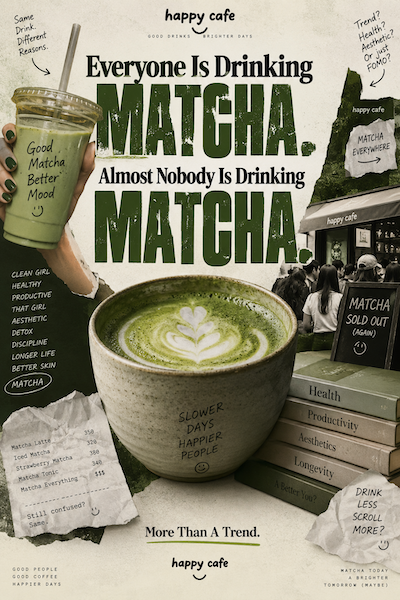
There is a specific green that has colonised your feed. Not olive, not lime. A dense, chlorophyll-loud green that photographs like it was rendered rather than poured, sitting in a clear glass over a gradient of oat milk. You know the one. You have probably paid ₹380 for it.
Matcha has completed one of the fastest cultural migrations in modern food history: from monastery to café counter, from a whisked bowl of bitter meditation to a customisable, syrup-forward, algorithm-optimised lifestyle signal. Both of those things are matcha. Only one of them is matcha culture.
What you are actually drinking
Start with the agriculture, because the culture is downstream of it.
Ordinary green tea is a leaf you steep and discard. Matcha is a leaf you consume entirely. To get there, farmers shade the tea bushes for roughly three to four weeks before harvest, starving them of light. The plant panics, floods its leaves with chlorophyll and amino acids particularly L-theanine, the compound responsible for matcha's savoury depth and its famously unjittery caffeine and produces a leaf called tencha.
Tencha is steamed, dried, de-stemmed, de-veined, and then ground on granite mills that turn slowly enough not to scorch the powder. A stone mill produces around 30–40 grams an hour. Not kilos. Grams.
That single fact explains almost everything about matcha's current crisis. It is a product with a fixed, medieval production ceiling meeting a demand curve shaped by short-form video.
The ritual that came first
Powdered tea arrived in Japan with the Zen monk Eisai in the late twelfth century, imported from Song-dynasty China, where the practice would eventually die out. Japan kept it and made it architecture.
By the sixteenth century, the tea master Sen no Rikyū had stripped the practice down to something close to philosophy. Chanoyu the way of tea is not a beverage service. It is a choreographed encounter governed by two ideas worth stealing.
Ichi-go ichi-e: one time, one meeting. This gathering, these people, this light through this window, will never recur. Behave accordingly.
Wabi-sabi: the preference for the worn, asymmetric, and imperfect over the polished and new. A cracked bowl repaired with lacquer is worth more than a flawless one, because it has a history.
The tea room itself was designed as a rebuke to status. The entrance the nijiriguchi was built deliberately low, so that samurai, merchants and lords all had to remove their swords and crawl in on their knees. Inside, everyone was equal, and everyone was slow.
Hold that image next to a drive-thru matcha with strawberry cold foam. Not to sneer. Just to notice the distance travelled.
The three American booms
Here is the part that punctures the idea that matcha's popularity is a 2025 invention: this is the third time Western demand has broken Japan's supply.
In 1996, Häagen-Dazs launched a green tea ice cream and drained the market. In 2001, Starbucks put a green tea latte on the menu and did it again. Each time, Japanese producers scrambled, expanded, and normalised.
The current shortage which began in late 2024 and is still running is the largest of the three, and the first that industry bodies have called a genuine, structural matcha shortage rather than a spike. It is specifically a shortage of tencha, the shade-grown leaf used for ceremonial grade, and not a shortage of Japanese green tea in general over the same period, Japan's broader green tea exports actually rose.
The numbers are brutal in a very particular way. Tencha auction prices in 2026 reached roughly ¥10,843 per kilogram about double the 2025 level while traded volume fell around 10%. Kyoto lots opened near ¥8,235/kg and ran up to about ¥13,972/kg, with Kagoshima reaching roughly ¥19,000/kg. Farmers are converting sencha fields to tencha because tencha now pays, which means the shortage is quietly spreading into everyday Japanese tea too.
And the supply cannot simply respond. Demand rose roughly eightfold in five years; a tea bush takes about five years to reach full production, and tencha is grown well by only a few hundred farmers. Record heatwaves during the 2024 and 2025 spring shading windows caused yield declines of around 40% in the highest-grade Uji tencha, and the surge exhausted the reserve stocks producers traditionally blend in to stabilise quality.
Climate change, an ageing farming population, and a fifteen-second video format are now in the same supply chain.
Then it came for India
India did not import matcha gradually. It imported it all at once, through a screen.
Search interest for matcha in India has grown nearly fourfold over five years, driven largely by Gen Z and social virality. The Indian matcha market generated around $41.9 million in 2024 and is projected to reach $96.4 million by 2033, with homegrown brands moving past trend-led launches to source ceremonial-grade powder directly from Japan a sign of a more origin-aware consumer.
That last detail matters more than the growth rate. The first wave of any imported food trend is performance. The second wave is literacy people learning to distinguish Uji from Kagoshima, first harvest from second, ceremonial from culinary. India is somewhere in the handover between the two.
The appeal is not mysterious, and it is not only aesthetic. Matcha offers a slower caffeine release than coffee, fewer jitters, and a deliberately unhurried mode of consumption that prioritises process as much as effect. For a generation that has been told its whole life that it is overstimulated, a drink that requires you to stand at a counter and whisk something for ninety seconds is not a beverage. It is a small, defensible argument about how to live.
The counterfeit problem
Scarcity plus hype produces fraud with total reliability.
Products branded as "Uji matcha" or "Japanese-style matcha" are increasingly appearing with no actual connection to Japan, meaning labels alone are no longer a reliable indicator of origin. Inside Japan itself, there have been cases of powdered sencha being sold as matcha outright. In Western markets, culinary-grade matcha is routinely relabelled and sold as ceremonial.
If you want to actually evaluate what you are buying: look for a named prefecture and harvest rather than a vague "Japanese origin"; expect first-harvest ceremonial grade to be genuinely expensive right now, because it is; be suspicious of dull, yellowish-khaki powder, which usually means late harvest, stems, or oxidation; and treat aggressive sweetening on a café menu as a hint that the base is not worth tasting.
What survives
The easy take is that matcha has been ruined that a sacred practice has been flattened into content, and the tea rooms of Uji are owed an apology by every person who has ever ordered a blueberry matcha.
That take is lazy, and it is also ahistorical. Tea has been a commodity, a status object and a geopolitical instrument for most of its existence. Rikyū's austere aesthetic was itself a reaction against an earlier era of flashy, competitive, imported-porcelain tea culture. Purity was never the starting condition. It was always the correction.
What is worth defending is smaller and more portable than authenticity. It is the part of the ritual that actually transfers: that you made the thing yourself, that it took a minute, that the minute was the point.
You do not need a tatami room or a four-hundred-year-old bowl. You need to notice that you are drinking something. In an economy engineered to make you consume without noticing, that is not a small thing to have inherited.
The green is doing very well. The pause is what needs protecting.
-Maitrayee Repal-