Are We Busy, or Just Afraid to Slow Down?
Why are our calendars getting fuller while our minds rarely feel finished?


Are We Busy, or Just Afraid to Slow Down?
Why are our calendars getting fuller while our minds rarely feel finished?
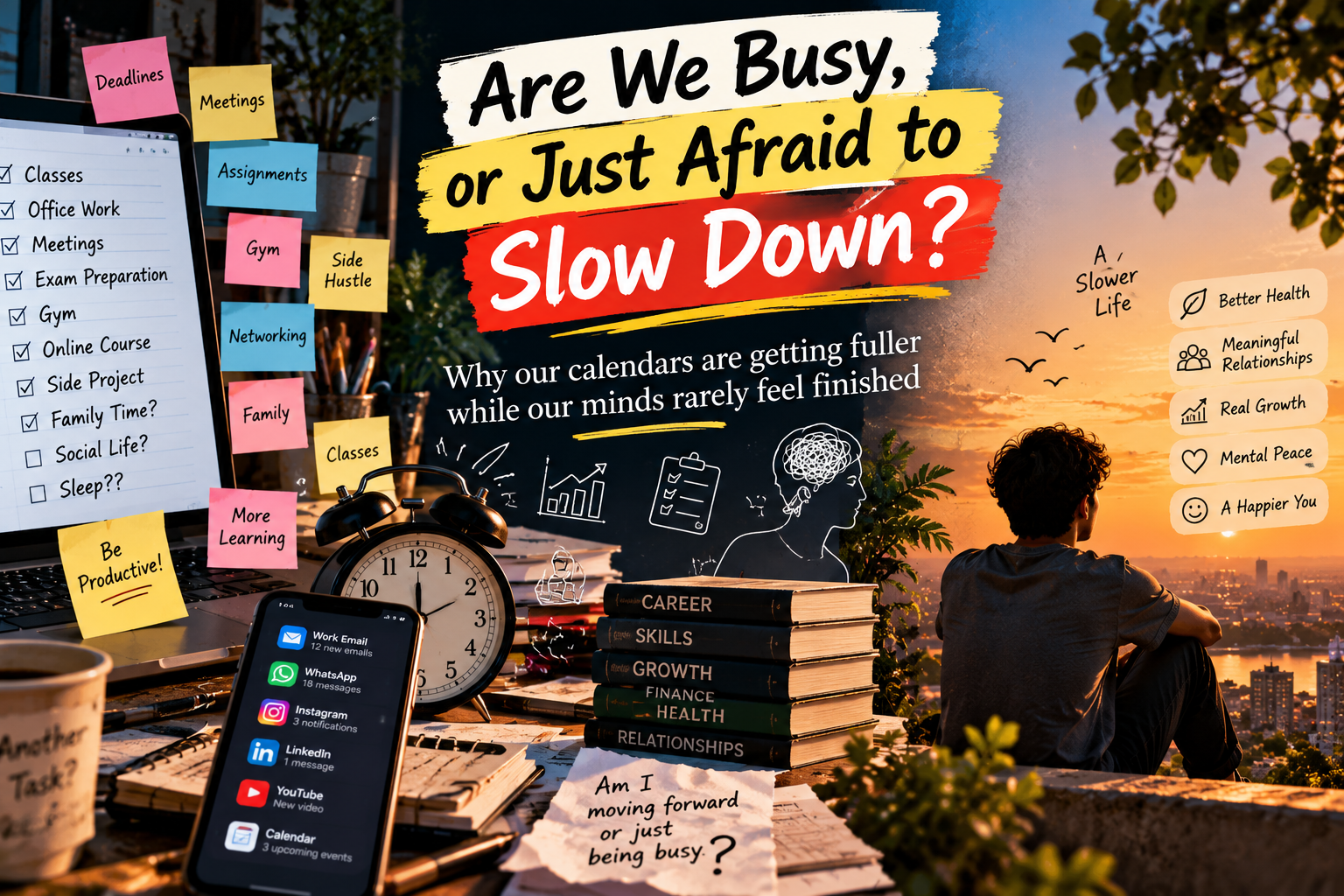
Different lives. Same sentence: “I’m busy.” And somewhere along the way, being busy stopped being just a description of our schedule. It started sounding like proof that our life is important. Think about a Sunday. You wake up thinking, Aaj thoda rest karunga. Then you clean your room, reply to WhatsApp messages, finish pending work, order groceries, attend a webinar, go to the gym, and perhaps meet a friend. By Sunday night, you are tired enough to need another Sunday.
Rest ka plan bhi ek task ban gaya hai.
But why?
When did having nothing to do become something we feel guilty about?
Look at a college student preparing for competitive exams. After six hours of classes, they attend a two-hour coaching session, solve mock tests, watch a YouTube lecture on current affairs, and then feel guilty because they didn't study for another hour.
Now look at a 35-year-old working parent. After a full day at work, there is dinner, children's homework, household work, messages from the office, and planning for tomorrow. Technically, the person has “left work.” But mentally, work hasn't left them. And then there is the retired parent who says, “Mala khup kaam aahe” because there are medicines to pick up, grandchildren to help, social commitments, errands, and household responsibilities.
Being busy is not a problem. It is becoming a lifestyle. And social media has added another layer. Earlier, people could work hard without displaying it. Today, even productivity has become content.
“5 AM routine.”
“Day in my life.”
“Study with me.”
“Another certification completed.”
“Gym done.”
“Building my business.”
You open Instagram or LinkedIn on an ordinary Tuesday and see ten people doing something impressive. Someone got promoted. Someone started a business. Someone is travelling. Someone completed a course. Someone is preparing for UPSC. Someone is running a marathon. And suddenly you think: “Everyone is moving. Main kya kar raha hoon?”
That is where FOMO enters. Sometimes we don't add another task because we genuinely want it. We add it because we don't want to feel left behind. But there is an important distinction here. Ambition isn't the problem. Learning isn't the problem. Hard work isn't the problem.
The problem begins when “I want to achieve more” quietly becomes “I must constantly be doing more.” Recent Deloitte research shows this tension particularly clearly among India's Gen Z and millennials. In its 2026 India survey of 806 respondents, 96% of Gen Z respondents said they were interested in senior leadership roles, but only 9% identified leadership as their primary career goal. Work-life balance and financial independence remained among their top priorities. That tells us something interesting: young people aren't necessarily rejecting ambition.
They are asking: “How much of my life should ambition take?” And this isn't only about jobs.
India's latest Time Use Survey also reminds us that “work” is much bigger than office hours. In 2024, women aged 15–59 who participated in unpaid domestic services spent about 305 minutes a day on them, roughly five hours. Women participating in caregiving spent around 140 minutes a day, compared with 74 minutes for participating men. So when someone says, “I have nothing planned today,” we should remember that an empty calendar doesn't necessarily mean an easy life. Sometimes the work is simply invisible. Maybe that's why we need to rethink our relationship with busyness. A packed calendar can make us feel productive. But movement is not always progress. You can spend twelve hours checking things off a list and still have no idea where you're going. And sometimes an hour spent drinking tea with your parents, playing with your child, walking without headphones, reading a book, or simply staring out of the window may look “unproductive” on a calendar but feel far more meaningful in real life.
So perhaps the question isn't: “How busy are you?” Maybe it should be:
“What are you actually busy building?”
Because doing more isn't always the same as moving forward.
Maybe it's simply time that belongs to you.