The SNEAKER Drop Is a Slot Machine
The SNEAKER Drop Is a Slot Machine


The SNEAKER Drop Is a Slot Machine
There is a specific face people make at 11:59 on a drop day. Thumb hovering, four tabs open, one on the payment page and one on a resale listing that doesn't exist yet. You know the face. You have made the face.
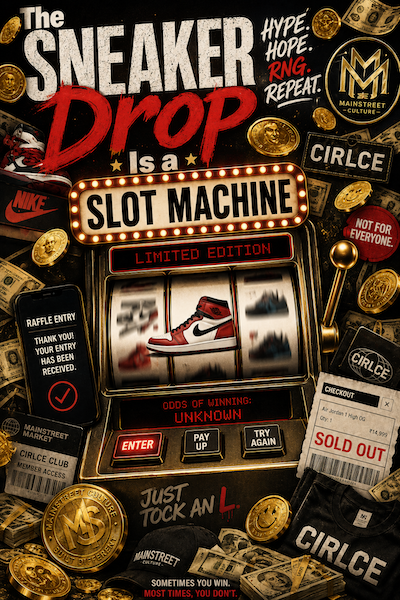
It is the same face people make watching a wheel spin.
For about a decade, sneaker culture in India ran on a promise that made that face feel rational: get in at retail, get out above it. Sneaker resale in India was the side hustle every hypebeast understood. Cop the hype drop, flip the pair on StockX, GOAT or an Instagram reseller, pocket the spread. Buy the pair, take the photo, or take the profit. Somewhere in the last eighteen months that promise quietly stopped clearing. The hype drops are still landing. The resale profit is not.
The flip economy already collapsed
The number that ended the era is boring. In 2020, roughly 58% of sneaker releases traded above retail on the secondary market. By 2026 that is down to about 47%. Buy two pairs to flip and one of them, statistically, is a loss before you have opened the box.
Then the fees arrive. StockX and GOAT take somewhere between 9% and 13% depending on your seller tier, more if you are new. Add shipping. A general-release Jordan that costs about ₹18,000 landed needs to sell for meaningfully more than that just to break even, and most GRs are now sitting on resale apps at or below what people paid. eBay actually cut its sneaker fee to 8% this year, which tells you exactly how hard platforms are fighting over a shrinking pool of flippers.
Nike understood the arbitrage and killed it the obvious way: it made more shoes. Supply went up, the resale premium went down, and the number of people trying to flip went up at the same time. Classic squeeze from both ends. GOAT Group launched Sneakers.com in March, a discount channel for exactly the kind of inventory that used to be scarce enough to be an asset. When the company that built its brand on rare product opens a clearance door, the thesis is over.
The market itself is fine. Resale volume is still growing, still projected to roughly triple by 2030, still dominated by Gen Z and millennials. What died is one specific thing: the belief that a shoe is a trade.
So where did the gambling go?
It did not go anywhere. It got repackaged as shopping.
Open Instagram tonight and count the formats: the mystery box, the ₹499 "guaranteed hit" wheel, the blind box, the raffle that costs money to enter, the TCG pack break streamed live, the Labubu pull filmed in a car with the caption pray for me. Every one of these is the same machine wearing a different outfit. You pay a fixed amount. A randomiser runs. You get either the grail or the filler.
The industry is honest about the economics when it thinks you are not the audience. Independent testing of sneaker mystery box operators in 2026 put realised value at roughly 38% to 58% of what buyers paid, with sell-back on won items landing around 60-75% of listed value. The house edge is 40-60%. That is worse than most casino tables. And hype-themed boxes — the ones biased toward Travis Scott and Off-White outcomes — actually pay out worse than generic boxes, because expensive top-end inventory forces the operator to lower the hit rate and pad the bottom with junk. You are not paying for expected value. You are paying for the two seconds before the reveal.
Blind boxes work the identical way with better art direction. Pop Mart built a company valued in the tens of billions on a secret-figure pull rate of about 1 in 72. That number is not random. It is tuned. Far enough away to feel special, close enough to feel possible.
Behavioural scientists have a phrase for this and it is worth learning: variable ratio reinforcement. A fixed reward closes the loop — you buy, you receive, you are done. A variable reward keeps it open forever, because the next one could be the one. Research on loot boxes and card packs consistently links them to gambling-adjacent behaviour, and the "near miss" — pulling the right character in the wrong colourway — lights up the same circuits as an almost-win on a slot.
The toys are cute. The mechanism is not.
The Indian bit, which is where it gets sharp
India spent 2025 and 2026 doing something unusually decisive about gambling. The Promotion and Regulation of Online Gaming Act got presidential assent in August 2025, the rules kicked in on 1 May 2026, and the effect is close to total: every online money game is banned. Not games of chance. Every game where you pay a stake expecting to win money, explicitly regardless of whether it is skill, chance, or both. Rummy, poker, paid fantasy. Gone. Up to three years' imprisonment and a fine up to ₹1 crore for operating one. Banks are barred from processing the transactions. The Supreme Court upheld the 28% GST on the sector in May.
The stated reason was youth protection, against a backdrop of estimates that Indians were losing something like $2.3 billion a year on wagers.
Now hold that next to your feed.
The law shut the front door. The reward loop it was written to interrupt is currently running, unregulated, inside e-commerce. A ₹2,000 sneaker mystery box with a published 50% expected value is not an online money game under the Act, because you paid for a product and you received a product. That framing is the entire legal shield, and operators know it precisely — the moment a platform lets you convert a win into cash or crypto instead of shipping it, regulators elsewhere have treated it as a casino. Ship the shoes and you are a retailer. Pay out the money and you are not.
So the arbitrage has moved from the shoe to the statute.
Meanwhile the underlying Indian scene is genuinely, expensively hyped. A standard Nike or Adidas lifestyle pair runs ₹10,000 to ₹20,000. Limited drops hit lakhs on resale. The Louis Vuitton Air Force 1 sits somewhere near ₹9 lakh. Retail allocation here is tiny, which manufactures scarcity even on releases that sit on shelves in the US, which is why the Indian resale premium held up longer than the global one, and why paid raffles and Instagram reseller DMs still feel like the only way in. Scarcity plus a young market plus no regulatory attention is a very good environment for a randomiser.
The taste era is the actual escape route
Here is the genuinely good news, and it is not a lecture.
Hypebeast, as an identity, is basically finished. The signal that used to be worth something — I got the pair you couldn't — stopped being scarce and therefore stopped being interesting. Search behaviour on resale platforms shows people actively looking for ASICS, Salomon, Anta, New Balance, Mizuno, rather than defaulting to Jordan and Dunk. Sustainability and secondhand are now bigger stated drivers than speculation. Homegrown labels like Comet and Gully Labs are doing Hindi lettering and taash prints and building something that isn't a copy of a copy of American mall culture from 2003.
That shift matters because it removes the thing the gamble was feeding on. If your fit only works when the shoe is rare, you are dependent on a system that has to keep you rolling. If it works because you chose well, you are out.
Nobody needs to be told to stop buying things. That has never once worked. What actually works is seeing the structure: the wheel, the near-miss, the padded filler tier, the credit that can only be spent on more spins. Once you can name the loop, it loses most of its grip. The 2 AM listing check, the third box, the "one more pull and I'll stop" — those are not character flaws. They are a designed response to a designed system, and the design is not on your side.
Buy the shoes you want. Pay the price on the tag. Let somebody else find out what's in the box.
If spending on boxes, raffles or spins is starting to feel difficult to control, that is a common and treatable pattern, not a personality trait. Talking to someone — a friend, a counsellor, a helpline — is a reasonable first move.