India Is Building Chips. Gen Z Should Not Sleep on This
Sand to Silicon to Flex: India’s Chip Glow-Up, Explained
|


India Is Building Chips. Gen Z Should Not Sleep on This
- Pulse Desk
Union Minister Ashwini Vaishnaw dropped a video titled “The chip journey, simplified.” and honestly? It should be mandatory viewing. Not a press conference. Not jargon soup. Just a minister sitting with a shiny wafer, a packaged chip and a value-chain chart, explaining how the thing that runs your phone, your metro card and your AI app is actually made.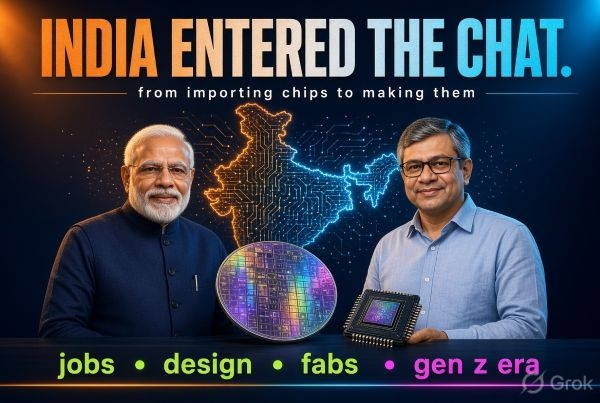
Here’s the tea in human language.
It starts with sand. Ordinary-looking silica-rich sand. That sand is melted and purified into a silicon ingot — basically a giant crystal log. That log is sliced into ultra-thin discs called wafers. Think potato wafers, except these are thinner than a pen tip and cost a fortune to make perfectly clean.
Then the magic: circuits get drawn onto that wafer. Vaishnaw’s analogy is chef’s kiss. Imagine writing your name on a fingernail. Now imagine writing every classmate’s name. Now imagine putting entire Class 10 textbooks on that same fingernail. That is the precision of chip fabrication. About 40–50 layers get stacked on that wafer, like a 40-storey building compressed into something you can balance on a finger. Individual chips are then cut out, given a body, wired, tested and packed. That last stretch is ATMP — assembly, testing, marking and packaging. From there, the chip becomes a memory module, a phone brain, a car controller, an AI accelerator. Sand → ingot → wafer → fabricated wafer → chip → product. That’s the whole pipeline.
India used to sit at the consumer end of that pipeline. We bought phones. We imported chips. We designed some chips for global firms, sure, but we didn’t own the factory floor.
That is changing.
Under the India Semiconductor Mission, the government has approved 12 units with about $20 billion in investment. Three plants — Micron, Kaynes and CG Power — have already started commercial production in 2026. Tata’s giant fab in Dholera and a packaging plant in Assam are part of the same wave. Then came Semicon 2.0: a ₹1.27 lakh crore push not just for factories, but for the full ecosystem — chip design, equipment, materials, advanced packaging, research and talent. The aim is bigger than “one fab photo-op.” It is design-to-packaging-to-export. Electronics is already India’s third-largest export category. The next target is climbing further up that list.
Why this matters for the economy is simple. Chips are industrial oxygen. Cars, defence, 5G, EVs, data centres, railways, medical devices — everything drinks chips. If India only imports them, every global shock hits our factories and our prices. If India makes, packages and designs them, money stays home, supply chains get safer, and exports get fatter. Semicon 2.0 is targeting investments in the ₹4 lakh crore range, production around ₹2 lakh crore and exports around ₹1 lakh crore. That is not vibes. That is industrial policy with a spreadsheet.
Now the Gen Z chapter, because this is not just a “grown-ups in Gujarat” story.
India already trained 85,000 semiconductor engineers ahead of schedule. The new target is another one lakh, with design programmes spreading to hundreds of universities, including Tier-2 and Tier-3 campuses. Global chip firms are short of people. India is building the bench. For us, that means careers beyond generic coding: VLSI design, verification, analog/RF, packaging, process engineering, materials, EDA tools, quality, and fab operations. Startups under the Design Linked Incentive scheme are already getting support. Students from Assam to Puducherry to Dhanbad have designed chips. Direct jobs from the ecosystem are projected in the tens of thousands, with a much larger ripple in suppliers, testing labs and electronics manufacturing.
Give credit where it is due. Prime Minister Narendra Modi’s call to think 20 years ahead — not one election cycle — is the reason this is being treated as nation-building, not a pilot project. And Ashwini Vaishnaw, who also handles Information & Broadcasting plus Electronics and IT, is doing something rare: explaining hard industry like a teacher who actually wants you to get it. No cap, that communication style is a flex. A country that can teach its youth how a wafer becomes a chip is a country that is done being just a market.
India is not Taiwan overnight. Advanced 7nm-to-3nm work is still an eight-year climb. But the journey has started, plants are humming, and Gen Z finally has a front-row seat in a sector that will decide who owns the next decade of tech. That’s not a slogan. That’s the assignment.