Clarity Is Just Confusion That Got Resolved
Clarity Is Just Confusion That Got Resolved


Clarity Is Just Confusion That Got Resolved
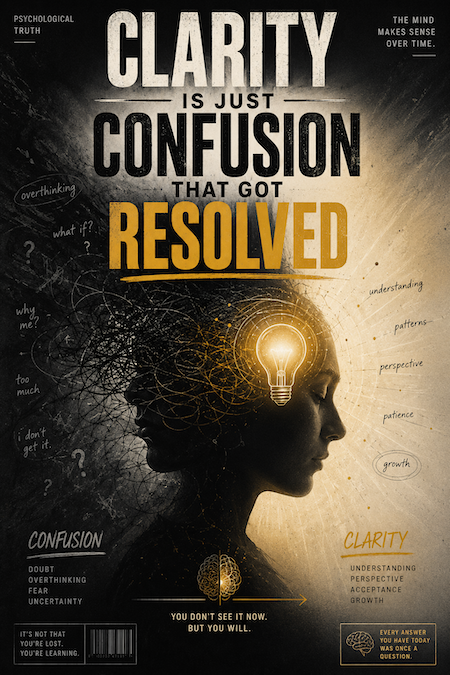
You are roughly four seconds away from not being confused anymore. One tab. One paste. One prompt.
Everything interesting about how you will think for the next ten years is packed into what you do in those four seconds.
Confusion is a job, not a symptom
Most of us were raised to treat confusion as evidence of failure. Indian classrooms are especially efficient at this. Confusion means you didn't revise, didn't attend, didn't get it. The kid who asks the second follow-up question is holding up the syllabus. Clarity is the product, and it arrives pre-packaged from a teacher, a coaching notes PDF, or a playlist at 1.5x.
The learning sciences say almost the opposite.
Confusion shows up in the research as a state of cognitive disequilibrium. Your existing mental model just got contradicted by something and it can no longer hold. What that does, mechanically, is force you to stop, deliberate, hunt for the mismatch, and rebuild the model. That work is the learning. Not the moment afterwards where it clicks. The grinding bit before.
In studies of students working through hard material, confusion turns up as one of the most frequently recorded emotional states, more common than most of the things we assume dominate studying. It isn't an interruption of the process. It substantially is the process.
The version that doesn't work
Anyone who has stared at a compiler error for two hours and learned nothing except that they hate computers already knows the obvious objection. So here is the distinction that matters, and it is the whole article.
Researchers separate productive confusion from unproductive confusion, and the difference is resolution.
In one classic tutoring study, learners hit 62 impasses and only picked up the underlying principle in 33 of them. Roughly half the confusion went nowhere. When the disequilibrium never resolves, you don't get insight, you get frustration, then disengagement, then a slow belief that you are not a maths person or not a systems person or not built for this.
Confusion that resolves builds understanding. Confusion that persists builds an identity. Choose your resolution window deliberately.
So the goal is not to suffer more. The goal is to be stuck on purpose, with an exit.
Being wrong first, on purpose
There's a body of work on exactly this, and its most-cited researcher is Manu Kapur, now at ETH Zurich. His name for the design is productive failure.
The setup is counterintuitive. Instead of teaching students the correct method and then giving them problems, you hand them the hard problem first, before they have the tools. They flail. They generate solutions that are incomplete or plainly wrong. They burn through their existing knowledge and hit its edge. Only then does the instruction arrive.
Across classroom and controlled studies, those students end up with deeper conceptual understanding than students who were taught the clean method up front. The retention gap is the striking part. In one replication, the productive-failure group's scores actually ticked slightly upward two months later, while the directly-instructed groups dropped by around a fifth.
The reason is not mystical. When you struggle first, you build a personal map of where the problem is hard and why your instinct fails. The correct method then lands in a slot that already exists. When you're handed the method cold, there is no slot. There is a screenshot.
Failing first also raises the cost of the failure, which is why nobody enjoys the design while it's happening. Kapur's students consistently feel like they are learning less. They are not.
What 2026 changed
Here is the tension nobody at your college is going to frame honestly, so we will.
The four-second gap between confusion and clarity has been closed. Not narrowed. Closed. Search results answer themselves before you click anything. Every assignment, every error message, every reading has a fluent, confident, immediately available explanation attached to it.
The evidence on what that does is arriving, and it is mixed in an interesting way rather than a comforting one.
A randomised trial published last year had two groups learn the same material, one with a chatbot and one with traditional methods, then tested retention over 45 days. The traditional group scored about 11 percent higher, roughly a grade band, and their scores clustered tighter at the top. EEG work out of MIT's Media Lab found lower cognitive engagement in students writing with AI assistance than in those using search or nothing at all. The International AI Safety Report this year flagged cognitive offloading directly, citing a study in which clinicians' ability to spot tumours without AI support fell about 6 percent three months after the tool was introduced.
And a recurring finding across this literature: people using AI produce better outputs while overestimating how much they understand. The artefact improves. The person's read on their own competence detaches from reality.
That is not a story about AI being bad. It's a story about the confusion being outsourced along with the task.
The honest counterargument
Being fair here matters, because the doom version of this is lazy and Gen Z has heard it about every technology since the calculator.
Reduced cognitive load is not automatically a loss. It's what a tool is for. Nobody thinks less of an engineer for not doing long division by hand. Some cognitive work genuinely deserves to be offloaded so attention can go somewhere harder. Researchers who study this also find that AI literacy acts as a protective factor: people who understand what the tool is doing, and who evaluate its output rather than accept it, show a much weaker dependency effect.
The finding isn't "don't use it." The finding is that where you place the confusion determines what you keep.
The actual technique
None of this cashes out as "struggle more, it builds character." That's just unproductive confusion with better branding. What it cashes out as is a few small, unglamorous habits.
Form a wrong answer before you ask for the right one. Even a bad one. Ten minutes, a guess written down, a hypothesis about the bug. That's the slot. Without it the answer has nothing to attach to.
Ask for the question, not the answer. "What am I misunderstanding here" produces a different brain ste tan "fix this." One resolves your confusion. The other removes it and takes the model with it.
Give confusion a deadline, not an eviction notice. Twenty minutes on the error, thirty on the proof. When the timer goes, ask. You have then been productively confused rather than romantically stuck.
Test the clarity later, cold. Close everything. Explain the thing to a friend or a wall. Clarity you actually own survives the tab being closed. Clarity you borrowed doesn't, and you would genuinely rather find that out in your room than in a viva or a technical round.
Notice which confusions you're avoiding. There's a difference between the confusion of a hard concept and the confusion of not having read the material. Only one of them is worth sitting in.
The point
Clarity and confusion aren't opponents. They're the same process at two different timestamps. Every clean explanation you've ever admired is somebody else's confusion, resolved, written down after the fact with the flailing edited out.
The uncomfortable middle stretch, where you can feel the shape of a thing without being able to say it, is not a sign that you're behind. It's the only place understanding has ever been manufactured.
Stay there slightly longer than is comfortable. Then ask.