-connected-but-still-alone
We have never had so many ways to talk. So why does real communication feel so difficult?


Connected, But Still Alone
We have never had so many ways to talk. So why does real communication feel so difficult?
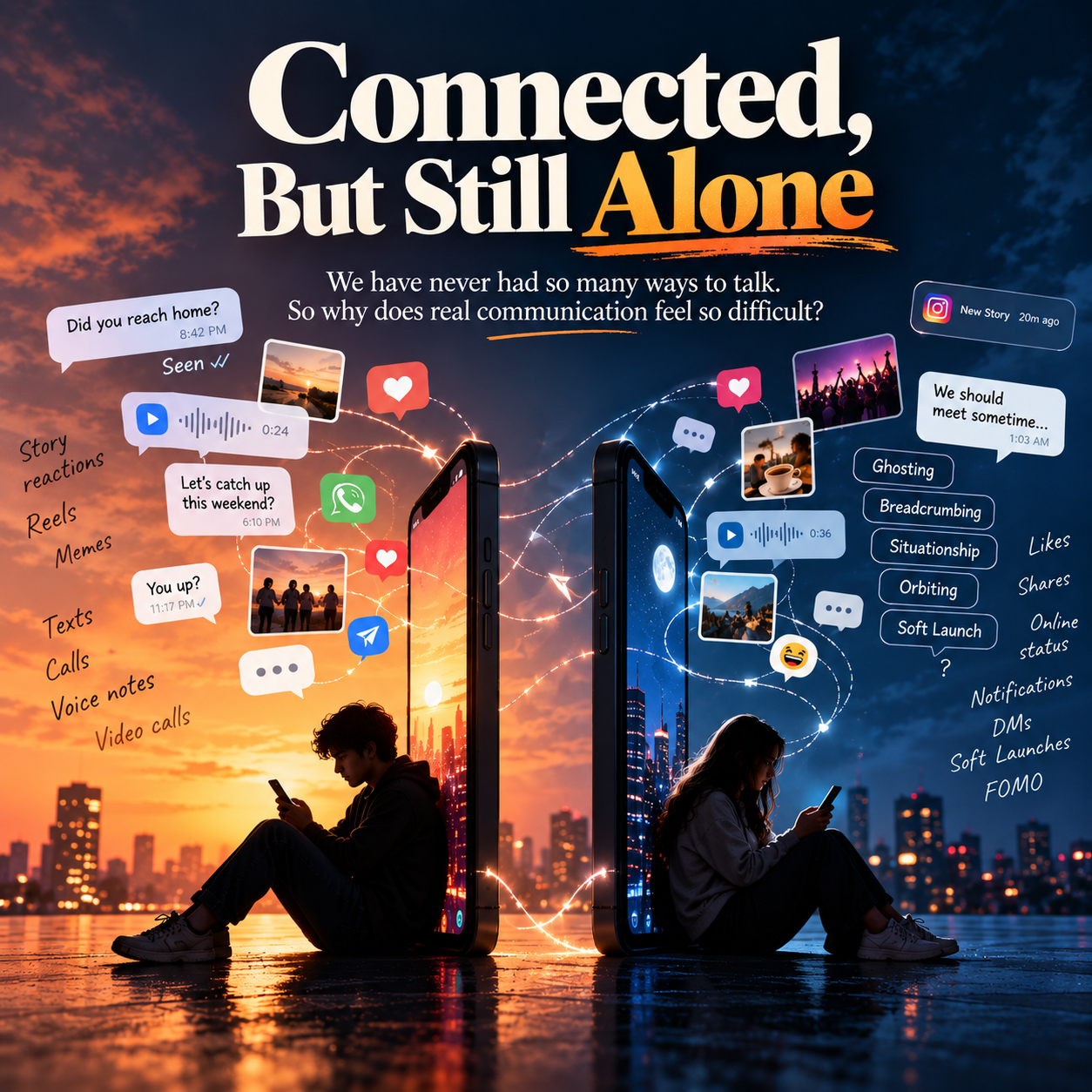
“Did you reach home?”
Seen.
No reply.
Twenty minutes later, they upload an Instagram story.
You watch it. They know you watched it. Still, nobody says anything. Communication? Technically, yes. Conversation? Not really. .
This is the strange part of relationships today. We have never had so many ways to reach someone. Texts, voice notes, calls, video calls, story reactions, reels, memes, emojis, GIFs, and yet sometimes saying the simplest thing feels incredibly difficult.
“I don't feel the same way.”
“I think we should stop this.”
“What exactly are we?”
Bas, itna bolna bhi complicated ho gaya hai.
And somewhere along the way, we have developed an entire vocabulary to describe the confusion.
He stopped replying but continues watching your stories.
Ghosting? Breadcrumbing? Orbiting?
You behave like a couple, talk every day, but nobody wants to define what the relationship actually is.
Situationship.
You are dating someone but don't officially announce it. A carefully selected photo appears on Instagram, perhaps showing a hand, a coffee cup, or two silhouettes.
Soft launch.
Gen Z now has words for relationship behaviours that earlier generations may have experienced without such neat labels. Recent Indian Express reporting notes that psychologists see this expanding vocabulary less as evidence that young people are necessarily more confused, and more as an attempt to find language for complicated emotional experiences.
And honestly, these words can be useful.
If someone says, “I think I'm being breadcrumbed,” they may finally have a way to describe something that has been bothering them.
But here's the interesting question:
Are these words helping us communicate or helping us avoid communicating?
Imagine this conversation:
“Guys, I think I'm being breadcrumbed.”
“Really? What did he say?”
“He replied after three days.”
“Then why don't you ask him what he wants?”
“Arre, no. Let me see what happens.”
And there it is.
We can identify the behaviour, analyse the screenshots, consult three friends, and probably watch seven reels explaining it, but still avoid asking the person involved:
“What do you actually want from this relationship?”
A recent Indian Express article makes a similar point: a label can describe a relationship dynamic, but it cannot resolve it. The concern begins when terminology replaces an emotional conversation. Then there is the seen zone. Someone hasn't replied for two hours.
Two hours becomes:
Are they busy?
Are they ignoring me?
Did I say something wrong?
Are they losing interest?
Should I double-text?
A 2025 study of Computers in Human Behavior found that people's tolerance for waiting for a reply varies with factors such as message urgency and the other person's previous responsiveness. Shorter tolerance was associated with different follow-up behaviours, showing how much context can influence when a delayed reply starts feeling like being ignored.
And sometimes, the problem isn't even romantic.
“Bro, we need to meet.”
“Definitely, bro.”
“This weekend?”
“Sure.” Three weeks later: Still no meeting.
Friendship maintained. Meeting pending.
Even when we are physically together, our phones can compete for our attention. A September 2026 systematic review examined phubbing ignoring people who are physically present by focusing on a phone and its consequences across romantic relationships, friendships, families, education, and workplaces.
So maybe the real issue isn't that young people don't communicate.
We communicate constantly.
We send updates, reactions, memes, reels, and emojis throughout the day.
But communication and connection are not the same thing.
You can know someone's Instagram stories, favourite café, Spotify playlist, weekend plans, and relationship status and still not know whether they are actually okay.
Technology isn't necessarily the villain. It has made staying connected across distance easier than ever. The problem is more subtle.
We now have more opportunities to communicate and more opportunities to avoid uncomfortable conversations.
Maybe we don't always need another relationship label. Maybe sometimes we just need five honest minutes. No screenshot. No story reaction. No “seen.” No decoding.
Just: “Tell me honestly. What are you feeling?”
Because in a world where we have more ways to talk than ever before, perhaps the rarest thing isn't communication.