The Sydney Sweeney Ad That Split the Internet in Half
The Sydney Sweeney Ad That Split the Internet in Half


The Sydney Sweeney Ad That Split the Internet in Half
If your feed has been full of athletes posting training clips captioned "Dear Sydney Sweeney" lately, you already know what this is about. A new ad for a sports prediction platform called Novig dropped Sweeney into sports gear with footballs and other equipment strategically covering her body, and within days it turned into one of the more genuinely split debates the internet has had in a while.
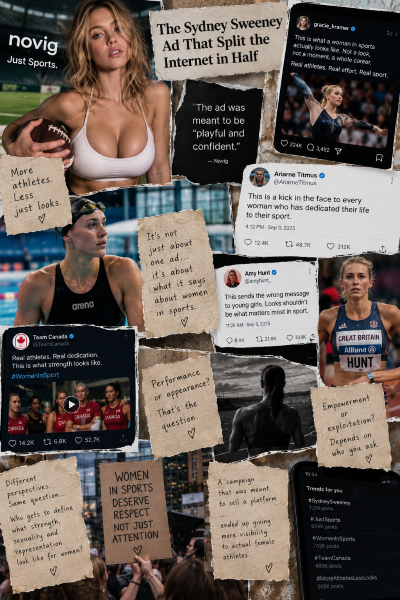
Here is the actual timeline in case you only caught the memes and not the details. Novig launched the campaign under the tagline "Just Sports" in early September. Sweeney, who also holds equity in the company, appeared in a series of provocative shots, and the brand openly said the provocative angle was intentional. Almost immediately, female athletes started responding, and not quietly either. Gymnast Gracie Kramer posted her own competition footage with the caption calling out what a woman in sports actually looks like. Olympic swimmer Ariarne Titmus called the ad a kick in the face to every woman who has dedicated her life to her sport. British track star Amy Hunt warned it risks sending young girls the message that looks matter more than ability. Even entire national teams got involved, with Team Canada's Olympic account posting a response video of its own athletes training and competing.
The core of the criticism is not really about Sweeney personally, it is about timing and context. Women's sports have spent years fighting to be covered and taken seriously for performance instead of appearance, finally gaining more visibility, sponsorship and respect on those terms. Critics argue an ad like this, using an actor's sexuality to sell a sports platform, quietly undoes some of that progress by putting the emphasis right back on how a woman looks instead of what she can actually do. For a lot of Gen Z and Gen Alpha viewers who grew up watching women's sports finally get real coverage and real respect, that regression stung in a very specific way.
On the other side, there is a real argument worth hearing too. Defenders point out that Sweeney is an actor and a business owner in this specific case, not an athlete claiming to represent women's sports, and that her choice to appear a certain way in an ad she has a financial stake in does not automatically speak for anyone else's choices. Novig also framed the campaign as playful and confident rather than degrading, and some people online pushed back on the backlash itself, arguing that policing what a woman chooses to wear or how she markets herself, even in a sports adjacent context, can end up feeling like a different version of the same old control over women's bodies that everyone claims to be against.
What made this moment bigger than a single ad, though, is how the response actually played out. The reaction videos, dozens of athletes across multiple countries posting real training and competition footage under a shared format, ended up spreading further and faster than Novig's own campaign ever did. In a strange way, the backlash became its own viral moment, arguably giving more visibility to actual female athletes than the original ad ever intended to give anyone.
This whole debate taps into something bigger than one campaign too. It is really about who gets to define what strength, sexuality and representation are supposed to look like for women right now, and whether those things have to be separate at all, or whether that expectation is exactly the problem. Some people think a woman choosing to be sexual in her own campaign is empowerment on her own terms. Others think doing it specifically inside a space that female athletes have fought hard to be respected in, rather than sexualized in, crosses a line that has nothing to do with personal choice and everything to do with context.
There is no clean answer here, and that is kind of the point. It is not really a debate about right or wrong, it is a debate about whose voice gets centered in a conversation that both sides genuinely believe they are fighting for the right side of.