Your Feed Knows You Better Than You Think
Are we choosing what we watch or teaching algorithms what to show us next?
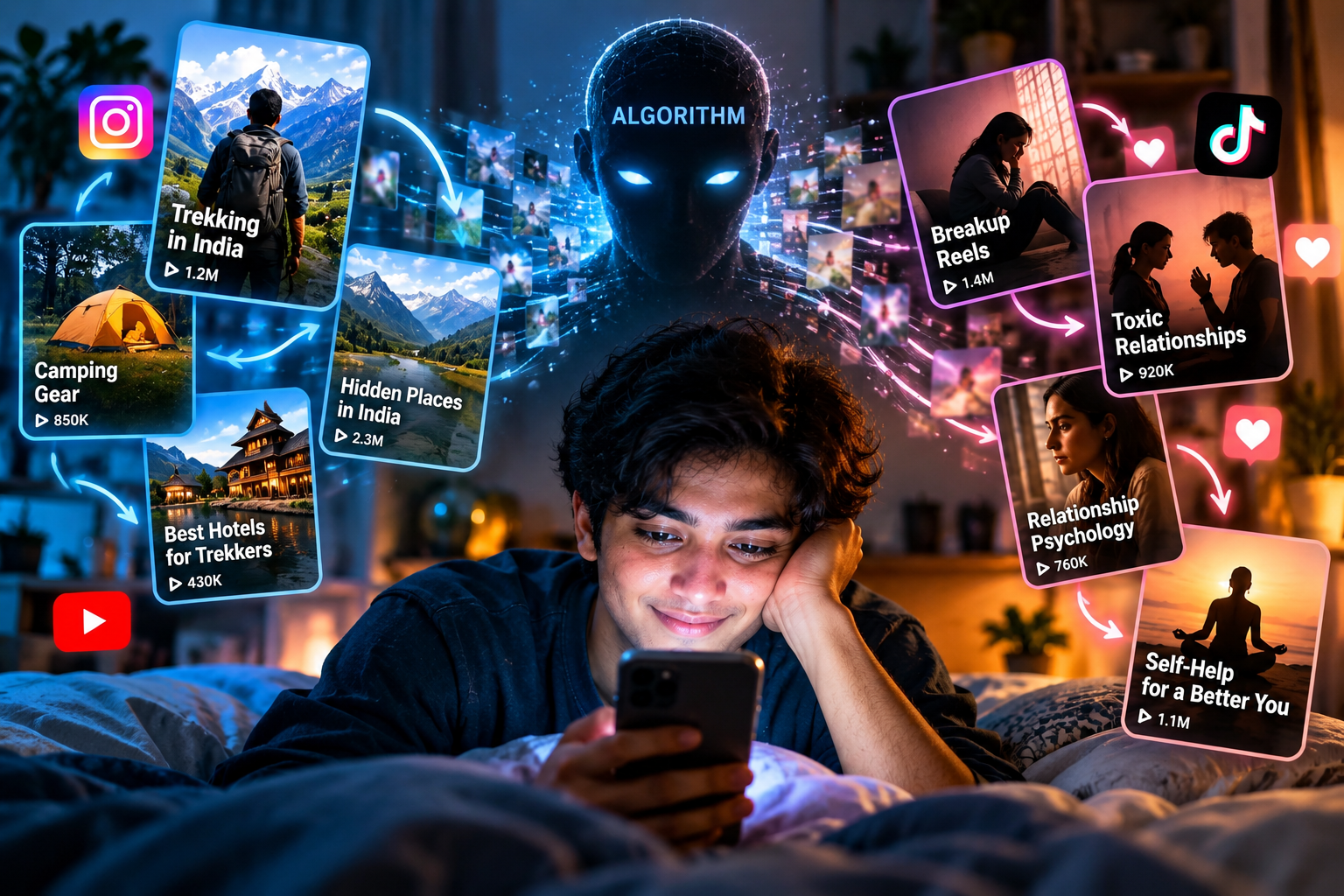
You watch one travel reel. Then another one appears. Soon, your feed is full of trekking videos, camping gear, hotels, and “hidden places in India”. After a few days, you start wondering: “Instagram ko kaise pata chala ki mujhe trekking pasand hai?” The answer is not that Instagram can read your mind. It is much simpler and much more interesting.
You are constantly giving the algorithm clues. Every like, share, search, follow, skip, and viewing decision can become a signal about what you may want to see next. TikTok, for example, says its recommendation system considers user interactions such as videos watched, likes, shares, comments, follows, and searches, along with other signals. And this brings us to a bigger question: Is our feed simply reflecting our interests or slowly shaping them?
The Rabbit Hole
Think about a simple example. You watch one breakup reel. Then you get relationship content. Then videos about “toxic relationships”. Then psychology content. Then self-help videos. Suddenly, your entire feed seems to be talking about relationships. This doesn't mean the algorithm has decided who you are. It is a possible recommendation loop:
You show interest, the system responds, you engage again, and the system learns more. In simple terms: Your behaviour → Algorithm learns → Personalised recommendations → You engage → Algorithm learns again. The interesting part is what happens in between. You may have opened Instagram for five minutes. One video leads to another, and another. Before you realise it, half an hour has passed. The platform did not force you to watch those videos. But it did make the next choice easier to make. That distinction matters.
Are We Training the Algorithm?
This question becomes even more relevant as platforms make personalisation more sophisticated. In June 2026, Meta announced that activity businesses already share with Meta from their websites and apps could be used not only for personalised advertising, but also to personalise Feed content and Meta AI responses. Meta said the change does not involve collecting a new category of data, while also introducing controls around this activity. Imagine you visit a website and buy camping equipment.
Later, your Meta experience may become more relevant to camping and outdoor activities. Meta itself uses a similar example while explaining the change.
Now consider the larger picture. Your digital behaviour is no longer happening in isolated boxes. What you search, watch, click, or buy across different online spaces can contribute to increasingly personalised experiences.
If every person receives a slightly different version of the internet, are we all really experiencing the same internet?
From an Anthropological perspective, this is fascinating.
Human beings have always been influenced by their environment. What we see around us affects what we notice, discuss, and eventually consider important. Our digital environment is now personalised at an individual level. That doesn't mean algorithms control us. But they can influence what gets placed in front of us next.
Who Is Choosing Whom?
The good news is that users still have agency. We can unfollow accounts. Search for subjects outside our usual interests. Use “Not Interested”. Follow different creators. Deliberately expose ourselves to unfamiliar ideas.
Platforms also recognise the need for diversity. TikTok, for instance, says it works to introduce different types of content into recommendations rather than repeatedly showing the same material.
But perhaps the most useful thing we can do is simply become aware of the feedback loop.
We influence the feed. The feed influences what appears next. And what appears next becomes the environment for our next choice.
So maybe the real question isn't: “How does my feed know me so well?”
Maybe it is: “What have I been teaching my feed about myself, and what has it been teaching me in return?”
Because the algorithm is learning from our attention. The interesting question is whether we are paying attention to what our attention is becoming.
By Pranay S. Pale