The $10,000 Lie: How Fendi Sold India's Craft Back to the World!
The $10,000 Lie: How Fendi Sold India"s Craft Back to the World!
|


The $10,000 Lie: How Fendi Sold India's Craft Back to the World!
Fendi did the thing again. A $10000 bag dropped and within hours the internet had already renamed it. Nobody official called it the Navratri bag. The internet did that on its own because one look at the mirror work and beads and every Indian person immediately knew exactly where this design actually came from.
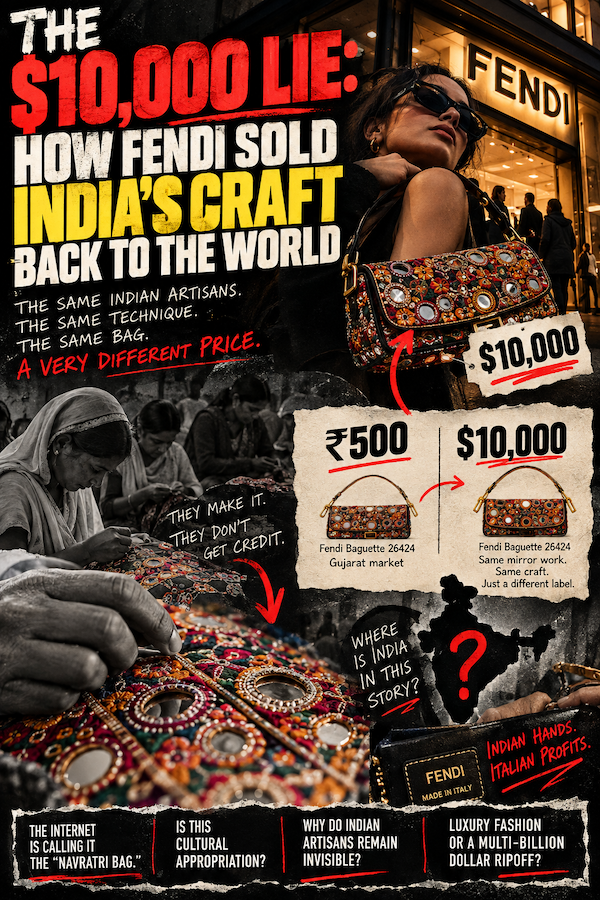
The same embroidery sits in stalls across Gujarat and Rajasthan for maybe five hundred rupees. Fendi just added several zeros and called it art. The actual product is listed as the Baguette 26424 Multicolour Re Edition with embroidery and mirrors. It is technically a reissue of a bag from 1995 but dressed up so heavily in colour and shine that it barely resembles the original anymore. Fendi is proud of the numbers behind it too. Something like forty thousand beads. Hundreds of mirrors. Over a hundred and thirty hours of work per piece.
On paper that sounds impressive. On the ground in Gujarat that same skill has existed for generations without anyone slapping a European price tag on it. Honestly this whole cycle feels familiar at this point. Earlier this year it was Prada getting dragged for basically recreating the Kolhapuri chappal without crediting anyone. That backlash got loud enough that Prada had to publicly acknowledge Indian artisans just to calm things down.
Now Fendi is having its own version of that moment. Someone online called the bag the Navratri bag and asked the obvious question everyone keeps asking every time this happens. When do these brands actually start crediting the people whose culture they keep borrowing from. Here is the part that makes this messier though. This bag was reportedly made by artisans working out of Mumbai. So Indian hands genuinely built this thing.
The problem is not that the craft is fake. The problem is that Fendi's own website says nothing about where any of it comes from. No India. No Gujarat. No Rajasthan. No Navratri. Just a generic description like the design invented itself out of nowhere. That is honestly the part that stings the most for a lot of people. Nobody is saying brands cannot take inspiration from other cultures. That has literally always happened in fashion.
The actual issue is who gets remembered once the idea starts making money. A woman buying this exact embroidery in a local market gets to keep the story attached to it automatically. The same design sold overseas for lakhs somehow loses that story completely. The stitching does not change.
The credit just disappears somewhere in the process. There is also a money side of this that barely gets talked about. The artisans doing this embroidery by hand are not the ones getting rich off a $10000 price tag. Most of that price is just the name Fendi and whatever reputation lets them charge like that. The actual skill involved gets paid a fraction of what the finished bag sells for. That gap between what craft is worth and what a logo is worth is basically the entire reason this argument keeps resurfacing every few months.
To be fair a few people online have pushed back a little on the outrage too. Some point out Fendi never actually marketed this as a festival themed bag. That name came entirely from social media reaction not from any official campaign. It is a fair distinction honestly. But even with that in mind the core complaint still holds up fine. If real Indian artisans made this bag the least Fendi could do is say so clearly instead of staying silent about it. At this point a lot of young Indians online are not even mad about one specific bag anymore. It is the pattern that gets exhausting. Prada happened. Now Fendi happened. Give it a few months and it will probably be someone else. Same story every time. A traditional Indian craft gets rediscovered by a big Western label. It gets a shiny new price tag. It gets praised in fashion coverage while the actual place it came from gets zero mention anywhere.
Until brands actually start naming the regions and the people behind these designs this exact same story is going to keep showing up on our timelines every couple of months with a different logo attached to the same old craft.
-Devangshu Purohit