When Ganpati Bappa Leaves, What Remains?
From idol waste to study tables, from nirmalya to compost, Maharashtra is discovering how a festival can leave behind more than memories.


When Ganpati Bappa Leaves, What Remains?
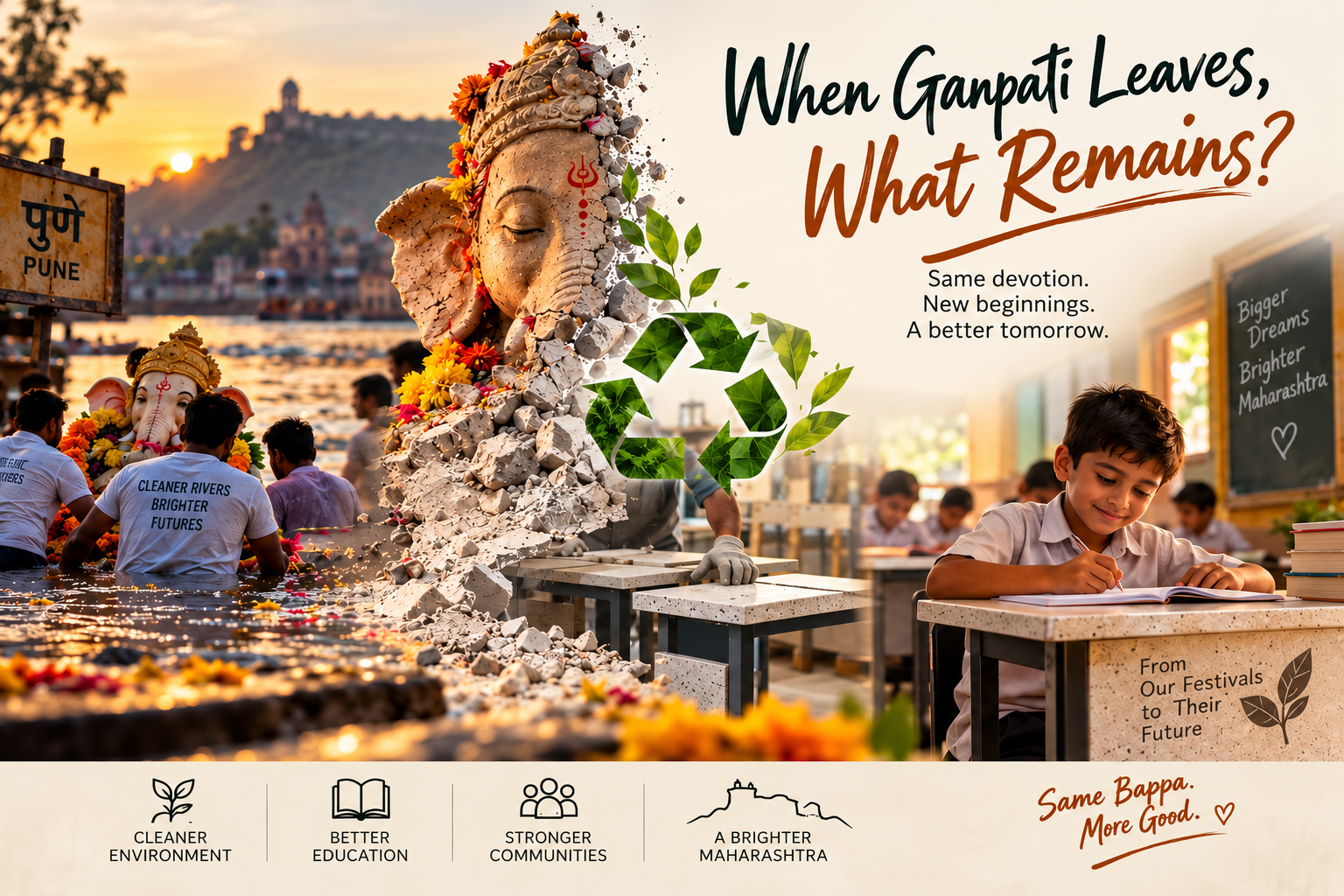
In a 2026 initiative, around 1,500 kg of Plaster of Paris recovered from 700 Ganpati idols was converted into 760 study tables for students of a municipal school in Rabale. It is a beautiful story. But it is not the only one.
Across Maharashtra, especially in Pune, many efforts show that Ganeshotsav does not simply end with visarjan. Volunteers, mandals, organisations, and ordinary citizens are finding ways to turn the festival's energy into something useful for society.
Some collect nirmalya and turn it into compost. Some create book banks. Some support students. Some provide platforms to artists. Some work on cleanliness and environmental protection.
The examples are different, but the thought behind them is the same:
What can we leave behind after Bappa leaves?
From an idol to a study table
Dr. Binish Desai has spent years asking a simple question about things we throw away:
“Can this become something useful?”
His work on waste-based products has explored ways of giving discarded material a second life, including Plaster of Paris from Ganpati idols.
The Navi Mumbai initiative shows what that idea can look like on the ground.
POP recovered from immersed idols was processed and converted into study tables, with technical support from institutions including IIT Bombay and the Institute of Chemical Technology.
The result was not just recycled material.
760 study tables reached school students.
Think about that journey.
A Ganpati idol.
Then waste.
Then recycled material.
Then a study table.
And finally, a child sitting down to study.
That is a different way of looking at waste.
Malhar's question: Why just complain?
There is another story behind this larger conversation.
In 2017, Malhar Kalambe saw the condition of Mumbai's beaches after Ganeshotsav and decided that simply complaining about the problem was not enough.
He called his friends. They started cleaning. That small effort eventually grew into Beach Please, a youth-led environmental initiative.
Malhar's story is important because it reminds us that community action does not always begin with a big organisation or a big budget. Sometimes it begins with a few friends asking:
“If this bothers us, why don't we do something about it?”
These are examples, not exceptions
And this is perhaps the most important part of the story.
The stories of Binish Desai and Malhar Kalambe are inspiring, but they should not be seen as isolated examples.
Across Maharashtra, people are experimenting with their own ways of making festivals more meaningful.
Pune, in particular, has a long tradition of connecting public festivals with social work.
Take the Akhil Mandai Ganpati Mandal's book-bank initiative. Books that are no longer being used can reach students who come to Pune for higher education.
The Kasba Ganpati Sarvajanik Ganeshotsav Mandal has also connected its public festival with initiatives such as educational support, village adoption, women's empowerment, opportunities for artists, and a children's library.
Then there are efforts around nirmalya collection.
Flowers and other offerings that would otherwise become waste are collected separately and processed into compost or other useful products. In 2026, the Dr. Shree Nanasaheb Dharmadhikari Pratishthan reportedly prevented around 2,070 kg of nirmalya from entering water bodies through collection efforts in areas including Badlapur, Vangani, Ambernath and Ulhasnagar.
These are only a few examples. There are many more such stories scattered across Maharashtra in Pune's neighbourhoods, housing societies, public mandals, villages, cities and among groups of young volunteers.
Some receive media attention.
Many don't. And that may be the most interesting part.
A group of students collecting books may never make the news.
A local mandal composting its nirmalya may not go viral.
A few young people cleaning a neighbourhood after visarjan may get no recognition.
But their work still matters.
What if every mandal did just one thing?
Ganeshotsav already has something that many social initiatives struggle to build: people coming together.
There are volunteers. There are resources. There are local networks. There is public participation.
So imagine if every mandal decided to take up just one meaningful initiative every year.
One could start a book bank.
Another could collect nirmalya.
Another could support a local school.
Another could give local artists a platform.
Another could organise a health camp.
Another could work on neighbourhood cleanliness.
Another could help students with educational material.
It doesn't have to be huge.
It just has to be consistent. And perhaps the best ideas will not come from a central plan.
They will come from individual communities understanding what their own neighbourhood needs.
Maybe this is what visarjan should make us think about
We usually see visarjan as the final moment of Ganeshotsav. The idol is immersed. The music stops. The decorations come down. And everyone goes home.
What will our Ganpati leave behind?
Not just memories. Not just photographs. Not just the sound of the dhol tasha.
But perhaps a cleaner river, a child with a study table, a student with a book, an artist with a platform, or a community that discovered what it can do together.
Because these stories are not about a few exceptional people. They are reminders of something that is already happening around us.
Maharashtra has many such stories. We just need to notice them.
Perhaps that is the real question to ask when Bappa leaves: not just what did we celebrate, but what did we create together? The idol may be immersed. The celebration may end. But the spirit of coming together to create and inspire others with such stories can continue.