INDIA’S HERITAGE SPORTS: A RICH LEGACY OF STRENGTH.
INDIA’S HERITAGE SPORTS: A RICH LEGACY OF STRENGTH.


INDIA’S HERITAGE SPORTS : A RICH LEGACY OF STRENGTH.
In recent years India has seen a spurt in sporting culture. Besides being a champion cricketing nation, we are now winning laurels in Olympic sports like badminton, hockey, wrestling, javelin, in addition to becoming a chess power zone. As a matter of fact, India has a long rich history of indigenous and traditional sports. Some of these are still popular, others not so.
Kabaddi became an international sport after it was introduced in Asian Games 1990. The exciting blend of agility, strength, speed, and co-ordination caught up, culminating in the launch of Pro Kabaddi League in 2014, which is a huge success. Its allure pulls several youth today.
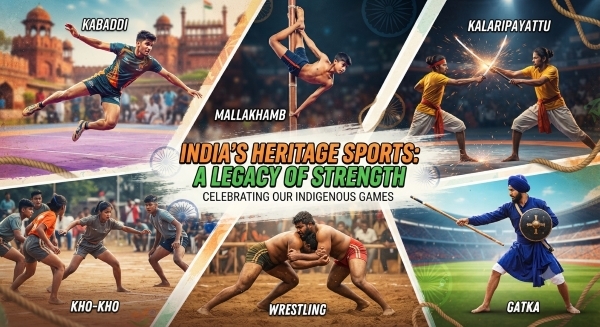
Mallakhamb originated in Maharashtra. It is a mixture of strength, gymnastics, aerial yoga, and martial arts, which helps build a muscular body. It is the state sport of Madhya Pradesh. Young, supple bodies wrapping around the khamb (pole) to twist themselves to impossible, yet graceful shapes is a sight to behold.
Kalaripayattu (Kalari - training ground, Payattu – practice) is one of the oldest martial art forms of India. This traditional psycho-physiological discipline of Kerala encourages physical, mental and spiritual control. Known as ‘Mother of Martial Arts,’ it has four stages – body conditioning, wooden weapons, metal weapons, and bare hand combat. Interestingly, it inspires dance forms such as Kathakali, Mohiniyattam, and Bharatanatyam.
Sqay is a traditional martial art and combat sport originating in Kashmir. Rooted in ancient sword and shield fighting, it sharpens one’s skills in both armed and unarmed states.
Kho-Kho is among the most popular Indian sports even today. It originated in Maharashtra. It requires sharp reflexes, body flexibility, and awareness.
Wrestling, then known as Mallayuddha, was prominently played by men of all ages. Bhim and Jarasandha were reputed wrestlers of their time.
Gatka is Punjab’s traditional martial art played with a wooden stick simulating a sword, and a small round hand shield for defence.
Satoliya (Lagori) originated in Rajasthan, but is popular all over India. It is played with a soft ball and seven flat stones. It is a fine mixture of flexibility, anticipation, and team work.
Dhopkhel is popular in Assam. Played on a large ground, it involves tagging opponents by throwing a soft ball on them before they catch it. It requires high acrobatic skill, stamina, and speed.
Rumal Jhapatta involves a pair of opponents who vie for a handkerchief placed in a circle on the ground. It builds agility, sharpness, and speed.
In addition, several indoor games like Chaupar (Ludo), Moksha Pattam (snakes and ladders), Karoom (carrom), Chaturanga (chess) encourage strategic thinking, coordination, motor skills, and probability assessment.
India has been home to several traditional sports since generations. Children played them to maintain vigour, agility, mind sharpness, perfection, and muscularity. Since independence several policies were framed to revive and nurture these sports. This is all done with a vision of improving India’s sports culture, and what better way than to go back to our roots? Sport today is a major part of a nation’s stature. India shall not lag behind.