Saying Sorry Is Not Enough
Saying Sorry Is Not Enough


Saying Sorry Is Not Enough
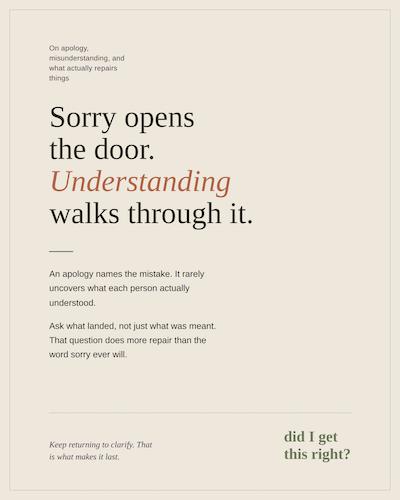
The core problem is that an apology addresses behavior while misunderstanding lives somewhere deeper. When two people argue they rarely walk away with the same story of what happened. One person may apologize for raising their voice while the other was actually hurt by a comment that never even registered as a problem to the person who said it. The apology lands on the wrong target. It closes one door while leaving another wide open.
There is also a subtler issue at play which is that people often apologize for the wrong thing without realizing it. We tend to apologize for whatever feels safest to admit rather than for what actually caused the hurt. It is easier to say I am sorry I was late than to say I am sorry I made you feel like you do not matter to me. The first apology is specific and contained. The second requires a kind of self awareness that takes more effort to reach. When we default to the easier apology we may technically be sorry but we are not actually addressing the misunderstanding that caused the pain in the first place.
So what helps more than a quick apology. The honest answer is that it is slower and less immediately satisfying. It means pausing before assuming that your version of events matches the other person's. It means asking directly what did you understand from what I said or what I did rather than guessing based on your own intention. It means describing your intention plainly instead of expecting it to be obvious especially since intention is invisible and can only be known if it is spoken aloud. It also means being willing to sit with a bit of discomfort. Asking did I get this right can feel awkward because it admits you are not certain and it opens the door to hearing something you may not want to hear. But this discomfort is often the exact space where real understanding starts to form.
None of this means apologies are useless. An apology can still matter as an opening gesture. It signals that you care enough about the relationship to acknowledge that something went wrong. But it works best as a beginning rather than an ending. It should be followed by curiosity about the other person's experience rather than a quiet assumption that the matter is now closed.
Relationships that last are rarely the ones with the fewest misunderstandings. Misunderstanding is inevitable whenever two people bring different histories different sensitivities and different ways of reading tone into the same conversation. What actually distinguishes strong relationships is a willingness to keep returning to clarify rather than letting small gaps in understanding quietly harden into resentment over time. The couples and friendships that endure are usually the ones who treat conversation as an ongoing practice rather than a one time fix. They ask more questions. They repeat things back to check they heard correctly. They allow for the possibility that their first read of a situation might be wrong.
In the end saying sorry is a small act inside a much larger process. The real work is not in the apology itself but in the willingness to keep checking whether both people are actually seeing the same thing. That ongoing effort is what prevents misunderstanding from becoming a permanent fixture in a relationship rather than a passing moment that gets resolved and returned from.