The Psychology of First Impressions
The Psychology of First Impressions


The Psychology of First Impressions
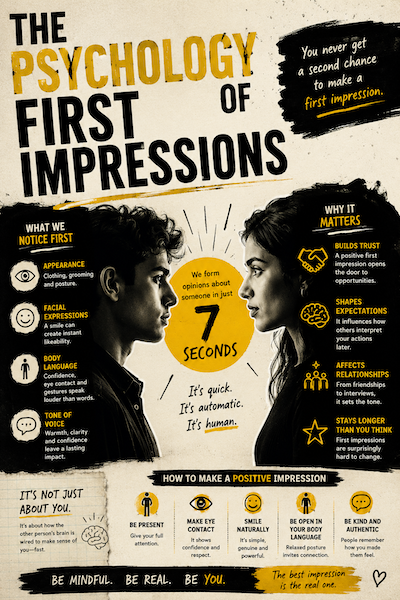
You decide what someone is like before they have finished their first sentence. This is not an exaggeration. Psychologists have measured it. Judgments about trustworthiness competence and likability form within a tenth of a second of seeing a face. A tenth of a second is faster than most people can consciously register that a judgment has even happened.
The face reading machine
This machinery seems to lean heavily on features that have nothing to do with actual character. Faces with slightly upturned mouths and wider eyes get rated as more trustworthy regardless of who the person actually is. Faces that resemble expressions of anger or contempt at rest get rated as less trustworthy even on people who are simply relaxed. The brain is not reading personality. It is pattern matching a face against emotional expressions it already knows how to interpret.
Why the mind rushes to judge
This fast judgment system almost certainly comes from deep evolutionary pressure. For most of human history quickly sorting a stranger into friend or threat mattered more than being right. A slow accurate judgment was less useful than a fast rough one when the wrong call could be fatal. Speed won out over precision and that wiring never really went away even though modern life rarely demands split second threat assessment from a stranger's face.
The result is a mind that treats first impressions with far more confidence than they deserve. Once an impression forms it does not sit quietly waiting for more evidence. It actively shapes how new information gets interpreted.
The impression that edits the evidence
Researchers call this the halo effect when it runs in the positive direction. One good trait especially something visible like attractiveness or confidence bleeds outward and makes a person seem smarter kinder and more capable across the board even without evidence for any of it. The reverse also holds. One bad early signal can taint judgments of traits that have nothing to do with it.
Working with a biased system
None of this means first impressions are always wrong. Sometimes fast intuition genuinely tracks something real particularly around basic emotional states like whether someone seems angry or at ease. But the confidence people place in snap judgments about deeper traits like honesty or intelligence is not matched by their accuracy. Studies comparing first impression ratings against real world outcomes usually find only weak correlations.
The mind will always rush to a verdict. The only real choice is whether to treat that verdict as final or as a first draft.