The Psychology Behind the Stanley CupObsession
The Psychology Behind the Stanley Cup Obsession


The Psychology Behind the Stanley Cup
Obsession
A forty ounce steel tumbler should not be able to start a stampede. But it did. Stores ran out of
stock within minutes of drops. People camped outside Target before sunrise. Videos of grown
women crying over a cup went viral not because it was rare content but because everyone
somehow understood the crying. Psychology has a lot to say about how a water bottle became a
personality.
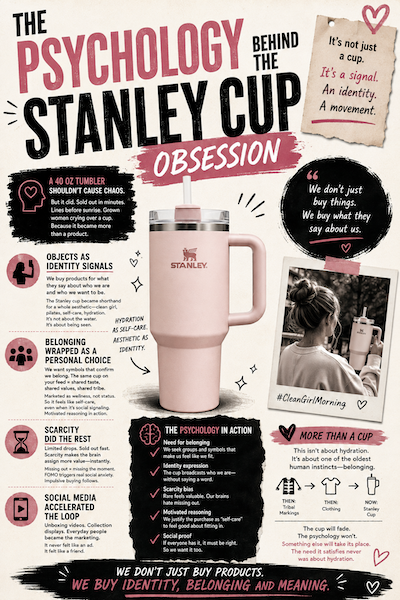
Objects as identity signals
Consumer psychologists have long argued that people do not buy products for function alone. They
buy them for what the product says about who they are and who they want to be seen as. A Stanley
cup is technically just insulated steel. Socially it became shorthand for a whole aesthetic. Clean girl
mornings. Pilates. Hydration as self care. Owning one was never really about drinking water more
efficiently. It was about being legible as a certain kind of person at a glance.
This is not new behavior dressed in a new object. The same psychological mechanism drove
obsessions with Birkin bags and before that with any object that let a person wear their identity in
public. What made Stanley different is how it collapsed the price point. You did not need luxury
money to buy belonging. Forty five dollars got you into a visual language that millions of other
women were already fluent in.
Belonging wrapped as a personal choice
Social identity theory explains a piece of this well. People are wired to sort themselves into groups
and then seek symbols that confirm they belong to the group they want to be part of. Carrying the
same cup as everyone else on your feed is a quiet signal of shared taste and shared values even if
nobody ever says that out loud. It feels like an individual purchase. Functionally it operates more
like a uniform.
What makes this especially effective with young women specifically is how the trend attached
itself to wellness culture. The cup was not marketed as trendy for its own sake. It was marketed as
part of taking care of yourself. Hydration goals. Self improvement. This reframing matters because
it lets people participate in a status object while telling themselves and others that the motivation
is health rather than image. Psychologists call this kind of self justification motivated reasoning. The
desire to fit in gets dressed up as a desire to be well.
Scarcity did the rest
Once the aesthetic layer existed scarcity marketing poured gasoline on it. Limited color drops
selling out in minutes created exactly the conditions psychologists know drive impulsive buying.
When something feels scarce the brain assigns it more value almost automatically regardless of the
object's actual usefulness. Missing a drop did not just mean missing a cup. It meant missing entryinto a moment other people were having without you. Fear of missing out is one of the most reliable
levers in modern marketing precisely because it recruits real social anxiety rather than
manufactured desire.
Social media accelerated the entire loop. Unboxing videos and collection displays turned ownership
into performance. Each video functioned as a small advertisement disguised as personal content
which meant the marketing never felt like marketing. It felt like watching a friend.
More than a cup
None of this makes the people who bought one irrational or shallow. Wanting to belong is one of the
oldest human motivations there is. Long before cups it was clothing before that it was tribal
markings. The Stanley moment is simply this ancient instinct running through the fastest
distribution system humanity has ever built.
What is genuinely interesting from a psychological standpoint is how visible the mechanism
became this time. Usually identity purchases happen slowly enough that people do not notice the
pull. The Stanley rush compressed months of typical trend adoption into days which made the
psychology behind it unusually easy to observe in real time. People were not just buying a cup. They
were watching themselves and each other want the same thing at the same moment and reacting
to that shared wanting almost as much as to the object itself.
The cup will fade the way every trend eventually does. The mechanism behind it will not. Something
else will take its place because the need it satisfies was never really about hydration at all.