The Society WhatsApp Group Is The Most Powerful Political Body In India And Nobody Is Watching It
The Society WhatsApp Group Is The Most Powerful Political Body In India And Nobody Is Watching It
|


The Society WhatsApp Group Is The Most Powerful Political Body In India And Nobody Is Watching It
214 members. Three admins. One missing cat. And a decision about who gets to live here, taken in twelve messages before dinner.
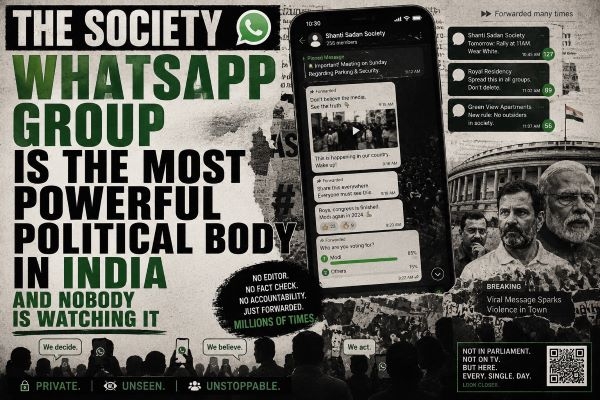
Somewhere on your phone right now is a group called something like "Shanti Residency A Wing Official" and it has 214 members and you have it muted, and if you unmute it for four hours you will witness the full range of human political behaviour compressed into a single scrolling column.
Someone's water is not coming. Someone's Swiggy guy took the resident lift. There is a photo of an unattended slipper. The security guard's name is invoked with the reverence usually reserved for a defence minister. And then, somewhere between a Good Morning flower gif and a poll about Ganpati decoration, a decision gets made about whether a family is allowed to rent 402.That is not a joke. That is the mechanism.
We have spent years talking about how Indian politics happens on social media, meaning X and Instagram and YouTube. Meanwhile the actual governance of the space you physically live in, who enters, who is watched, who is welcome, who is asked to leave, is being conducted by a WhatsApp group with no rules, no minutes, no appeals process and one uncle who types entirely in caps.
The admin who did not want to be admin. Volunteered in a weak moment three years ago, now cannot leave, is legally and emotionally responsible for a broken water pump at 11pm.
The forwarder. Health tips, temple messages, a video about how lemon cures things, and, increasingly, political content that arrived through four other groups and has been stripped of any origin. This person is not being malicious. This person is bored and retired and this group is their newspaper.
The vigilante. Has the CCTV app on their phone and treats it as a personal television channel. Posts screenshots. "Who is this person entering at 11:40pm." The person is somebody's daughter coming home from work.
The complaint filer. Every issue is escalated to "we should write to the committee." Has never once written to the committee.
The 200 silent ones. You. Me. Reading everything, saying nothing, occasionally sending a thumbs up under duress.
The lost cat. The single most unifying force in Indian residential life. Nothing else produces this level of cross-community cooperation. A cat goes missing and suddenly the group that was at war about parking allotment yesterday is running a coordinated search operation with photographs and shift assignments. There is genuine beauty in it and it is worth saying so before we get to the rest.
The shift is never announced. It goes like this. A message about security becomes a message about who is coming in. A message about who is coming in becomes a message about which delivery boys look suspicious. A message about noise becomes a message about "certain kinds of tenants." A message about hygiene becomes a message about food smells, and everybody in the group knows exactly what that means, and nobody says it, and that is the point... it never has to be said. This is the actual technology at work. Housing discrimination in India has a long and well documented history... courts have been hearing these cases for decades, the Supreme Court has openly observed that societies refuse single women, refuse particular communities, refuse people over what they eat. Maharashtra even added an anti-discrimination clause under RERA with real penalties attached. But you cannot prosecute a vibe. You cannot file a case against a group that never passed a resolution, only reached a consensus. There is no document saying no Muslims, no bachelors, no single women, no Dalit families. There is just a chat where somebody said "we should be careful about the kind of people," and eleven people reacted with a thumbs up, and the broker was quietly told the flat is no longer available.
The WhatsApp group is a perfect instrument for this because it produces the outcome of a bylaw with none of the evidence of one. Our parents' generation had nosy neighbours. Fine. Universal. Every culture has this.What our parents' generation did not have was: A camera at the gate feeding to fifteen phones. Visitor entry apps that log every guest with a photo and a phone number, stored somewhere, by a private company, with a privacy policy nobody has read. Domestic workers required to carry a QR badge. A vehicle log. A group where the footage gets posted for collective commentary. You have a residential association running a small unaccountable surveillance operation, and the data it produces gets adjudicated in a chat window by people with no training, no accountability and, frequently, very strong opinions about caste and community. The people surveilled hardest are always the same people. The maid. The driver. The delivery rider. The security guard, who is simultaneously the instrument of surveillance and its most precarious subject, and who can lose his job over a message sent by a man he has never spoken to. And the twist for our generation specifically: the young woman coming home late, the couple who are not married, the friend group who came over, the son who has long hair now. Society WhatsApp groups police behaviour that has nothing to do with maintenance, because once a group exists, it will find things to be about.
Three reasons, and all three should worry you.
It is invisible. Nobody reports on it. There is no journalist covering the Shanti Residency A Wing group. There is no archive. Messages get deleted, phones get changed, and the entire deliberative history of a decision that changed someone's life evaporates.
It is unappealable. If your society denies you a flat, what exactly do you do? Sue 214 people for a mood? Most people just leave and find somewhere else, which is precisely how neighbourhoods segregate... quietly, transaction by transaction, with nobody ever having done anything technically wrong.
It is where the elders talk to each other. This is the bit Gen Z consistently underrates. We think political persuasion happens on Instagram. For the generation actually holding property, capital and municipal influence in this country, the society group is a primary information source. Forwards land there and are believed there, because they arrive not from a stranger but from Sharma uncle from B-402, who is a nice man who once helped you jump-start your car.
That is a trust network. Trust networks are the most efficient delivery mechanism for misinformation ever invented.
The unglamorous answer is that these things are decided by attendance. Society committees in most of India are elected by a shockingly small number of people who bothered to turn up on a Sunday morning. Under-30s almost never attend. Which means the rules of the building you live in are written by a self-selecting group with a lot of free time and a very specific worldview, entirely by default. Turn up once. Ask for meeting minutes to be circulated. Ask what happens to the visitor data and who has access to the camera feed. Push for a written tenant policy, because a written policy can be challenged and a vibe cannot. When the group starts sliding, one person saying "let's keep this to society matters" changes the temperature more than you would think, because the 200 silent ones are silent out of awkwardness, not agreement.
None of this is heroic. It is just showing up to a room with plastic chairs. But the alternative is that the most consequential political space in your daily life continues to be governed entirely by people who joined WhatsApp in 2014 and have never left.
-Devangshu Purohit