The Guy At The Next Table Might Be FilmingYou And You'll Never Know
The Guy At The Next Table Might Be Filming You And You"ll Never Know
|


The Guy At The Next Table Might Be Filming
You And You'll Never Know
Meta sold seven million pairs of camera glasses last year.
They're in India, they start at ₹22,400, and the etiquette for
living around them does not exist yet. Nobody is coming to write
it either.
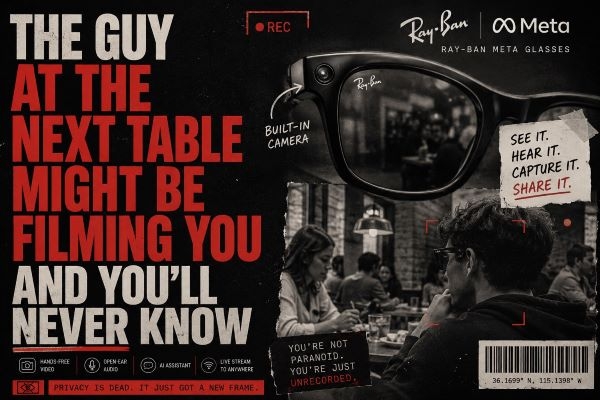
You have already been in a room with a pair. You just did not clock it.
That is the entire product. Ray-Ban Meta glasses look like Ray-Bans. Not like Google Glass, which looked like a medical device and got its wearers a nickname so brutal it killed the category for a decade. These look like Wayfarers. Because they are Wayfarers. EssilorLuxottica makes both.
There is a 12MP camera in one arm, open-ear speakers in both, a mic array, and Meta AI sitting behind it all waiting for you to say hey Meta. Gen 2 shoots 3K video, runs about eight hours, and charges to half in twenty minutes. And the numbers stopped being a niche story a while ago. EssilorLuxottica sold over seven million pairs of smart glasses in
2025, roughly tripling everything sold in all previous years combined. In the first quarter of 2026 the global smart glasses category shipped around 2.25 million units in one quarter, up 167 percent year on year, with Meta holding about 69 percent of it. Meta is aiming at ten million units a year. For context on how weird that is: display-less smart glasses shipped about as much in one quarter of 2026 as the entire category did across all of 2024. This is not a gadget story anymore. It is an infrastructure story.
They landed here in May 2025 at ₹29,990 for Gen 1. Gen 2 followed at ₹39,900, and the range now starts around ₹22,400 on Meta's India store. There is Hindi interaction support. There is, for reasons that are extremely funny and extremely on-brand, a Deepika
Padukone AI voice option. At forty thousand rupees, this is not a mass Indian product. Let us be honest about that. That is a phone budget, and most people will choose the phone. So who is actually buying them here? Content people, largely. Anyone whose output is POV footage... gym, cooking, riding, travel, street. The hands-free camera genuinely is a better tool than a phone for that, and everyone who has tried both knows it.
Then the early-adopter tech crowd. Then, increasingly, people who wear glasses anyway and figured if they're spending on frames, may as well. The prescription push is the real tell. Meta launched prescription-forward lines in 2026 with adjustable nose pads and optician-adjustable temple tips. Those are eyewear features, not tech features. When the biggest hardware companies on earth start leading with frame fit instead of chip specs,
they have decided the bottleneck is not capability. It is whether you would be seen in them.
There is a small LED that lights up when the camera is recording. That is the entire consent architecture. One light. On a device specifically engineered to be indistinguishable from ordinary sunglasses. In a country where indoor lighting is bright, people wear sunglasses inside for no reason, and nobody is examining the temple of a stranger's frames for a status indicator. Think about what that means in practice. Every interaction now carries a small unresolvable question. Is this being recorded. In a gym, a classroom, a metro, a lift, a party, a bar, a temple, a hospital waiting room. You cannot ask, because asking is aggressive and you will feel paranoid. And you cannot tell, because the design goal was that you cannot tell. The people this lands hardest on are, predictably, the same people every technology lands hardest on. Women, in a country where filming women without consent is not a hypothetical harm but a well-documented industry. Delivery workers, domestic staff, anyone whose employment is precarious and whose footage can be posted before they know it exists. Anyone who is in a place they have not told their family they are in. Meta will point at the LED. The LED is real. It is also a solution designed to satisfy a regulator, not a person.
This is where the honest version of this article diverges from the easy one. The glasses are good. Actually good, in a way the Metaverse never was. A camera at eye level captures what you were looking at, rather than what you thought to hold your phone up for. Anyone who has tried to film their kid, their dog, a gig, a ride, or a plate of food
while also experiencing it knows that the phone is a wall between you and the moment. The glasses remove the wall. That is not marketing. That is a genuine improvement. Live translation across a growing list of languages is legitimately useful in a country with twenty-two official ones. Hands-free everything while riding is safer than what most people currently do with a phone in a jacket pocket. And for anyone with limited vision or mobility, having something that describes the world out loud is not a novelty, it is
access. The uncomfortable truth is that most genuinely transformative technology arrives
exactly like this. Obviously useful, obviously unsettling, and adopted long before anyone agrees on the rules.
Our generation has a specific relationship with being recorded that older commentary keeps missing. We were not surveilled into this. We opted in. We have been documenting ourselves voluntarily since we were eleven, and we largely made peace with the trade. Which is why the glasses will not be stopped by privacy discourse. Privacy discourse has lost every fight it has picked since 2010. What is actually different this time is the direction. Everything until now was you recording yourself and choosing to publish. The glasses turn every wearer into a passive collection point for everybody else. You are no longer only producing your own footage. You are, without consent and without
knowledge, appearing in other people's. And there is a second-order thing worth naming. Meta's whole business is what it knows about you. A camera that sees what you see and a mic that hears what you hear is the most valuable data-collection surface ever put on a human face. Whatever the current policy says about what is stored and processed, policies change, and you are buying a decade-long device against a two-year policy. Say it out loud when you sit down. "Heads up, these have a camera, it's off." Four
seconds, kills the whole ambient anxiety.
Take them off in bathrooms, changing rooms, gyms, hospitals. This should not require explanation but apparently it does. If someone asks you to take them off, take them off, without the speech about how you weren't even recording. And if you are around
someone wearing them and it bothers you, say so. Early. Norms get set in the first two years of a technology existing and then they calcify for a generation. We are inside that window right now.
The phone was intrusive but it was honest. It sat between us, visible, and everyone knew what it did. The glasses are the opposite deal. Total convenience, total ambiguity. Genuinely better as a camera and genuinely worse as a social object. Both things are true. That is what makes this actually interesting, and that is why the discourse around it is so bad... everyone wants it to be one or the other. It is going to be everywhere within three years regardless of what any of us think. The only real question is whether we bother agreeing on how to behave around it before that, or after.
-Maitrayee Repal