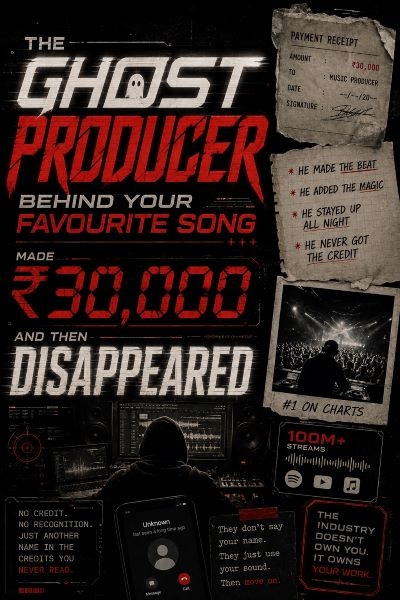
The Ghost Producer Behind Your FavouriteSong Made ₹30,000 And Then Disappeared
The Ghost Producer Behind Your Favourite Song Made ₹30,000 And Then Disappeared
|


The Ghost Producer Behind Your Favourite
Song Made ₹30,000 And Then Disappeared
Play your most-listened track of the year and look at the credits. You will get an artist, maybe a composer, maybe a lyricist, and a label. What you will not get is the person who actually built the thing. The arranger who decided the drop lands on the second bar
instead of the fourth. The session guitarist who came in for three hours, played the riff that makes the song the song, took a flat fee and went home. The bedroom producer in Ludhiana or Kochi or Andheri who made the entire beat and sold it outright because the
offer was thirty thousand rupees now versus a percentage of nothing later.
Ghost production is not an Indian invention, and globally it is a fairly transparent arrangement... the ghost trades credit for a bigger one-time payout, everyone understands the deal. What makes the Indian version specific is that it is not really a deal. It is the default setting of an industry that has run on work-for-hire since the 1970s, where session musicians show up, perform, leave, and their contracts, if contracts exist at all, quietly hand over every future right in perpetuity. Their artistry is stitched into the DNA of a
song that then gets monetised endlessly by people who were not in the room. The composer Joell Mukherji, who has worked with Amit Trivedi and Pritam and made over 150 ad films, put the whole problem into a song he released called Credit De Do Yaar, which is funny for about four seconds and then stops being funny.
Here is why credit is not a vanity issue, and this is the part that gets lost when people wave it away as ego. Credit is the plumbing that money flows through. The Indian Performing Right Society disbursed over ₹600 crore in royalties in 2024-25, and nearly 70 per cent of its collections now come from streaming. That money moves according to metadata. If your name is not in the file, you are not a person the system can pay, no matter what you played. And the Indian industry spent decades building a structure
specifically designed to keep names out of that file. The 1977 Supreme Court ruling in the IPRS case cemented the principle that once a composer assigned rights to a film producer, the producer held them, and film music has dominated Indian music ever since. It took the 2012 Copyright Amendment and then a Bombay High Court judgment in 2023 to establish that authors and composers are entitled to royalties every time a recording goes out over FM radio, a win Javed Akhtar publicly celebrated as protection for people who had been deprived of their rightful claims for generations. But notice who that
protects. Authors, composers, lyricists, featured performers. The people with a category. The guy who programmed the drums has no category. There is no equivalent of IPRS or ISRA fighting for session musicians, which is why credit reform for them has to start with the most basic possible ask, which is putting the name down at all.
And the industry has changed in a way that makes this worse rather than better, which is counterintuitive but true. Streaming collapsed the old model where a label bankrolled everything and a handful of named composers ran the show. Now a Punjabi track can be built in a bedroom, uploaded, and pull numbers that outrun anything a studio system produces. That should have distributed credit outward. Instead it concentrated it, because the streaming era runs on artist-as-brand, and a brand needs a single face. The face signs the deals, does the interviews, takes the festival slot, sells the merch. The four people who actually made the record are a cost line. Add to that the total absence of enforcement infrastructure... producers in this industry will tell you that even where contracts exist they are frequently not notarised, so anyone can simply deny signing one. The result is an arrangement where the leverage sits entirely with whoever is holding the release, and a nineteen-year-old with a laptop and one shot at a placement will take any terms offered, because the alternative is no placement. Nobody in that transaction is a villain, exactly. It is just a market with a very large power gap and no referee.
So what do you do about it, as someone who mostly just listens? Less than you would like, but not nothing. Notice that the credits are missing, because most listeners genuinely have never looked and assume the absence means there was nobody there. When a composer does credit properly, say so loudly... Varun Grover released the All India Ranksoundtrack on his own channel with every instrumentalist named, and a five-year trend of composers crediting musicians more consistently exists precisely because a few people made it a norm and got noticed for it. If you make music yourself, and a lot of people reading this do, the ask is more direct: write the names into the metadata, get the contract notarised, and understand that a flat fee for a track that might run for twenty years is a bet you are making against your own future. Credit alone does not pay bills, as the session musicians will correctly tell you. But credit is the precondition for everything that does. The song you have played four hundred times has a full set of parents. Right now the system is set up so you will only ever meet one of them.
-Devangshu Purohit