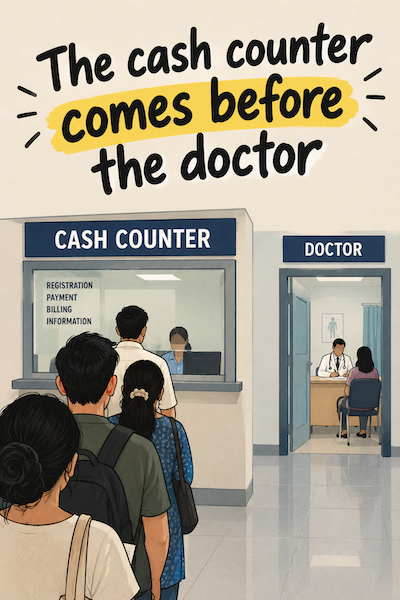
The Cash Counter Comes Before The Doctor
Okay so picture this. Your relative is bleeding out in the back seat of a car at 2am and you pull up to the nearest hospital that has an emergency sign lit up in red. You carry them in. A nurse looks up. And before anyone touches your relative someone in a glass cabin asks you for a deposit. Fifty thousand rupees. Card or cash. The card machine is right there on the counter next to a form nobody has time to read.
This is not a rare horror story. This is Tuesday in a hundred cities across the country. The Supreme Court settled this exact question decades ago in Parmanand Katara. Every hospital public or private is legally required to stabilise an emergency patient first and sort out payment after. The judgment did not leave room for interpretation. It said medical aid must be given to preserve life and the question of payment or legal formalities can come later. That is not a suggestion sitting in some law journal nobody reads. That is binding law that every hospital administrator in the country technically knows about.
And yet the deposit counter exists in almost every private hospital as a completely normal fixture of the building. Nobody hides it. It is not even treated as something illegal happening quietly in amback room. It is architecture. A designated desk a designated staff member a designated moment in the sequence where care stops until money moves. The gap between what the law says and what actually happens at the door is not a secret gap. It is a gap everyone has simply agreed to live inside.
This is the part that makes it his territory because the mechanism is not corruption in the dramatic sense. Nobody is bribing anyone. Nobody is hiding evidence. The hospital is not breaking the law in a way that looks like breaking the law. It is breaking the law in a way that looks like paperwork. A deposit is not phrased as a condition for treatment. It is phrased as a formality that happens to occur before treatment starts in practice even when nobody says the words we will not treat you until you pay.
Think about who is actually standing at that counter at 2am. It is never the patient. The patient is unconscious or in too much pain to argue. It is a family member who is scared and has never read a Supreme Court judgment in their life and has no idea that the demand being made of them is illegal. They do not have a lawyer's phone number saved. They have a bleeding person and a stranger in a glass cabin holding the only door to a doctor. The power imbalance is not incidental to the mechanism. It is the entire mechanism. The hospital is betting correctly that almost nobody in that moment will say I know my rights.
And even the people who do know rarely fight it in the moment because fighting it costs time and time is the one thing you do not have. You can file a complaint later. You can write to the statemedical council later. Later does not stabilise a person who is losing blood right now. So the deposit gets paid the treatment starts and the legal violation just sort of dissolves into the relief of your relative being alive. Nobody circles back to hold the hospital accountable because the entirem incentive structure of a medical emergency pushes you toward compliance and away from confrontation.
The private hospitals that do this are not unaware of Parmanand Katara. Ask any hospital administrator directly and most will recite the judgment back to you accurately. What they have built instead is a system where the emergency treatment technically begins in some minimal triage sense while the deposit is being processed which lets them argue on paper that care was not refused it was simply running in parallel with billing. That framing is doing enormous work. It lets a hospital comply with the letter of a judgment while functionally recreating the exact coercion the judgment was written to prevent.
The fix nobody wants to fund is also boring which is real penalties enforced by state medical councils actual mystery audits of emergency departments and a helpline number printed on every hospital gate that connects a scared relative to someone who can intervene in minutes not months. Rights that exist only in a judgment and not in the muscle memory of a 2am decision are not really rights yet they are potential rights waiting for enforcement to catch up. Fikar not though because once you know the mechanism you know the one sentence that changes the room which is this is illegal under Parmanand Katara and I am recording this conversation.
Hospitals move very differently once they know you know.
-Maitrayee Repal