Abortion Access In India: Where The Real Argument Actually Is
Abortion Access In India: Where The Real Argument Actually Is
|


Abortion Access In India: Where The Real Argument Actually Is
India does not have an abortion debate in the way America has one. Nobody here is seriously campaigning for a complete legislative ban, and no party has built an electoral identity around it. Abortion has been legal since 1971, two years before Roe v. Wade, and the Medical Termination of Pregnancy Act was passed by a Parliament that framed it as a public health measure rather than a moral battle. Women were dying from unsafe procedures, so the state made safe ones lawful.
That head start makes India look progressive on paper. The honest picture is more complicated, because the two positions that dominate global debate, complete prohibition on one side and full reproductive autonomy on the other, both describe something India does not have.
What the prohibition argument looks like here
The strongest restrictive case in India is not the foetal personhood argument that drives American politics, though that view exists. It is the sex selection argument, and it has real history behind it.
Once ultrasound became cheap in the 1980s, sex determination followed by termination of female foetuses distorted birth ratios across large parts of north and west India badly enough that Parliament passed the PCPNDT Act in 1994, prohibiting prenatal sex determination outright. The logic is uncomfortable but coherent: in a society with deep son preference, a broad and easy right to terminate does not operate neutrally. It gets used to eliminate girls.
From this premise, gatekeeping is protective rather than paternalistic. Requiring a registered medical practitioner's opinion, restricting who can provide, and keeping records is how you stop a right from becoming an instrument of a very old prejudice. Critics of liberalisation also point out that a broad mental health ground effectively becomes abortion on request with extra paperwork, which is either the point or the problem depending on where you stand.
What the full autonomy argument looks like here
The counterargument starts by noting what the MTP Act actually does. It does not give women a right. It gives doctors a defence. Section 3 permits termination when a registered medical practitioner forms an opinion that specified grounds are met. The decision belongs to the physician, not the pregnant person, and the entire structure treats her as the subject of a clinical judgement rather than the author of one.
Courts have been steadily pushing against that. In X v. Principal Secretary in 2022, the Supreme Court held that all women, irrespective of marital status, have equal access up to 24 weeks, and extended access to married women in cases arising from marital rape despite the exemption in criminal law. The reasoning rested on Article 21, framing reproductive autonomy, dignity and privacy as constitutional rights rather than statutory concessions.
Advocates argue this exposes the gap. If autonomy is a fundamental right, a statute that makes it conditional on two doctors agreeing is already a compromise, and one that mostly burdens women who cannot argue with a doctor.
The numbers nobody argues about
Here is where the Indian debate stops being philosophical.
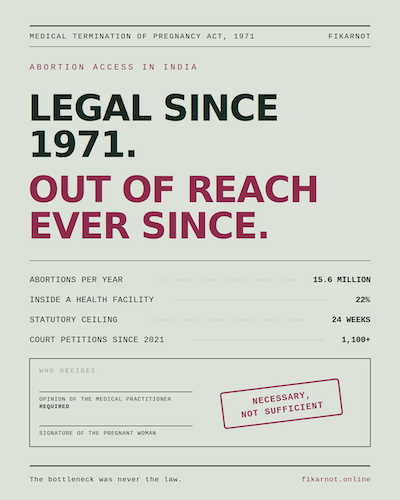
Guttmacher's national study estimated 15.6 million abortions in India in 2015, of which only about 22 percent took place in health facilities. Roughly 81 percent were medication abortions, most obtained outside any facility, largely from chemists. Around 5 percent used methods that were probably unsafe.
The provider shortage explains a lot of it. India has long fallen far short of the recommended density of one abortion centre per 20,000 population, and rural districts are worst served. Unsafe abortion has repeatedly been identified as a leading contributor to maternal mortality here, with estimates in the range of eight to thirteen deaths a day depending on the study and the year.
So the country with one of the world's older liberal abortion laws still has millions of women getting pills from a counter with no follow up, no ultrasound and no idea what to do if something goes wrong. Legality and access turned out to be almost separate variables.
The permission problem
There is a second gap, at the other end of the timeline. Beyond 24 weeks, termination requires clearance from a state medical board, and in practice this pushes women into court.
Since 2021, more than 1,100 cases have reached the High Courts and the Supreme Court from women seeking permission past the statutory limits, usually after a late foetal diagnosis, a rape prosecution that moved slowly, or a minor whose pregnancy was noticed late. Outcomes vary between benches. In 2026 the Supreme Court permitted a termination at 30 weeks, among the latest it has ever allowed.
A right that requires a writ petition is functionally a right for people with lawyers, information and time. Most of the women affected by late diagnosis have none of the three.
Where this leaves us
The moral question of when a life begins to count is genuinely unresolved, and no amount of data settles it. Reasonable people land in different places, and India's own history with sex selection makes the restrictive concern harder to dismiss than in most countries.
But India's actual failure is not located at that question. The law already permits far more than most women can access. The bottleneck is trained providers, functioning district facilities, chemists who counsel instead of just selling, medical boards that convene quickly, and the plain fact that most people have no idea what the law allows them. Arguing about the line at 24 weeks is a debate worth having. It is just not the one killing anybody.
-Maitrayee Repal