The ₹1 Per Page Shop Outside Your College Went To Court For You And Nobody Told You
In 2012, three of the largest academic publishers on earth sued a photocopy shop. The shop was inside Delhi School of Economics. How that ended is the reason your syllabus is affordable.


The ₹1 Per Page Shop Outside Your College Went To Court For You And Nobody Told You
In 2012, three of the largest academic publishers on earth sued a photocopy shop. The shop
was inside Delhi School of Economics. How that ended is the reason your syllabus is affordable.
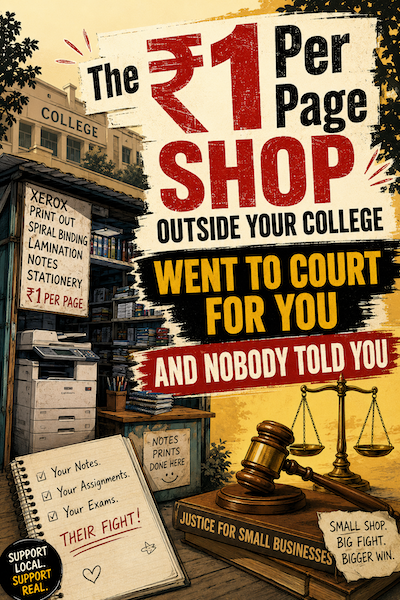
There is a shop. You know the one. Ten by ten, a Canon machine that has been running since before you enrolled in that college, a boy who has memorised which chapter of which book every second year needs by the third week of term, and a wall of spiral bound compilations with names like ECO 401 UNIT 2 AND 3 written on the cover in marker.
You have spent money there. Not much. That is the point.
What you almost certainly do not know is that this exact business model was hauled into the
Delhi High Court by Oxford University Press, Cambridge University Press and Taylor and
Francis, that the case ran for five years, and that if it had gone the other way the economics of getting a degree in this country would look completely different for you personally.
What actually happened
In August 2012 the publishers filed suit against Rameshwari Photocopy Service, a shop
operating on licence inside the Delhi School of Economics campus, and against Delhi University itself. The allegation was straightforward. The shop was photocopying substantial extracts from their textbooks, binding them into course packs that matched the prescribed syllabus, and selling them. That, said the publishers, is infringement.
Their proposed fix was not that the shop shut down. It was that the university take a licence
from the Indian Reprographic Rights Organisation, which would have permitted reproduction of up to about 15 percent of a copyrighted work. Pay for the licence, keep the shop, everyone is legal.
In October 2012 the court granted an interim injunction. The shop stopped selling course packs. And then something happened that does not usually happen. The students showed up. Two groups formed specifically to fight the case, and the court allowed them to be added as defendants rather than treating them as spectators. Their argument was not legal romance. It was arithmetic. A single unit of a postgraduate economics syllabus can draw on eight or nine books. Buying all of them is not a stretch, it is impossible, and any honest person in the room knew it.
In September 2016, Justice Rajiv Sahai Endlaw dismissed the suit outright.
The reasoning turned on Section 52(1)(i) of the Copyright Act, which exempts reproduction of a work by a teacher or a pupil in the course of instruction. The court held that a course pack assembled for a class falls inside that exemption, and, crucially, that it made no difference
whether the university photocopied the pages itself or licensed a shopkeeper to do it. If the act is protected, the identity of the hand operating the machine does not change that.
Copyright, the judgment observed, is not a natural right of absolute ownership. It is a statutory arrangement with a purpose attached, and the purpose is the progress of knowledge.
The publishers appealed. In December 2016 a Division Bench declined to hold that course
packs infringe copyright, but it did not simply rubber stamp the first ruling either. It sent one
question back to be decided on facts: whether the specific extracts used were genuinely
necessary for the purpose of instruction. It also refused to reimpose an injunction, and instead required the shop to file quarterly records of the course packs it sold.
Then, in March 2017, the publishers withdrew.
So the case did not conclude in a grand final judgment. It was abandoned. Which means the
position you are living under is a strong High Court reading of a statutory exception, not a
Supreme Court settlement, and it holds for now.
Why this should bother you slightly
Notice what the fight was actually about. Not piracy in the way that word gets used. Not
somebody uploading a PDF to a Telegram channel. It was about whether a photocopy shop on a campus is part of the university or a commercial parasite on it.
That distinction decides whether Indian higher education stays functional. A prescribed reading list here routinely assumes access to imported academic titles priced in a currency the reader does not earn in. Public university libraries hold a handful of copies for hundreds of students. The photocopy shop is not a workaround for that gap. It is the load bearing structure that lets the gap exist without the whole system collapsing.
Which is also why nobody plans for it. Every syllabus in this country is quietly written on the
assumption that the shop exists. No committee has ever formally approved that assumption. It is just true.
The bit that never gets said
The person who took the risk in all of this was the shopkeeper.Not the university, which has legal counsel and cannot be shut down.
He did not set out to be a test case for access to knowledge in India. He was just doing what the students needed and what the professors quietly relied on.
What you can actually do
Almost nothing, honestly. But two things are free.
Know that the exception exists, because most students genuinely believe the course pack is a shady arrangement everyone tolerates, and that belief is exactly what makes the practice easy to attack next time. It is not shady. A court examined it in detail and said so.
And if your department is the kind that circulates readings properly, with permissions or open access links or library scans, notice that somebody did work to make that happen. Departments that do this are rare, and they exist because one faculty member decided to care.
The shop will probably still be there next term. It has survived Oxford. It will survive your
semester.