SpaceFest Is the Move If You Want Gaming Skills to Actually Pay Off in Tech
SpaceFest Is the Move If You Want Gaming Skills to Actually Pay Off in Tech
|


SpaceFest Is the Move If You Want Gaming Skills to Actually Pay Off in Tech
- Pulse Desk
You’re already spending hours in ranked queues, building insane worlds, or grinding that one game that lives rent-free in your head. Cool. Now picture using that same brain — the pattern-spotting, the 3D thinking, the “how does this system even work” curiosity — on rockets, satellites, and the next wave of space tech. That’s exactly what events like SpaceFest are built for.
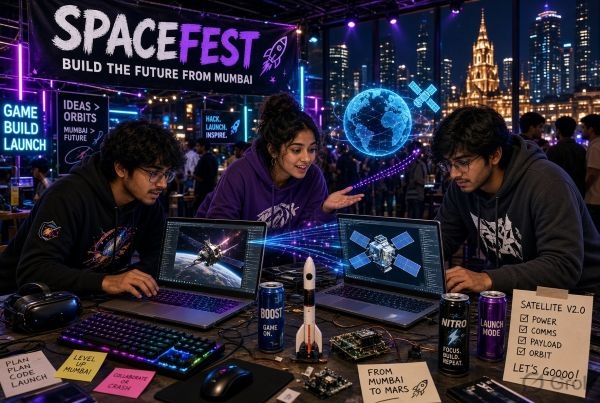
Think of it as the spot where your two worlds stop competing and start overlapping.
Why This Hits Different for Gamers and Tech Kids
Most of us treat gaming as the hobby and “real tech” as something separate. That’s outdated. Space-tech needs the exact skills a lot of you already have: simulation thinking, systems design, 3D environments, storytelling, community building, and rapid problem-solving under pressure. The industry is opening up fast. India’s space-tech sector sits around $8.5–9 billion today and is projected to hit $100 billion by 2040. Maharashtra already makes about 25% of the country’s aerospace, defence and navigation systems and wants to become a proper global space hub. They’re talking incubation centres, industrial land, and policies to back startups.
SpaceFest puts that future in the same room as you. There will be dedicated zones for sci-fi, gaming and space-inspired entertainment. Expect fan experiences, celebrity drops, hardware exhibits, aerospace demos, investor conversations, and student-focused programmes. Before the main event they are running school outreach and a college-level innovation challenge. That’s not just “come look at rockets.” That’s “come show what you can build.”
How to Actually Use It
Show up with a plan, not just a camera roll.
Walk the gaming and sci-fi zones first. See how studios and creators are already mixing space themes with games, VR, and interactive experiences. Then hit the workshops and exhibits. Hands-on sessions on hardware, robotics, and emerging tech are where you turn “I play a lot of games” into “I understand how simulation and real-world engineering talk to each other.”
Talk to people. Founders, engineers, investors and policymakers will be there. Ask questions that show you get both sides: “How are you using game engines or AI for training or visualisation?” or “What skills do you actually hire for right now?” Those conversations beat another certificate.
Enter the innovation challenge if you’re in college. Even if you don’t win, you get practice pitching ideas that sit at the intersection of entertainment and hard tech. That’s portfolio gold.
After the event, don’t ghost the energy. Follow the official site (spacefest.in), join related communities, and start a small project: a space-themed game prototype, a short film, a simulation, or even content that explains the tech in a way other Gen Z people will actually watch.
The Bigger Picture
This isn’t a one-weekend flex. It’s a signal that the space economy is becoming a real career lane, not just government missions. Private companies, startups, software, AI, robotics, design, and content all have roles. The same skills that make you good at games — iteration, systems thinking, visual storytelling — transfer. You can keep one foot in gaming (content, indie games, esports-adjacent experiences, even space-themed titles) while building the other in actual technology that launches things into orbit.
Ten years from now the kids who treated events like this as just another festival will still be grinding the same games. The ones who used them to meet people, pick up skills, and test ideas will be the ones shipping products, joining startups, or creating the next layer of space entertainment.
Keep an eye on SpaceFest. Go if you can. If you can’t, treat it as the reminder: the overlap between the games you love and the tech that is actually growing is already here. You just have to step into the room.