YOUR THRIFTED KURTA HAS A BETTER RESUME THAN YOU DO
YOUR THRIFTED KURTA HAS A BETTER RESUME THAN YOU DO


YOUR THRIFTED KURTA HAS A BETTER RESUME THAN YOU DO
Someone's grandmother stitched it. Someone's mother wore it to a wedding in a decade you've only seen in photographs. It sat in a trunk, got sold by weight to a raddiwala, ended up on a cart outside a Sunday market, and now it's yours for two hundred rupees because you liked the block print and didn't ask any further questions.
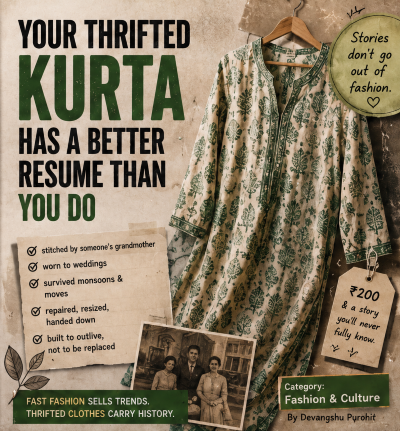
Compare that to the ninety-nine rupee top you bought online last month, wore twice, and are now embarrassed by, not because it aged badly, but because it was never built to age at all. That's the quiet difference between the two garments hanging in your cupboard right now. One was made to be discarded within a season. The other was made by someone who genuinely didn't have the option of discarding it, and so made it well enough that discarding was never really on the table.
What Gen Z is calling a "thrift find" is mostly just Indian households finally being allowed to stop hoarding what earlier generations couldn't bear to throw away. Every family has that trunk, the one nobody opens except during a move or a big cleanup, full of clothes an aunt insists are "coming back in style," which, annoyingly, they usually do. Fast fashion made disposal feel normal for exactly one generation, the one that grew up with ten-item hauls and return-free shopping. The kurta on the cart is proof that disposal was never actually the default, retention was, and it's back in fashion because it never really left the wardrobe, it just got temporarily unfashionable to admit you were wearing your mother's old clothes on purpose.
There's also something the algorithm can't manufacture: provenance. A fast-fashion piece has a barcode and a shipping number. A thrifted kurta has a story nobody can fully reconstruct, and that mystery is doing more aesthetic work than the fabric itself. You don't know whose wedding it was. You don't know why it ended up at that specific cart on that specific Sunday. You just know it survived long enough to get to you, which is more than most things bought this year will be able to say a year from now.
The irony nobody talks about: brands are now printing "vintage-inspired" prints onto brand-new polyester and charging triple for the privilege of looking like something that already existed for free in someone's trunk. The market figured out that authenticity sells, and then, predictably, started manufacturing the appearance of it, faux-faded fabric, deliberately mismatched buttons, "distressed" finishes stitched in at the factory. Meanwhile the real thing, unbothered, is still sitting on a cart, priced by weight, waiting for someone to actually want it for what it is instead of what it resembles.
Wear it as an aesthetic if you want, nobody's asking for a heritage essay every time you get dressed. But that print survived longer than your phone's battery life, longer than most of your subscriptions, longer, probably, than the app you found the "vintage" version of it on. Respect the resume.