"WE'RE JUST TALKING" IS DOING THE WORK OF THREE RELATIONSHIP STAGES
"WE"RE JUST TALKING" IS DOING THE WORK OF THREE RELATIONSHIP STAGES


"WE'RE JUST TALKING" IS DOING THE WORK OF THREE RELATIONSHIP STAGES
Somewhere in the last decade, "talking" quietly annexed dating, situationship, and almost relationship into one exhausting label that means everything and commits to nothing. You're texting good morning. You've met the friends. You've fought about a Story he didn't reply to. But if anyone asks, officially, you're "just talking", a phrase built entirely so neither person has to be the one who asked for more.
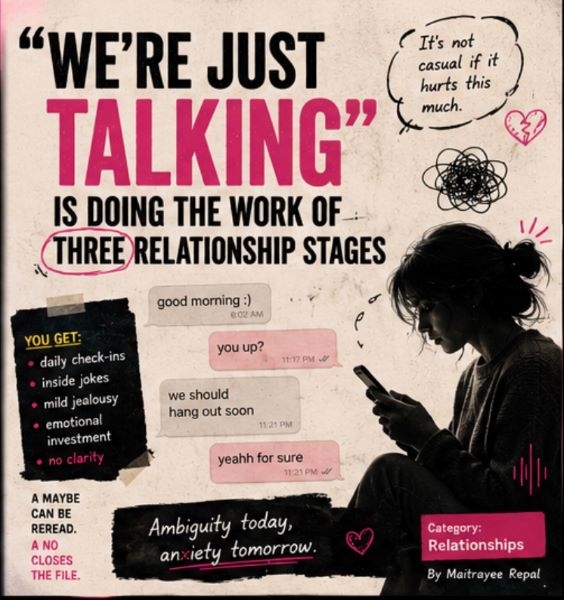
The appeal is obvious: nobody gets rejected if nobody ever asked. "Just talking" lets two people do almost everything a relationship does, the daily check-ins, the inside jokes, the mild jealousy when someone else likes their photo, without either party signing up for the part where it could end badly and have a name attached to the ending. It's relationship behaviour with an escape hatch built in, and the escape hatch is the entire point.
But "just talking" isn't actually a stage of a relationship. It's a stall tactic dressed up as a stage, and stall tactics run on one fuel, ambiguity, which is also, conveniently, the exact thing that makes people anxious, obsessive, and bad at eating regular meals. Ambiguity is why you've read the same three-word text nine times looking for subtext that was never there. It's why "hey" at 11pm gets a fifteen-minute internal debate before you type back "hey" like it cost you nothing. Certainty is boring to perform online but wildly underrated to actually feel.
The maddening bit is that everyone involved usually knows what they want within the first three weeks. What eats the next three months isn't confusion. It's the fear of saying the want out loud and hearing a no that has a name attached to it, instead of a maybe that doesn't. A maybe can be reread, reinterpreted, kept alive on hope alone. A no closes the file. So people choose the maybe, over and over, because an open file, however painful, still feels more survivable than a closed one.
There's a specific kind of exhaustion that comes with maintaining a "just talking" arrangement for months on end: the performance of casualness while doing none of the actual emotional work casual relationships are supposed to require. You're invested enough to feel a pang when they go quiet for a day, but you've agreed, unofficially, not to say so, because saying so would be "too much" for something that was never officially anything. So the pang gets swallowed, and shows up later as an unrelated argument about something small, because the real argument was never allowed to have its own conversation.
Group chats haven't helped. Every friend has an opinion on what a delayed reply "means," every screenshot gets forensically examined for tone, and somewhere in that process the actual two people involved stop talking to each other about the relationship and start talking to everyone else about it instead, which is its own kind of avoidance, just with better production value and a bigger cast.
The people who exit "just talking" quickest aren't the ones with the least to lose. They're usually the ones who've decided a clear no is cheaper, long-term, than an indefinite maybe, that a few weeks of discomfort now beats months of low-grade dread every time a notification lights up the screen. That's not bravery so much as arithmetic: ambiguity has a cost, it just gets paid slowly, in installments, instead of all at once.
You don't owe anyone a DTR speech by week two, some things genuinely do need time to become clear, and rushing a label onto something real just to escape ambiguity isn't honesty, it's a different kind of performance. But if you've caught yourself refreshing a chat for the fourth time this hour, rereading a "talking stage" for meaning it was never going to give you, that's not "just talking" anymore. That's just you, hoping quietly, and calling it casual so it hurts less if it doesn't work out.