Muscle Memory Has No Delete Button
Muscle Memory Has No Delete Button
|


Muscle Memory Has No Delete Button
Your mind agreed to move on. Nobody informed your hands.
You ordered for two.
Not on purpose. You said it out loud before you heard yourself say it, extra sugar in the second one, the cup that was never yours. The chaiwala didn't even look up. He's been making that second cup for eleven months, so today he made it again because you asked for it. You paid for both. You drank one. And then you stood at a tapri you've stood at four hundred times, holding a glass of tea that belongs to a person who isn't in this city anymore, feeling like you'd been caught doing something. That's the part nobody prepares you for. You can decide to move on at 2am with total conviction and a written list of reasons... and your hands will not receive the memo. Your hands were never invited to that meeting.
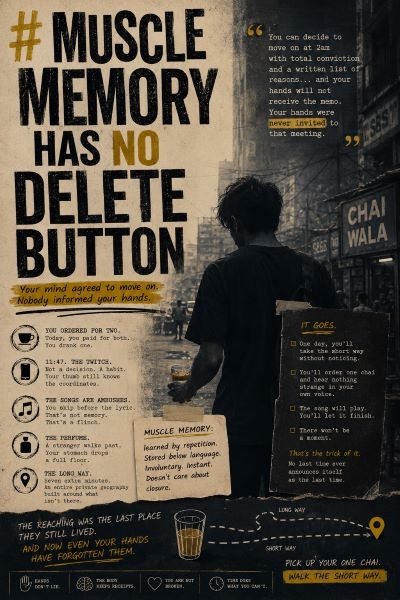
Because memory isn't one thing. There's the memory you can talk about in therapy, the dates and the fights and the last message and who said what. And then there's the other kind, the one stored below language, the one that learns cycling and typing and exactly where the light switch is in a house you moved out of six years ago. That second kind doesn't take instructions. It has no interest in closure. It was built by repetition, and you repeated them for months, so now they're in there the way a keyboard shortcut is in there. Involuntary. Instant. Completely unbothered by the fact that you cried about it. So you walk the long way now. Adds seven minutes. You've done it so often that it stopped being avoidance and quietly became your normal route, which is somehow worse, because now the detour itself is muscle memory. You built an entire private geography around one corridor and one bench and the stretch of road outside one hostel gate. Your feet know the borders of a country that doesn't exist. Your friends have no idea they're being walked around a border every single day.
And at 11:47 your thumb still checks. Not because you expect anything. It's not even a decision, it's closer to a twitch. You deleted the chat months ago and your thumb still goes to the exact coordinates where it used to sit, third from the top, and you open the wrong conversation and apologise to someone else for typing "hey" at midnight. You type one letter into a search bar and autocomplete finishes a name you have not said out loud since March. You hold your phone at the same angle you learned to hold it around them. There is no version of you that chose any of this. Then the songs, which are the cheapest ambush of all. A song that was neutral for nineteen years of your life is now radioactive, and you skip it in under two seconds, before the lyric, before the line, sometimes before the first note fully lands. That isn't memory. That's a flinch. That's your body pulling its hand off a hot vessel. And the perfume is worse, because a total stranger walks past you in a lift in a mall you don't even like, and your stomach drops a full floor before your brain has assembled the name. Six months of work undone by a person you will never see again who happened to buy the same bottle.
Here's what's actually different for us, and it isn't that we feel more. Our parents' bodies got to forget, because the stimulus genuinely left. The person moved cities. The letters stopped coming. The shop shut down. The song fell off the radio and stayed off. Absence back then was total, so the reflex starved, and a starved reflex eventually dies. Ours never starves. The cafe is two hundred metres from your lecture hall. The song is on four playlists the algorithm builds for you weekly. They're still in the group photo somebody posts on a random Tuesday, still tagged, still in your friend's story at a wedding, still online at 1:47am. The reflex gets fed. Daily. Small doses. Just enough to stay alive indefinitely.
And you've told everyone you're fine, and you might genuinely be right. That's what makes it humiliating. This isn't longing. Most days you don't want them back, you've done the maths, you know how it would end the second time. It's just that the body keeps every receipt of your ego shredded. Your mouth still knows their order. Your feet still know the detour. Your thumb still knows the coordinates. You are being betrayed by the most honest part of you, the one part that never learned how to lie about this, that isn't performing recovery for anyone and doesn't know what recovery means. It goes, though. It does actually go. Some ordinary month you'll take the short lane without noticing you took it. You'll order one chai and hear nothing strange in your
own voice. The song will play in an auto and you'll let it finish, and you'll be thinking about attendance. There won't be a moment. That's the trick of it, and it's the cruelest design feature in the whole thing... no last time ever announces itself as the last time. And when you finally clock
it, weeks later, standing somewhere unremarkable, you'll feel something you'll be far too embarrassed to say out loud.
Because the reaching was the last place they still lived. And now even your hands have forgotten them. You'll want it back. Just for a second. Then you'll pick up your one chai and walk the short way.
-Devangshu Purohit