You Own Seven Black T-Shirts Because Of The Hostel Washing Machine
You Own Seven Black T-Shirts Because Of The Hostel Washing Machine
|


You Own Seven Black T-Shirts Because Of The Hostel Washing Machine
Your personal style isn't taste. It's logistics that hardened into a personality.
You think you like black.
You don't. You like not seeing the stain. There's a difference, and the difference is roughly three years of a shared washing machine, a bucket, and one hook behind a door doing the structural work of an entire wardrobe. Open any hostel cupboard in this country. Pune, Vellore, Manipal, Kota, Jaipur, doesn't matter. The contents are identical to a degree that should be studied. Six or seven tees in black, navy, charcoal and one traitorous white one that has gone the colour of
weak chai. Two pairs of jeans, one of which has not been washed since a date you'd have to think about. A hoodie doing forty percent of your personality. One good shirt on a hanger, untouched, waiting for an occasion that keeps getting postponed. One blazer bought in a panic for placements, still smelling of the shop. Slippers that have outlived friendships. Nobody chose this. Every single person believes they chose this.
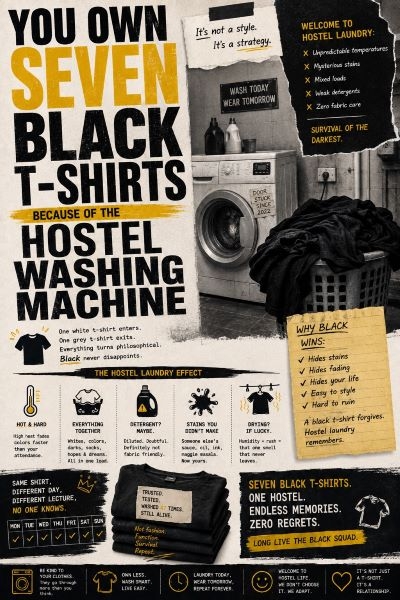
Because there's a rulebook nobody wrote down and everybody follows. No white, because it takes exactly one wash cycle with a stranger's red gamcha to end that experiment permanently. No linen, because ironing is a fantasy and the iron is with a guy on the third floor who has stopped answering. Nothing that says dry clean only, because that is a sentence written for people with cars. Nothing with a care label longer than two lines. Nothing that cannot survive being beaten against a wet floor by a man who is charging you twelve rupees a piece and returning your clothes thinner every month.
Then the monsoon arrives and takes the last of your options. Nothing dries. Your entire cupboard develops that specific smell, the wet-cotton-and-cupboard smell that every hostel kid can identify blindfolded. So you drift toward synthetics, because polyester dries in three hours and cotton dries in never. Which means you now sweat more, which means you buy deodorant instead of solving the problem, which means a body spray becomes a permanent line item in a monthly budget that has no room for it. The clothes got easier. You got worse.
And here's what makes it genuinely funny. The exact wardrobe you were forced into is being sold, right now, at a premium, as a philosophy. Capsule wardrobe. Essentials. Five pieces, twenty outfits. Neutral palette, considered restraint, quiet luxury. There are entire brands whose pitch is a small number of dark, simple, hard-wearing pieces you can wash without thinking. Which is your cupboard. That's your cupboard, at eight times the price, with a founder story attached.
The rich version of a limited wardrobe is called minimalism. The broke version is called being broke. Same clothes. The only variable is whether the constraint was chosen. But the part that actually matters is what happens after. You leave. You get a flat, a job, a washing machine that is yours alone, a balcony that gets sun, an iron you have never once used. And you keep buying the same clothes. Dark, easy, synthetic-safe, machine-indifferent. At twenty-six you will stand in a store, pick up something in a light colour, hold it for a moment, and put it down for a reason you won't examine. That reason is a corridor in a building you moved out of years ago.
That's the thing about constraint. It doesn't feel like constraint from the inside. It feels like preference. You spent three formative years being trained by infrastructure, and infrastructure is the most persuasive teacher there is, because it never argues with you. It just makes one option annoying and lets you conclude you never wanted it.
Every generation gets its uniform decided by something boring. Our parents dressed for offices without air conditioning and iron-dependent formality. We dressed for a queue at 7am and a machine that ate socks. Neither of us picked it, both of us defended it as taste. And honestly, the wardrobe works. That's the annoying part. It's the most functional set of clothes you'll ever own, and it was designed entirely by scarcity. Nothing in it needs babysitting. Everything goes with everything. You can pack for four days in a bag the size of a laptop sleeve. People will spend real money trying to arrive at this on purpose and it will never look as natural on them as it does on a guy walking to a 9am lab in a black tee he has owned since second year. Just be honest
about the authorship. You didn't develop a signature aesthetic. You were shaped by a bucket, a dhobi, a monsoon and a machine you shared with sixty people, and you will spend the rest of your life buying variations of a uniform that none of you designed.
-Devangshu Purohit