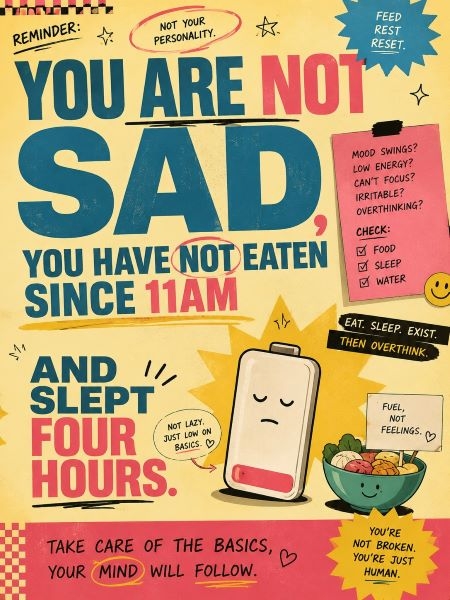
You are not sad, you have not eaten since 11am and slept four hours
You are not sad, you have not eaten since 11am and slept four hours
|


You are not sad, you have not eaten since 11am and slept four hours
Before you diagnose the day, check whether the machine running the diagnosis has been fed.
It always announces itself as a thought and never as a symptom. It is 6pm, you are on the bed with your shoes still on, and the thought arrives fully formed, I am so behind, I have wasted this entire year, everybody else has something figured out and I do not, and it does not feel like a mood. It feels like clarity. That is the specific danger of it. Low states do not present as noise, they present as insight, as the fog finally lifting to reveal what was always true. And you take it seriously because it arrives in your own voice, which is the most trusted voice you know. Meanwhile the actual timeline of the day reads like this. You slept four hours, most of them badly, because you were on your phone until 2:40. You had chai at nine and chai at eleven and chai at three. You had one proper meal, at 11am, roughly seven hours ago. You have been indoors since morning and the last time you spoke to a human out loud was a two sentence exchange with a delivery guy. Nothing in that list is a tragedy and every item on it is a load bearing input, and yet the conclusion you have drawn from it is not I am depleted, it is i am failing.
The mechanism has a name and it is embarrassingly well documented. Your brain does not receive emotions with labels attached. It receives a physical state, tight chest, low energy, flat affect, irritability, and then runs a search for a reason, and it will find one, always, because everybody has a shortlist of grievances available at all times. The technical version is misattribution of arousal, and the classic demonstration is the bridge study from the seventies where men who had just crossed a frightening suspension bridge were significantly more likely to read their own racing heart as attraction to the woman who interviewed them. Same body, different story, and the story felt true from the inside. The sleep evidence is even more direct. Work from matthew walker's lab found that after a night of deprivation, the amygdala responded to negative images dramatically more strongly, while its connection to the prefrontal regions that normally regulate it weakened. In plain terms, four hours of sleep does not just make you tired. It turns the volume up on threat and turns down the thing that keeps threat in proportion, so a mildly annoying message becomes evidence about your entire social standing. The hunger version is cruder and you already know it, it is why every family has a rule about not discussing anything serious before dinner.
None of which means the sadness is fake, and this is where the take usually goes wrong and turns into a wellness lecture where every feeling gets dismissed as low blood sugar. That is not the argument. The argument is about sequence. The content of the 6pm thought is often real, you may well be genuinely stuck in a degree you did not choose, and that deserves attention. But the intensity is being supplied by the body, and intensity is what determines whether you act on it usefully or just lie there being crushed by it. The same true fact, examined after eight hours of sleep and a meal, becomes a problem with steps attached. Examined at 6pm on an empty stomach it becomes a verdict about your character. And the reason this matters practically is that people make real decisions in that state. They send the message. They quit the thing. They decide the friendship is over, the relationship is doomed, the plan is stupid, and then they sleep, and wake up, and the decision looks insane, and rather than concluding anything about their instrument they simply file the whole episode away and repeat it in nine days.
So the useful move is boring, which is the trouble with useful moves. Before you take the thought seriously, run the checklist, when did I last eat, how did I sleep, have I moved, have I been outside, when did I last talk to somebody properly, and just notice how many are red before deciding anything about your life. If three are red, the thought is not evidence, it is a readout. Postpone the verdict. Eat something, actual food, not another chai standing at the counter, and go outside for fifteen minutes even though it will feel pointless, and then see whether the thought survives, because a startling amount of the time it does not, and that is information about the thought rather than about you. And the equally important half, which the wellness version always skips, is what to do when it does survive. If you have slept properly and eaten properly for a stretch and the flatness is still there, if it has been weeks, if it has spread to the things you normally like and to people you normally want to see, then it is not a fuel problem and no amount of walks will touch it. That is worth taking to a professional, and it responds well to treatment, and the only thing standing between most people and that step is the belief that it should be fixable by trying harder. Check the machine first. Then, if the machine is fine and the reading is still bad, believe the reading.
-Maitrayee Repal