The Girls' Hostel Gate Closes At 8. The Boys' Doesn't. The rule isn't written on a noticeboard. It's built into the architecture, and that's why it never has to be defended.
The Girls" Hostel Gate Closes At 8. The Boys" Doesn"t. The rule isn"t written on a noticeboard. It"s built into the architecture, and that"s why it never has to be defended.
|


The Girls' Hostel Gate Closes At 8. The Boys' Doesn't.
The rule isn't written on a noticeboard. It's built into the architecture, and that's why it never has to be defended.
Same campus. Same fee structure. Same degree, same exams, same placement drive, same parents who took the same loan.
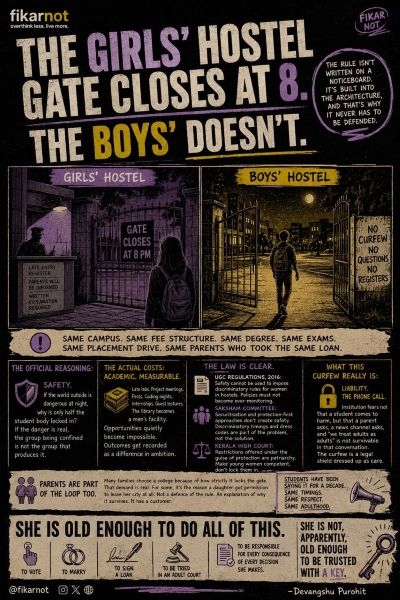
One gate has a register at it. You come back late, you sign, somebody grumbles, nothing happens, everyone goes to sleep. The other gate is a gate. It shuts. There is a warden and a phone call to a parent and a written explanation and a pattern of being asked where you were in a tone that is not asking about your location. Nobody put this on a noticeboard as a policy about gender.
It didn't need announcing. It arrived as infrastructure, and infrastructure is the most effective form of rule-making ever invented, because it never has to argue with you. It just closes. The official reasoning is always safety, and it is delivered with total confidence, usually by someone who has never had to sign a register in his life. And the reasoning does not survive four seconds of contact with its own logic, because if the world outside is dangerous at night, the response has produced a system where exactly one half of the student body is locked in and the other half is out there in the dangerous place, unsupervised, at two in the morning, in the same city. If the danger is real, and it often is, then the group being confined is not the group that produces it.
What the curfew actually does is transfer a public safety failure onto the people most affected by it and charge them for the transfer. And the costs are not abstract. They're academic and they're measurable. This exact contradiction has been documented for years: where a university runs a twenty-four hour library and a women's hostel curfew at the same time, the library becomes a men's facility by default. Lab work that runs late. Project meetings, fest organising, coding nights before a deadline, internships with a commute, that one guest lecture at seven. The pattern in most institutions is not that women are told they can't do these things.
They're told the gate shuts at eight, and the things quietly become impossible, and the outcome gets recorded later as a difference in ambition. None of this is a secret to the people who write the regulations, either. The UGC's regulations from 2016 state it about as plainly as an official document ever states anything: concern for the safety of women students must not be cited to impose discriminatory rules for women in hostels compared to male students, and campus policies should not turn into over-monitoring. That language did not appear from nowhere. It came out of the Saksham committee's work, which found, after going campus to campus, that securitisation and protection-first approaches do not actually produce safety, and specifically named discriminatory hostel timings and dress codes as part of the problem rather than the solution.
The Kerala High Court, hearing a challenge from medical students to a 9.30pm restriction that applied only to women, put it in language nobody could misread: restrictions offered under the guise of protection are patriarchy, and if young women are not equipped to look after themselves then the job of the state is to make them competent rather than to lock them in. So the rule has been formally criticised by the regulator, by a government-appointed committee and by a High Court. And it is still there, at your gate, tonight. Which tells you the rule was never really about a risk assessment. It's about liability, and it's about the phone call. The institution's actual fear is not that a student comes to harm. It's that a student comes to harm and a parent asks what time she left, and a news channel asks what the college's policy was, and an answer of "we treat adults as adults" is not survivable in that conversation while "gate closes at eight" is. The curfew is a legal shield dressed up as care. It protects the institution first and the student incidentally, if at all.
And parents are inside this loop too, not outside it. Plenty of families genuinely choose a college because of how strictly it locks the gate. That demand is real, it's often the only condition under which a daughter got permission to leave her city at all, and any honest piece about this has to admit that for some students the strict hostel is the reason they're on a campus rather than at home. That's not a defence of the rule. It's an explanation of why it survives, which is that it has a customer. The students have been saying all of it for a decade, loudly, in cold weather, at gates, in every city, and the demands have been consistent and modest. Same timings as the men. A register instead of a lock. An adult treated as an adult by an institution that is happy to treat her as an adult when the fee is due, when the attendance shortfall is calculated, when she signs a document accepting that she alone is responsible for her academic performance. Because that's the contradiction at the base of the whole thing, and it isn't complicated. She is old enough to vote, to marry, to sign a loan, to be tried in an adult court, to be responsible for every consequence of every decision she makes. She is not, apparently, old enough to be trusted with a key.
-Devangshu Purohit