EVERYONE IS DIAGNOSING THEMSELVES OFF A 30 SECOND VIDEO AND THE DIAGNOSIS IS ALWAYS THE FLATTERING ONE NOBODY HAS EVER WATCHED A REEL AND GONE, OH, SO I AM THE DIFFICULT PERSON IN MY FRIENDSHIPS.
EVERYONE IS DIAGNOSING THEMSELVES OFF A 30 SECOND VIDEO AND THE DIAGNOSIS IS ALWAYS THE FLATTERING ONE NOBODY HAS EVER WATCHED A REEL AND GONE, OH, SO I AM THE DIFFICULT PERSON IN MY FRIENDSHIPS.
|


EVERYONE IS DIAGNOSING THEMSELVES OFF A 30 SECOND VIDEO AND THE DIAGNOSIS IS ALWAYS THE FLATTERING ONE
NOBODY HAS EVER WATCHED A REEL AND GONE, OH, SO I AM THE DIFFICULT PERSON IN MY FRIENDSHIPS.
There is a very specific eleven seconds that has happened to all of us. A video starts with "five signs you have undiagnosed adhd," the signs are: you procrastinate, you lose things, you are bad at boring tasks, you hyperfocus on things you love, and your room is messy, and by sign three you are already texting the video to someone with the caption "this is literally me." and look, sometimes it genuinely is. That is the annoying complication in the middle of this entire piece. Plenty of people, especially women, especially anybody who was quiet and got decent marks, went through school with something real and undetected, and a reel was the first time anybody described their inner life back to them accurately, and that mattered. but notice which conditions the algorithm hands out and which ones it never does. adhd, autism, and the ex being a narcissist. That is the trinity.
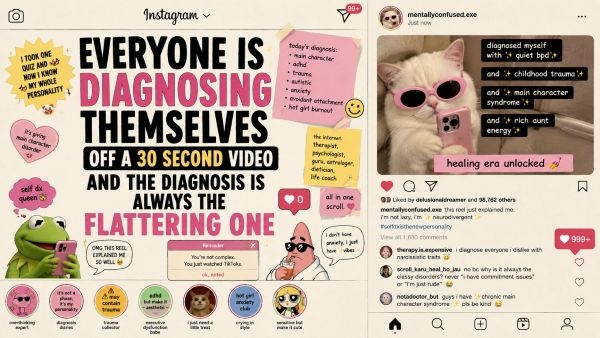
These are the three that keep circulating because they are the three that flatter. Added in the reel version means your brain is too fast and too creative for a boring world. Autism in the reel version means you are too perceptive and too honest for small talk. and the narcissist diagnosis, which you are always applying to somebody else, means the entire history of a relationship can be reassigned in one clean transaction where you were the empath and they were the disorder. What you will never see, not once, is a video with two million saves titled "signs you have avoidant traits and everybody has quietly stopped inviting you." there is no viral content for "you may be the friend who makes every hangout about a crisis." Nobody is saving the reel about how the thing you have identified as anxiety might partly be that you have not kept a single promise to yourself in eight months and some part of you has noticed. Those framings exist in actual clinical literature.
They just do not travel, because the currency of the feed is identification and nobody identifies with the version that costs them something. So the pool of available self diagnoses is pre-filtered for dignity, and the ones that survive are the ones that convert a difficulty into a distinction. A bad habit becomes a neurotype. An ordinary failure of effort becomes a symptom. and the moment it becomes a symptom, it stops being your responsibility, which is the actual product being sold here, not information, absolution. The real cost of this is not that people are faking, because mostly they are not faking, they are earnest and a bit desperate and doing amateur pattern matching with the only tools available at 1am. The cost is that a label arrives and the curiosity stops.
You had a real question, which was why is it so hard for me to start things, and that question had an actual answer sitting under it, possibly adhd, possibly that you are running on five hours of sleep, possibly that you are in the wrong degree because of a conversation your family had about you in eleventh standard, possibly three of those at once. The label answers it in one word and closes the file. And once the file is closed you stop investigating and start collecting, more videos, more confirmations, an identity built out of a symptom list, and the specific problem with an identity built out of a symptom list is that improving becomes a kind of betrayal of yourself. Also, and this needs saying in an Indian context, the label frequently gets deployed as an argument. "I have adhd" arrives as the closing statement in a fight about being consistently forty minutes late, and even if it is medically true it is being used the way it is being used, which is to end a conversation rather than start one.
None of which means self recognition is worthless, and the smug take that everybody should just shut up and see a psychiatrist ignores what that actually costs here. A decent psychiatric consult in a metro is one and a half to three thousand rupees, assessments run much higher, the waiting lists are real, the good clinicians are concentrated in about six cities, and telling your parents you want to see one is its own project with its own three week runway.
Against that, a free video that names your experience is not stupid, it is the only door that was open. so use it as a door. write down the actual pattern rather than the label, when it happens, since when, what it has cost you, whether it shows up at work and at home or only in one, because that is the information a professional will ask for and a symptom list is not. tell one person who knows you and can be honest about whether they see it too. and hold the diagnosis loosely enough that you can still be surprised, especially if it is the flattering one, because the useful thing about a real assessment is not the name at the end. it is that somebody outside your own head, who is not optimising for your engagement, gets to look at the pattern and tell you what they see, including the parts you would never have saved to a folder.
-Maitrayee Repal