Your camera roll has 14,000 images and you have never once looked at 2019
Your camera roll has 14,000 images and you have never once looked at 2019
|


Your camera roll has 14,000 images and you have never once looked at 2019
An archive nobody visits is not a memory. It is storage.
Scroll to the top of your gallery, all the way, past the years, and watch what is actually in there.
Four hundred screenshots, of which maybe six were needed for longer than an afternoon, a bank reference number, a meme you sent immediately and never saw again, a screenshot of a conversation you were going to show somebody in 2021, a photo of a whiteboard from a lecture you did not attend the rest of, nine near identical shots of the same plate of food, thirty one attempts at the same picture in the same pose because your friend cannot hold a phone level, a blurred photo of a parking spot, a photo of a document, a video that is fourteen minutes long and has never been watched by any human including you. And scattered through all of it, buried, unfindable, are perhaps two hundred images that would genuinely stop you if you saw them. That is the arithmetic. The signal exists. It is inside a haystack you built yourself, at a rate of roughly nine images a day, and the entire system runs on an assumption you have never examined, which is that capturing is the same as keeping.
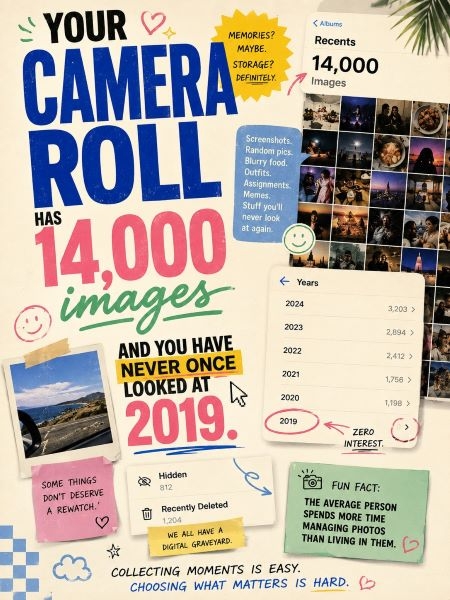
The intuition underneath is that a photo secures the memory, and the research pushes in the opposite direction. Linda henkel's museum study is the one people cite, where visitors who photographed objects remembered fewer details about them afterwards than visitors who simply looked, the so called photo taking impairment effect. Later work complicated it, the effect is not universal and photographing with intention behaves differently from photographing reflexively. But the mechanism that does seem to hold is offloading, the same thing that happens with phone numbers. Once your brain registers that a record exists elsewhere, it deprioritises the encoding, because why spend the metabolic cost of storing something that is safely on a device. That trade is rational and it would even be a good deal, except for the second half of the contract, which nobody honours. You offloaded the memory to an archive on the understanding that you would go back. You have never gone back. 2019 has sat there for years, untouched, a year of your life in ten thousand pieces that you have technically saved and functionally deleted.
And the deeper cost is not the forgetting, it is what the reflex does to the moment itself. There is a mode of attention that is fundamentally different from looking, and it is the one where you are evaluating the frame while the thing is happening. Where is the light. Is the angle right. Should i get a wider one. It is the difference between being at your cousin's haldi and covering your cousin's haldi, and once you are covering it you are staff, you are working, you have taken a position slightly outside the event in order to record it properly, and everybody at that function is doing the same thing so the event now has no audience at all, only crew. The strangest version of this is the concert, an entire arena of people watching a screen held at arm's length, filming a video with terrible audio that they will watch precisely once, on the ride home, and never open again. Meanwhile the person who watched it with their eyes, no phone, has the actual footage, permanently, in the only archive that ever gets revisited without effort. And the giveaway that the phone version is not really about memory is what happens to those videos. They are not made to be rewatched. They are made to be posted, watched by others for four seconds, and
abandoned, which means the true function was never preservation. It was broadcast.
So the fix is not the puritan one where you leave the phone in your bag and feel superior. Photos are genuinely one of the great inventions and your grandmother has eleven pictures of her entire twenties and would have loved more. The fix is separating the two jobs the camer roll is currently doing badly at once, utility and memory. Screenshots, documents, receipts, parking spots, whiteboards, all of that is utility and it has a lifespan of about a week, so it should be culled ruthlessly and not left to breed. What remains should be treated like a memory system rather than a landfill, which mostly means doing the two minute thing at the end of any big day, going through and keeping the four that matter, deleting the twenty nine that do not, and putting the four somewhere with a name. And then the part that makes any of it worth doing, actually go back. Open 2019 tonight, on purpose, for ten minutes. It will be a stranger experience than you expect, because you have several thousand images of a person you were and no longer entirely are, and you have never once sat with them. An archive nobody visits is just a hard drive with your face on it. The visiting is the whole point, and it is the only step in this entire process that has never been automated, because it is the only one that requires you to be there.
-Maitrayee Repal