Mess Food Is A Shared Generational Trauma And Nobody Has Written It Down
Mess Food Is A Shared Generational Trauma And Nobody Has Written It Down
|


Mess Food Is A Shared Generational Trauma And Nobody Has Written It Down
Ten lakh people are eating the same yellow dal tonight in different cities and none of them will ever compare notes.
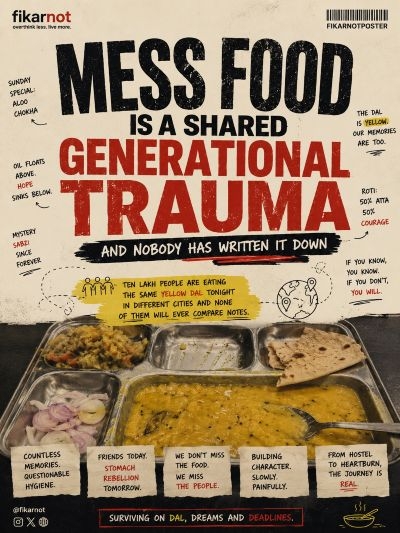
You can identify the day of the week by smell before you reach the stairs. Every mess in India runs the same calendar and nobody has ever seen it written down. Wednesday is paneer, which means a fluorescent gravy in which small white cubes have been suspended like evidence. Saturday might be chicken, which is the only meal with a queue that forms early and a politics of its own, because everyone knows the good pieces are in the first ladle and the last forty people are getting a bowl of hot orange water with a bone in it. Sunday is the special that isn't. And the dal is eternal, unchanging across states, institutions and decades, a yellow constant so reliable that it should be used to calibrate instruments. There are ten lakh people eating this exact meal tonight across this country and there is no literature about it whatsoever. That's the strange thing. This is one of the most universal shared experiences of Indian young adulthood, easily more common than the wedding you'll write six essays about, and it exists entirely as complaint. It has produced no writing, no film worth naming, no proper documentation. Everybody suffers it, everybody makes the same three jokes about it, nobody has ever sat down and said what it actually does to you.
Because it does things. It teaches you a specific relationship with food that takes years to unlearn, which is that eating is a chore performed inside a forty-minute window against a clock you don't control. You are not choosing. You are receiving. The rice count becomes a negotiation with a man who has decided your worth today. There is a ritual of asking for one more roti and being looked at. There's the second-plate economy, the friend who gets extra because he's friendly with the staff, the entire informal diplomacy of being on good terms with the guy holding the ladle, which is the first office politics anyone in this country ever learns and it is learned at eighteen with a steel plate in hand. And it produces the parallel economy that props the whole thing up. Maggi at eleven, because dinner ended at eight-thirty and the body has opinions. The Amul cheese slice that upgrades anything. The bhaiya outside the gate who has made a small fortune out of an institution's failure to feed people, and who is, in most hostels, more essential to survival than the mess itself. The tiffin service one guy's family arranged that turns him into a local celebrity. The half-fridge with four people's names on it. Every hostel in India has a shadow food system that exists purely because the official one doesn't work, and everyone treats this as normal rather than as the plain evidence of institutional failure that it is. Nobody complains upward, either. That's the other half of it.
There's a mess committee. It exists. There's a register where you can write comments and it has the same four entries from 2019 in it. There's a meeting nobody attends, held at a time chosen to ensure nobody attends. And the standard response to any complaint is that the rate per plate is fixed and the budget is what it is, which is often actually true, and is also the exact sentence that ends every conversation about anything in this country. The economics are genuinely brutal, to be fair to the people cooking. Feed several hundred people, three meals, at a per-head daily rate that would not buy you one cafe sandwich.
There is a person in that kitchen at 5am doing something close to impossible with what they've been given, and the students shouting at the counter are shouting at the wrong end of the chain entirely. The failure is upstream, in a contract signed by people who will never eat from it. And then, the part that nobody expects. You'll miss it. Not the food. Never the food. You'll be twenty-six, in a flat, ordering something expensive on an app for the fourth night running, eating it alone in front of a screen, and something will land that you weren't ready for. Because what the mess actually gave you, badly, accidentally, through terrible dal, was a table with people at it. Three times a day, without arrangement, without a group chat, without anyone having to be free.
You sat down and there were friends there. That is the single hardest thing to obtain in adult life and it was handed to you daily, for free, and you spent the entire time complaining about the sabzi. That's the trauma nobody writes down, and it isn't the food. It's that you were, for three years, never once made to eat alone, and you had no idea that was the luxury.
-Devangshu Purohit