Nothing Fits Because The Size Chart Is Lying To You
Nothing Fits Because The Size Chart Is Lying To You
|


Nothing Fits Because The Size Chart Is Lying To You
Same body, same afternoon, three different sizes. The tag is a manufacturing note, not a verdict on you.
Three shirts, three brands, all the same letter on the label.
The first one won't clear your shoulders. The second one hangs off you like it's still on the hanger. The third one, somehow, fits. Same body. Same afternoon. Same forty minutes, one trial room, terrible lighting, a queue outside and a guy knocking to ask if you need another size. And in that little cubicle, almost nobody thinks the correct thought, which is that these three companies are using three different measurement systems. What happens instead is quieter and much meaner. Something forms about your shoulders. Or your stomach, or your arms, or your hips, and it's phrased in the second person, and it stays.
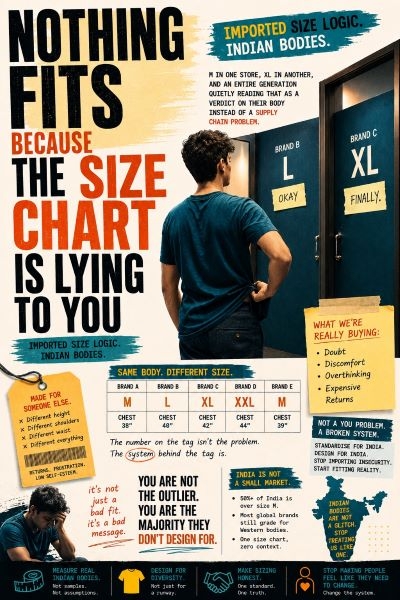
So here's what's actually going on behind that curtain, because it is genuinely not about you. There is no universal legal standard for what Small, Medium and Large mean. Those are letters. Not units. Not measurements of anything. Every brand sets its own, and the way they set it is this: a company picks a fit model, which is one single human being whose proportions they consider representative, cuts the base size on that person, and then grades every other size up and down from there using a formula. Which means an entire range of clothing, thousands of garments, is mathematically extrapolated from one stranger's body. If that stranger isn't proportioned like you, nothing in that store is going to work. Not one item. And you're going to stand there interpreting that as information about yourself. Now stack the second problem on top. Most of what sells here has historically been cut on charts borrowed from the US, the UK or Europe, because there was no Indian alternative to borrow from. Populations differ in ways that have nothing to do with size and everything to do with proportion. Shoulder-to-waist ratio. Torso length. Arm length. Where the curve of the hip sits relative to the waist. A chart built on one population's average will misfit another population's in ways that feel personal and are completely structural. This isn't a theory anyone has to take on faith. The government eventually treated it as the industrial problem it is. The Ministry of Textiles sanctioned a project called INDIAsize, run through NIFT, which put more than 25,000 people aged 15 to 65 through 3D body scanners across six regions covering Delhi, Mumbai, Chennai, Hyderabad, Kolkata and Shillong. The reasoning was blunt. Small, Medium and Large follow no common Indian standard, most brands here rely on charts derived from the US and UK, and the fit chaos that comes out of that has to be fixed at the source. The resulting standard is now being pushed toward adoption.
Sit with the scale of that for a second. It took a national survey, government sanction, thousands of body scans and years of work to establish something an entire country had been quietly blaming itself for one trial room at a time. Then there's vanity sizing, which is the part that should genuinely annoy you. Brands have, for decades, gradually attached smaller labels to the same measurements, because a customer who feels good about the number on the tag buys more. That is the entire reasoning. Which means the label is not even trying to be information. It is an emotional instrument, tuned deliberately, to produce a feeling in you at the counter. Once you know a lever is being pulled, it gets significantly harder for it to pull you.
And the industry is fully aware the system is broken, because it pays for it constantly. Apparel has brutal return rates online and fit is the single biggest reason people send things back. That cost is not a surprise to anyone. It's forecast, budgeted, absorbed as the price of doing business. So the failure is a known line item on a spreadsheet, and the shame produced by that failure is being carried, unpaid, by people standing in front of mirrors.
That's the actual trade happening here. They keep the margin. You keep the feeling.
The practical fix is unglamorous and has been sitting in every neighbourhood forever, which is that fit is a service, not a size. Buy for the widest part, alter the rest. Almost every person you've ever seen and thought looked sharp is either wealthy enough to buy clothes cut for their proportions or smart enough to spend two hundred rupees getting them adjusted afterward. Nobody in that group is naturally the right shape for a mass-produced garment. That shape does not exist. It was invented in a design studio and given to a fit model.
None of which makes a bad trial room afternoon feel better in the moment. But it does change
what the evidence means.
A size tag is a manufacturing note. It was written by a stranger who has never met you, working
from a chart built around a body that isn't yours, for a company that has decided its returns are
cheaper than its rethinking.
You were never the wrong size.
You were reading somebody else's homework and marking yourself on it.
-Devangshu Purohit