Every Cafe In India Serves The Same Six Things
Every Cafe In India Serves The Same Six Things
|


Every Cafe In India Serves The Same Six Things
Exposed brick, one neon line, pesto pasta. You could be in any city in this country and you would never know.
Take a photo inside the cafe you went to last weekend and show it to someone who wasn't there.
They cannot tell you the city. Not the state, not the region, not whether you're in Pune or Indore or Guwahati or a hill station three hours from a highway. They can tell you the year, roughly, because the aesthetic moves in cycles. But the location has been successfully deleted from the room, and this was done on purpose, and it worked so completely that we stopped noticing.
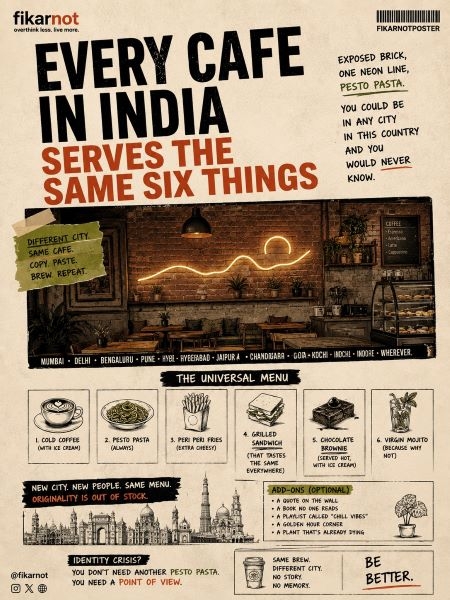
The checklist runs itself. Exposed brick, or the paint that pretends to be exposed brick. Filament bulbs on black wire. One neon sign in cursive saying something about coffee or good vibes, positioned at the exact height for a photo. Monstera in a corner, possibly plastic. A wall of mismatched frames. Wooden crates as furniture. A menu in a sans-serif font with lowercase headings. Terrazzo, if the owner spent more. And one seat that everyone in the room understands is the good seat, angled at the window, occupied for two hours by someone with a laptop and a cold coffee they finished ninety minutes ago. Then the food, which is the funnier
part, because it is six dishes wearing forty names. Pesto pasta. A pizza on a wooden board. A burger with a flag in it. Nachos. Some form of chicken in a bowl with rice and a name that suggests either Korea or Mexico depending on the sauce. A cheesecake in a jar. Every cafe in this country serves these, in every city, at almost the same price, prepared to almost the same standard, and each one presents them as a point of view. And it isn't laziness. That's what makes it interesting.
This is a rational business decision, repeated ten thousand times independently, converging on one answer. If you open a cafe today your primary marketing channel is other people's Instagram. That means the room has to photograph well before it has to feed anyone well, because the photo is the ad and the food is just the thing that keeps the person seated long enough to take it. There is a known set of visual elements that photograph well on a phone in warm light. Everyone has access to the same reference material, which is the same global feed.
So everyone builds the same room. Not by copying each other consciously, but by optimising honestly for the same metric, which produces identical outputs, which is what optimisation always does. The menu follows the same logic. Six dishes that a cook can be trained on quickly, whose ingredients hold for a week, that work at a price point students will pay, that are familiar enough that nobody has to be brave. Regional food is expensive to do properly, needs a cook who actually knows it, doesn't hold, and worst of all, people have opinions about it. Your
grandmother has a position on it. Nobody's grandmother has a position on pesto. That's the actual mechanism. The safest food is food nobody's family has a claim on. So an entire generation now has a default third place that is deliberately from nowhere, and the cost of it is quiet and adds up.
Because there used to be a version of this that was rooted. The Irani cafe. The old Udupi with the marble tables and a man who has worked there for thirty years and does not need to ask what you want. The bakery in a lane in Pune that has been doing one thing since before your parents met. The Bengali cabin, the Kerala tea shop, the place near the station that is famous for exactly one item. Those places were not designed. They accumulated. The lighting was bad because nobody thought about lighting. The chairs were uncomfortable in the specific way that means they were bought once, correctly, in 1981.
And they're closing, or converting, and the conversion is the sad bit. Because the ones that survive often survive by installing the brick, the bulbs, the neon and the pasta, at which point the thing that made them worth preserving has been removed to fund the preservation. Some of this is genuinely good, and it's worth saying. Cafes gave a lot of Indian young people the first public space that was theirs. Not a home with parents in the next room, not a college with an attendance register, not a mall built for transactions. A table you can sit at for three hours over one order, where nobody asks who you are, where a couple can sit without a family friend reporting back, where four people can work on something without needing a room. That's a real contribution to the social infrastructure of this country and the aesthetic monoculture is the price of scaling it. But you should know what you're paying. You're paying in the fact that a generation is having its most-photographed years in rooms that are professionally indistinguishable, and that the photographs will not tell your kids where you were. Just what year it was, and what the algorithm liked at the time. The neon sign says live laugh brew, in cursive, at the correct height.
It says that in every city. That's the entire point of it.
-Devangshu Purohit