The paralysis of picking... 400 options on netflix and you rewatch the same thing every night You did not spend forty minutes choosing a movie. Youspent forty minutes avoiding the cost of choosing one.
The paralysis of picking... 400 options on netflix and you rewatch the same thing every night You did not spend forty minutes choosing a movie. You spent forty minutes avoiding the cost of choosing one.
|


The paralysis of picking... 400 options on netflix and you rewatch the same thing every night
You did not spend forty minutes choosing a movie. You
spent forty minutes avoiding the cost of choosing one.
The ritual deserves to be described accurately because it is one of the most universal experiences of this decade and nobody has held a funeral for the evening it eats. It is 9:30. You open netflix with genuine intent, tonight you will watch something, maybe even the thing everybody has been talking about. You scroll the first row. You scroll the second row. You add something to your list, which is where content goes to die, your list currently holds sixty three items and functions as a museum of previous intentions. You watch a trailer at 1.5x. You check the imdb rating on your phone, then a reddit thread about whether it gets better after episode three, because you no longer trust your own reaction to things without consulting a committee.
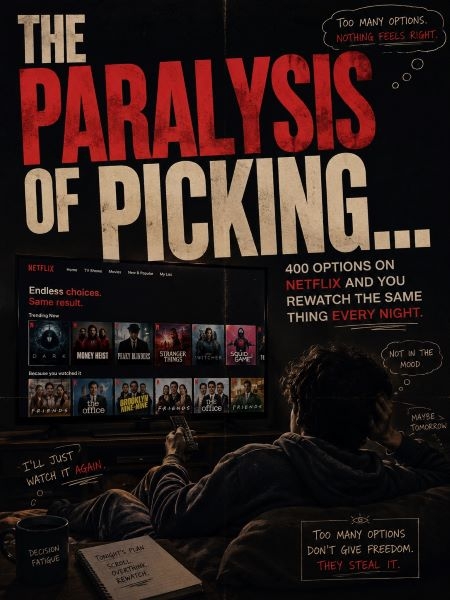
Somewhere around the forty minute mark a quiet exhaustion sets in, the specific fatigue of having made no decision while doing nothing else, and you put on the office. Season four. You will be asleep in twenty five minutes. The service has technically served you thousands of options and you have used it, tonight and most nights, as the world's most expensive way to watch something you own the DVD of.
The psychology here got famous through the jam study, the supermarket experiment where a stall with twenty four jams attracted more browsers but a stall with six jams produced ten times more purchases, and through barry schwartz's paradox of choice, the argument that beyond a point, options stop feeling like freedom and start functioning as burden. Worth saying honestly, the jam finding has had a rocky time in replication and choice overload does not appear everywhere researchers look for it. But the conditions under which it reliably does appear read like a description of a streaming platform on purpose. It shows up when options are numerous, hard to compare, unfamiliar, and when the chooser is tired. Four hundred titles across genres you cannot rank against each other, described by thumbnails engineered by a/b testing, evaluated at the exhausted end of a working day. It is the perfect storm the literature predicted, built at scale and installed in every home. And the sharpest part of schwartz's argument was never about the difficulty of choosing, it was about what large choice sets do to the experience afterwards. When there were six options, a mediocre pick was bad luck. When there are four hundred, a mediocre pick is your fault, and every minute of a so-so movie now carries a faint hum of the better movie you failed to find, which is why people check their phone during films they chose freely, they are still shopping.
The rewatch, seen properly, is not a failure of the system, it is your solution to it. It is the only option on the platform with zero risk, zero evaluation cost, and zero opportunity cost regret, because you cannot pick wrong when you already know exactly what you are getting. That is a rational response to a hostile environment and psychologists have names for the two strategies
in play. Maximisers try to make the best possible choice, exhaustively, and score their outcome against every alternative. Satisficers pick the first option that clears a bar and stop looking. The research on this is unusually consistent, maximisers end up with objectively slightly better
outcomes and feel measurably worse about them, less satisfied, more regret, more comparison.
The forty minute scroll is maximising. The office is satisficing with a nostalgia coating. And the reason this pattern matters beyond your evening is that the same architecture now runs your entire life. Dating apps turned people into a browsable inventory where every match hums with the possibility of a better profile two swipes away. Food delivery turned dinner into a forty option decision made hungry, which is the worst documented condition for deciding. Job portals, travel booking, even friendship in a big city has acquired the texture of a catalogue. The evening on
the couch is just the place where the condition is easiest to observe, because the stakes are low and the behaviour is still identical.
The fixes are unglamorous and they all amount to the same move, deciding how you will decide before you are inside the choice. Give the scroll a timer, ten minutes, and if nothing is chosen the default is the first thing on your list, which finally gives the museum a purpose. Better, decide the category in advance, tonight is a comedy under two hours, because a constrained choice
set is the entire lesson of the literature, six jams, not twenty four. Better still, let somebody else pick and surrender fully, no vetoes, which is one of the underrated pleasures of being in any kind of relationship. And keep the rewatch, genuinely, it is doing regulation work the previous piece in this series already covered.
The only thing worth retiring is the forty minute scroll, because it is the worst of every world, all the fatigue of maximising with none of the movie, and the honest name for it is not indecision. It is window shopping for a life you are too tired to start at 9:30 on a tuesday, and the window is winning.
-Maitrayee Repal