It's 42 Degrees And You're Dressed For ChicagoWe import our silhouettes from cold countries and then buy an air conditioner to survive them.
It"s 42 Degrees And You"re Dressed For Chicago We import our silhouettes from cold countries and then buy an air conditioner to survive them.
|


It's 42 Degrees And You're Dressed For Chicago
We import our silhouettes from cold countries and then buy an air conditioner to survive them.
Look at the fit. Oversized black tee. Over that, an oversized shirt worn open, sleeves rolled once. Cargos with more pockets than you have possessions. High socks. Chunky sneakers built for a city that gets snow. Maybe a cap. The photo is genuinely excellent. It will do numbers. Now look at the person. It is two in the afternoon in May, the auto has no roof worth mentioning, and there is a sweat patch travelling down a spine like a slow leak. He is not fine. He is committing.
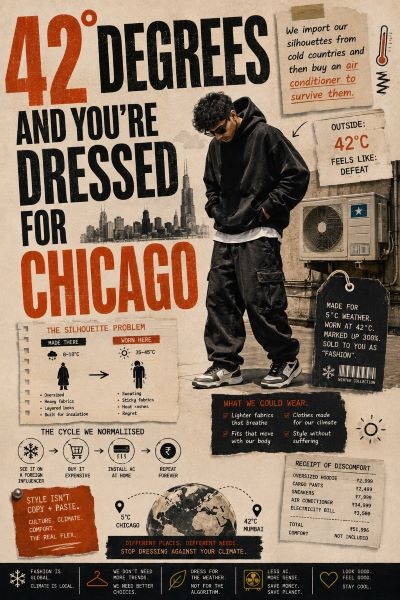
We do this every single year and nobody says the obvious thing out loud, which is that almost every trend arriving on your feed was designed in a place where it is cold. That's the whole mechanism. Layering is not a style invention, it's a heating solution. You put a shirt over a tee in New York or Seoul or London because the temperature genuinely requires a second layer, and fashion did what fashion does, which is take a functional necessity and make it look intentional. Then it travels. And what travels is the image, never the reason. So a silhouette engineered for fifteen degrees lands in a country where fifteen degrees is a news event, and we adopt the shape and quietly delete the logic that produced it. Then there's the fabric, which is worse.
Fast fashion runs on polyester because it's cheap, holds its shape, takes prints beautifully and survives shipping. It also does not breathe, traps heat and holds smell. The oversized graphic tee, the thing our entire generation is functionally uniformed in, is very often a greenhouse with artwork on it. Add black, which absorbs everything the sun sends, add closed chunky shoes in a month where the roads are ankle-deep water, add socks pulled high in ninety percent humidity, and you have an outfit that is fighting the climate on every single front while its wearer insists he's comfortable. Meanwhile there is an entire technology sitting in your father's cupboard, classified as uncle clothes. Loose cotton. Mul. Khadi. The kurta, which is essentially a garment engineered over centuries by people solving for exactly this weather with exactly these materials, using exactly the principle that modern performance wear brands now charge you a premium to rediscover, which is that air should be allowed to move. The lungi, the most aerodynamically sensible thing any Indian man will ever wear, and the one he will only wear where nobody can see him. We didn't abandon that clothing because it stopped working. It never stopped working. We abandoned it because it stopped being aspirational, and that's a different problem entirely.
Because global fashion status flows downhill from cold countries. Think about what formality even is here. The suit is three layers of wool designed for damp northern European weather, and we installed it as the uniform of Indian offices, courtrooms and weddings, and then solved the resulting crisis by building an entire air conditioning industry to make the buildings cold enough to justify the clothes. Read that again. We are refrigerating rooms in Chennai in April so that a dress code from London can survive inside them. That's not fashion. That's a climate control subsidy for someone else's tradition. The good news is that the correction is finally happening, and it's happening from the top of the market downward, which is the only direction anything ever happens in this country.
Indian labels are doing khadi in cuts that read as modern rather than ceremonial. The kurta is re-entering through the streetwear door as an overshirt. Co-ords are just pyjama logic with better marketing. And the funniest one, resort wear, is a category that consists almost entirely of loose cotton in light colours, which is to say it is subcontinental daily clothing that went abroad, got a rebrand and came back at four times the price with a linen surcharge. That's the loop we're stuck in. You can walk into a store today and pay several thousand rupees for a breathable oversized cotton overshirt in an earth tone, and it will be, in every meaningful way, a kurta your grandfather owned in three colours and wore without commentary.
None of this is an argument for dressing like a wedding guest at a lecture. Streetwear is fun, the fits are genuinely good, and nobody's asking anyone to give up an aesthetic they like. The point is narrower. Right now the climate is winning and we're pretending it isn't. There are people carrying a hoodie in June because the outfit requires it, changing shirts twice before an evening plan, and treating sweat as a personal failing rather than a predictable outcome of wearing plastic in the sun. The weather always had an opinion about what you should be wearing. It's the one voice in the conversation that isn't selling you anything.
We just spent twenty years dressing for someone else's winter.
-Devangshu Purohit