Comedy Is Doing A Job It Was Never Meant To Do
Comedy Is Doing A Job It Was Never Meant To Do
|


Comedy Is Doing A Job It Was Never Meant To Do
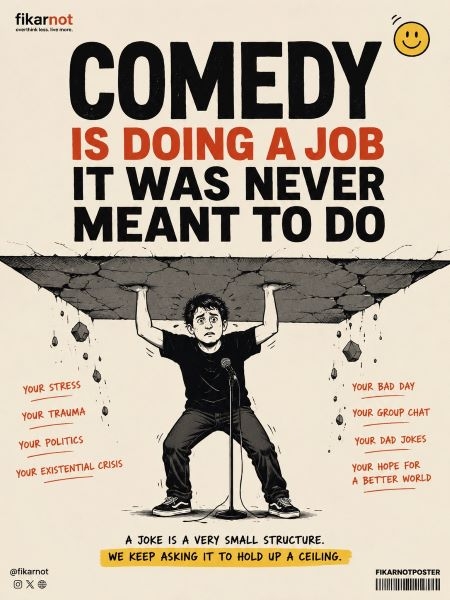
A joke is a very small structure. We keep asking it to hold up a ceiling.
Somewhere in this country tonight, in a room above a restaurant, sixty people are paying four hundred rupees each to hear a man in his late twenties say a thing that most of them have thought and none of them have said out loud at work. That's the transaction. It has almost nothing to do with laughing.
Stand-up in India grew up fast and slightly sideways. It arrived as entertainment, the same as anywhere else, five minutes on airport queues and Indian parents and how weird it is that we all have a mama who behaves like that. And then, over about a decade, it quietly turned into something else. It became one of the few remaining rooms where a certain register of speech is still permitted, and the moment that happened, the joke stopped being a joke and started being a delivery mechanism. Ninety percent bit, ten percent thing that couldn't be said any other way, and the ten percent is what everyone actually came for.
Which is a serious amount of weight to put on a form built for a punchline every twenty seconds. The record of what happens next is not vague, and it's worth stating plainly rather than vibing about it. In January 2021 Munawar Faruqui was arrested in Indore after a complaint by the son of a sitting MLA, booked under the section of the penal code dealing with acts intended to
outrage religious feelings, over material at a show in a cafe. Later that year both he and Kunal Kamra had multiple shows cancelled across cities after threats from organised groups, in situations where security did not materialise. In 2025 Kamra's parody targeting a Maharashtra politician led to an FIR, a venue in Mumbai being vandalised by party workers, and eventually the Bombay High Court directing that he not be arrested. Going back, All India Bakchod
collected a pile of FIRs over a roast in 2015 on obscenity grounds. And in August 2025 the Supreme Court, hearing a cluster of cases that included petitions from the India's Got Latent fallout, directed a group of comedians to publicly apologise for remarks about people with
disabilities.
Notice that the last one is different from the others, and this is where honest writing about the
subject usually collapses.
Because comedians in India are not one thing. Some of them are getting hit for satire aimed upward at power, which is a free expression problem with a long and unhappy history. And some of them are getting hit for jokes about disabled people, which is not censorship, it's an audience with a grievance that a court found worth acting on. Both are happening in the same industry, sometimes to the same lineup, and pretending they're one story helps nobody. Legal commentary on this is fairly consistent that offence alone has not been treated as sufficient for criminal liability absent a genuine threat to public order, which is precisely why the practical action tends to be the FIR, the cancellation, the venue withdrawing, the pre-emptive shutdown. The point is rarely the conviction. The process is the punishment, and everybody involved knows it.
Meanwhile the audience has developed an appetite that no comic ever asked to satisfy. We started using comedians as a proxy for institutions. When enough formal channels feel narrowed or slow or compromised, whatever gets said in an unregulated room starts to feel like the last honest speech in the country, and the person saying it gets promoted, in the crowd's imagination, from entertainer to representative. You can watch it happen live in the clips. Somebody says the thing, and the sound the room makes isn't laughter. It's release. That's a different noise and every comic can tell them apart from the stage. And the cost of that promotion is paid by one person, alone, with no institutional cover behind them.
A newspaper has lawyers. A political party has cadre and a legal cell. A studio has a compliance team. A stand-up comic has a phone, a manager if he's doing well, a venue owner who will fold in under an hour because his licence is the thing on the line, and a comment section that will turn on him from both directions within a day. He is structurally the most exposed speaker in the country and we have handed him the heaviest brief.
There's a counter-argument here and it deserves saying, because comedians are not all victims and some of them enjoy this enormously. Getting into trouble is a growth strategy. A cancelled show is worth more in reach than a completed one. Certain comics have discovered that the fastest route to relevance is to be shouted at by the right people, and the sincerity of the free speech framing gets a bit thin when the clip goes up within the hour with the controversy in the caption. Meanwhile audiences claim they want dangerous comedy and then applaud only the danger pointed in the direction they already like. Nobody in this ecosystem has clean hands, including the people watching.
But the structural thing stays true regardless of who's being cynical about it. A joke is a small, fragile machine. It's designed to hold a single idea for about fifteen seconds and then get out of the way. We have spent a decade loading it with everything else... commentary, dissent, grief, the entire national argument, the stuff that used to live in newspapers and public meetings and speech that felt less expensive. Small structures under heavy load fail in predictable ways.
The room upstairs is full tonight anyway. Sixty people, four hundred rupees, one guy walking out to a mic to find out which of tonight's lines is the one that follows him home.
-Devangshu Purohit