Is Britain Still British? How Immigration and Islam Are Reshaping National Identity
Is Britain Still British? How Immigration and Islam Are Reshaping National Identity
|


Is Britain Still British? How Immigration and Islam Are Reshaping National Identity
There was a time when even asking this question out loud would've gotten you laughed out of the room. Now it's like... one of THE most heated conversations in British politics, no cap. Walk through parts of London, Birmingham, Bradford, or Luton and a lot of people, especially on the political right, will tell you the Britain
they grew up in just doesn't exist anymore. And for them it's not really about numbers on a census. It's about identity. Culture. The whole "do I still belong here" feeling.
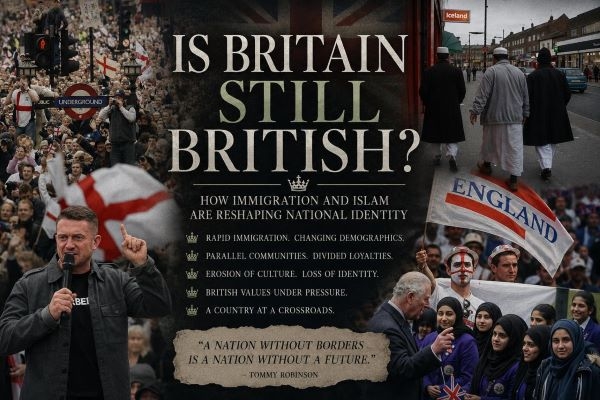
The Multiculturalism Promise, Explained For decades the UK government's whole pitch was... multiculturalism works, immigration is good actually, and don't worry, British identity isn't going anywhere. Successive governments kept saying this like it was a given. Critics of that approach say the promise was kind of undeliverable
from the jump. Their whole argument boils down to this... a nation isn't just laws and passports and institutions. It's also shared culture, shared history, a shared sense of what belonging even means. And you can't just import millions of people and assume that sense of shared belonging holds itself together on autopilot. Okay But We Need To Talk About Who's Saying This
A lot of this argument gets voiced loudest by people like Tommy Robinson and other figures in Britain's populist and nationalist scene. And look, before we even get into what he says, it's worth knowing who's saying it. Robinson has convictions for fraud, contempt of court, and violence-related offences, and his rhetoric has
been directly tied to real world harassment and unrest, most visibly the 2024 riots that followed the Southport attack, where misinformation he helped spread led to actual attacks on mosques and asylum accommodation. His supporters frame his activism as pure patriotism and cultural preservation. Critics, including a lot of
mainstream conservatives, would say that's a generous read of someone whose track record includes actual real world harm to the communities he's talking about. Both things can be true... some of the underlying anxiety he's tapping into is real and shared by ordinary people, and the person amplifying it the loudest has a
documented history that should matter to how much credibility you hand him.
The Actual Identity Debate Underneath All This Strip away the loudest voices and there's a genuine question people across the political spectrum sit with. Critics of how multiculturalism actually played out argue Britain quietly moved away from pushing integration and instead let parallel communities form, where different
groups keep separate schools, separate social circles, separate everything, with minimal overlap. The argument isn't "different backgrounds are bad." It's "where did the expectation that everyone eventually blends into one shared culture go." Whether that expectation ever fully existed, even for previous waves like the Irish
or the Windrush generation who faced almost identical accusations decades ago, is a whole separate conversation people conveniently skip.
Islam's Visibility In British Public Life One of the spiciest parts of this whole debate is how visible Islam has become in day to day British life. The nationalist argument goes something like... Britain's an increasingly secular, casual, "whatever works for you" kind of society, and it's struggling to sit next to a growing religious
community that holds onto tradition way more tightly. And the same voices say discussing any of this honestly is basically impossible now because you get labelled racist or Islamophobic the second you open your mouth, before the actual conversation about integration, free speech, or gender norms even starts. Worth noting though, that framing does a lot of quiet work. It treats an entire religion as one monolithic block instead of the actually massive, diverse population it is, different countries of origin, different levels of religious practice, huge numbers of
second and third generation British Muslims who'd tell you they don't relate to being treated as some outside cultural threat in the country they were literally born in.
It's Giving Generational Divide Too
This whole debate also splits hard by age. Younger Brits, generally speaking, are way more chill with multicultural identity, mixed friend groups, blended cultural influences, that's just normal to them, that's the only Britain they've known. Older and more conservative Brits often feel like the cultural defaults that shaped the country for centuries are dissolving in real time in front of them, and that feeling is genuinely disorienting even when it's not backed by hostility. So the real fork in the road becomes... is Britishness a set of civic values anyone can opt into. Or is it also
a historical, cultural inheritance that can get fundamentally reshaped by demographic change whether people consented to that change or not.
So... Where Does This Leave Us However you feel about Tommy Robinson and his crowd specifically, the popularity of this argument reflects something real that a lot of ordinary citizens are sitting with. But "is Britain still British" was never purely about immigration or religion at face value. It's about who gets to define national identity, whose anxiety gets taken seriously, and whether legitimate questions about integration can be separated from the people using those questions to stoke actual violence. This debate isn't going anywhere anytime soon. If anything, as Britain keeps shifting demographically and politically, this might end up being one of the defining fights of the century. The trick is having the conversation without letting the loudest least credible voice in the room be the one who gets to answer it.
-Devangshu Purohit