Sarees, Sneakers, No Rules: Inside India'sGenderfluid Fashion Takeover
Sarees, Sneakers, No Rules: Inside India"s Genderfluid Fashion Takeover
|


Sarees, Sneakers, No Rules: Inside India's
Genderfluid Fashion Takeover
Here's the plot twist nobody's talking about enough, gang. The whole "genderfluid fashion" conversation gets treated like it landed in India via a TikTok trend, some Western import Gen Z picked up off the internet. Except the kurta, the angrakha, the churidar, these have quietly been doing the genderless thing for centuries before anyone had a hashtag for it. India didn't discover gender-neutral dressing recently. It just forgot it had it, drew some very rigid lines somewhere along the way, and is only now finding its way back.
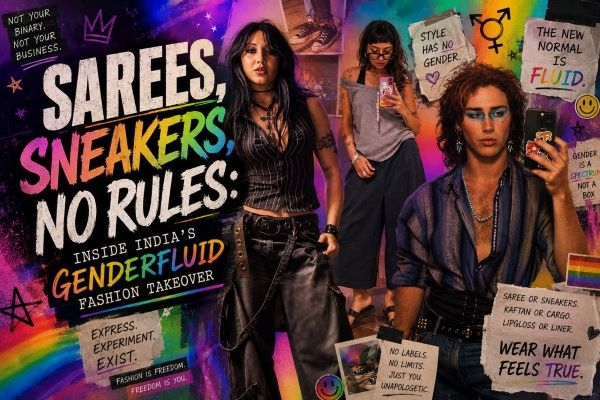
THE BINARY IS GETTING BORING, NGL
Walk into any mall five years ago and the fashion floor plan told you everything, men's section here, women's section there, sizing systems that didn't even talk to each other, aesthetics built for completely separate universes. That whole layout is starting to feel dated as hell. India's Gen Z has been quietly rejecting it for a while now, and the market's only just catching up, less "trend," more overdue correction. The ask isn't complicated either, just clothes that fit well, look good, and don't come with a gender prescription stapled to the tag. Not every "unisex" label is really unisex, and this generation clocked that fast. A lot of brands were just doing a men's pattern with
the neck loosened and calling it a day. The ones getting it right are building from a neutral pattern up, oversized fits, Indian proportions, sizing that goes properly wide without warping the silhouette across the range. Streetwear-first labels doing oversized tees, co-ords, and varsity jackets designed unisex from the ground up are basically the benchmark right now, no gendered colourways, no "boys get this graphic, girls get that one" nonsense.
And honestly the appeal isn't purely ideological either, it's practical. Shared wardrobes are a whole thing now, partners and siblings and roommates literally splitting one closet across genders, which is doubling wardrobe value for the same spend. Very SoBo, very "why buy two hoodies when one oversized one works for both of us."
Beyond the streetwear rack, there's a whole crop of Indian designers who've made gender-fluidity their entire thesis, not a capsule collection side quest. Akshat Bansal's label out of Haryana works in gender-agnostic, future-leaning silhouettes. Bengaluru-based designer Akshay Sharma built his entire label around an unapologetic gender-agnostic stance, sculpted bodysuits and cut-out pieces as a direct pushback against the boxes fashion usually forces people into. Tilla by Aratrik Dev Varman is doing something quieter but just as pointed, handwoven Indian textiles
and luxury craftsmanship built on genderless silhouettes, arguing that real luxury was never supposed to have a gender attached in the first place. And there's a designer out of NIFT Kolkata whose graduate collection, literally titled "Soft Masculinity," was a direct reply to being told to "be a man," reworking ruffles and soft silhouettes as an answer to that instead of running from it. None of this is niche runway noise anymore either. It's filtering straight down into what's actually selling.
This is where it gets genuinely fun, because Indian gender-fluid fashion isn't just streetwear and high concept design, it's showing up at the most traditional events on the calendar. Sarees paired with corset-style blouses and sneakers at a sangeet is basically normal now. Lehenga skirts getting worn with crop tops or shirts instead of the standard choli. Kurtas over jeans with sneakers and layered chains, worn by everyone regardless of who's technically "supposed" to wear a kurta. It's Indo-western mixing that respects the occasion while completely ignoring the old gendered rulebook around who wears what to a family function, and it photographs incredibly well, which matters when every wedding ends up as a whole content series anyway.
WHY THIS ACTUALLY LANDED IN INDIA SPECIFICALLY
A few things are doing the work at once here, and it's worth naming them instead of just calling it "vibes."
Comfort won, full stop. Oversized silhouettes are inherently more body-neutral than fitted ones,
and once comfort became the priority over tailored perfection, gendered fit lines started
mattering less by default. This wasn't a political statement to begin with for most people, it was
just what felt good, and genderlessness came along for the ride.
The traditional wardrobe already had the blueprint. Unlike a lot of Western markets working
against a history of hyper-gendered clothing, Indian fashion had genuinely fluid pieces sitting in
its own back catalogue the whole time. Gen Z isn't inventing gender-neutral dressing here,
they're just re-reading what was already there before it got boxed in.
Self-expression beats social script now. For a generation that's watched every identity
conversation happen in public, on timelines, fashion became one of the lowest-friction ways to
actually say something about who you are without needing a caption to explain it.
Not everything's solved, obviously. A lot of "unisex" still quietly defaults to a masculine
silhouette scaled down rather than a genuinely neutral pattern, which isn't the same thing even if
the marketing says it is. And plus-size gender-neutral fashion specifically is still an underbuilt
category in India, more gap than opportunity right now even though the demand is clearly there.
The conversation's ahead of the actual supply chain in a lot of places.
Still, the direction's obvious. This isn't a trend that's going to quietly fade back into gendered
racks in a year. It's a return to something India's wardrobe already knew how to do, just with
better tailoring and a much bigger audience watching.
-Devangshu Purohit