The Nepotism Debate Is Dead. The Real Problem Is Nobody's Cancelling Bad Films.
The Nepotism Debate Is Dead. The Real Problem Is Nobody"s Cancelling Bad Films.
|


The Nepotism Debate Is Dead. The Real Problem Is Nobody's Cancelling Bad Films.
Let's be honest. The nepotism conversation in Bollywood is so 2020. We had the Twitter wars, the Instagram infographics, the candlelight vigils for "outsiders." We argued, we trended, we moved on and then we went and watched Animal three times in theatres anyway.
Nepotism didn't lose. We just got bored of fighting it. But here's the thing nobody's saying out loud in their Bandra café while ordering an oat milk latte: the real villain was never the star kid. It's the studio that greenlit a ₹200 crore film because the lead's father once shared a producer's number.
Mumbai's film industry runs on one currency perceived safety. And nothing feels safer to a producer than a familiar last name.
Think about it from their angle. You're sitting in a Juhu office, staring at a ₹150 crore budget. Option A: cast a proven newcomer with actual range but zero pull. Option B: cast someone whose family WhatsApp group includes half of Twitter, three trade analysts, and a multiplex chain owner. You're picking Option B. Every time. And then you're calling it "a calculated creative decision." This is the system. And it has two kinds of outputs star kids who actually justify the bet, and star kids who exist purely because the bet felt comfortable.
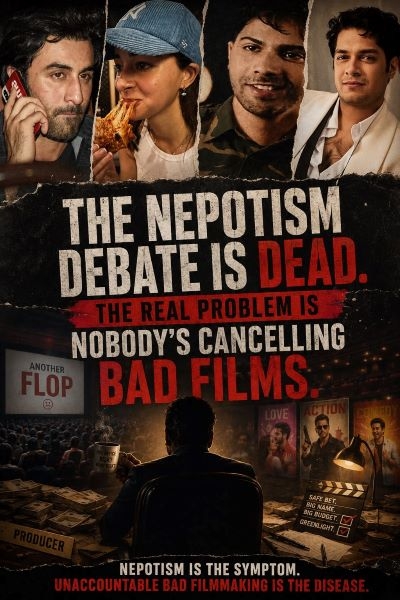
Here's the uncomfortable truth for nepotism warriors sometimes the industry gets it right.
Ranbir Kapoor is the son of Rishi Kapoor, grandson of Raj Kapoor, and quite possibly the most naturally gifted actor working in Hindi cinema today. Sanju was a masterclass in physical transformation. Tamasha was emotionally devastating in ways most Bollywood films don't even attempt. Rockstar still lives rent-free in a generation's chest.
The man put in the work. He took risks on weird scripts when he didn't have to. He failed publicly Bombay Velvet, Jagga Jasoos and came back sharper. Yes, the doors opened because of his last name. But he walked through them carrying something real. That's the distinction the nepotism debate keeps missing the problem was never talent that earns its place. The problem is mediocrity that never gets questioned.
Now let's talk about the other output.
Varun Dhawan has been in the industry for over a decade. Son of director David Dhawan, launched by Karan Johar, handed franchise after franchise. Dishoom, Judwaa 2, Coolie No. 1 a filmography that reads like a producer's checklist of safe, forgettable, assembly-line cinema. Every film designed to coast on charm, none designed to actually say anything.
And Ananya Panday. Where do we even start? Three years, multiple films, a PR machinery that works harder than the performances do. Gehraiyaan gave her a genuine shot at something layered surrounded by Deepika Padukone and Siddhant Chaturvedi doing real work and the cracks were impossible to miss.
But here's the thing neither of them greenlit their own films. A producer looked at the budget, looked at the risk, looked at the last name, and said yes. Repeatedly.
That producer faced zero consequences.
Then there's Junaid Khan Aamir's son, quietly dropped into Maharaj on Netflix. No theatrical pressure, no Friday verdict, controlled landing. He wasn't terrible. But the entire launch was architecturally designed to be critic-proof. An outsider with identical talent would've gotten one mid-budget theatrical shot, tanked due to zero marketing, and been told "the audience didn't connect." The studios didn't fix nepotism. They just made it more expensive and harder to audit.
Stop pretending the debate is about bloodlines. It's about accountability.
Producers greenlight bad scripts because the downside is survivable for them. A ₹200 crore flop hurts, but when you own the distribution, the OTT rights, and three other films in production you recover. Varun Dhawan gets another film. Ananya Panday gets another launch. The director gets another chance. The only people who don't recover are the ones who were never let in to begin with.
So next time a star kid drops a genuinely terrible film and the discourse shifts to their lineage redirect. Ask who wrote the cheque. Ask who approved the script. Ask which studio decided this story, with this cast, deserved your Friday night. Nepotism is the symptom. Unaccountable bad filmmaking is the disease. Ranbir proved the system can produce greatness. Varun and Ananya prove it mostly just produces content.
And we keep buying tickets to both.
- Devangshu Purohit